
A practical Lake Thun canoe travel guide to Switzerland's five-station Canoeing Trail between Gwatt and Leissigen, with Faulensee, Spiez, rental equipment and safety tips.
Lake Thun in Switzerland's Bernese Oberland invites a remarkably flexible small-boat holiday. Rather than hiring a canoe at one location and returning along exactly the same route, visitors can use a network of five rental stations along the lake's southern bank. The official Lake Thun tourism organisation describes the Canoeing Trail between Gwatt and Leissigen, including the bays around Spiez and Faulensee, with canoes and stand-up paddleboards available to hire. Depending on the location, travellers can arrange a short shoreline outing or a one-way trip that ends at another participating station. It is a way of seeing mountains, vineyards and villages at an appropriately gentle pace, but the route still deserves careful attention to weather, safe stopping places and the ability of the crew.
Five stations create an unusual kind of freedom
The tourism authority identifies rental points at the Spiez Bay Info Point, Faulensee tourist office, Blue Turtle Bistro, Wilke boatyard in Leissigen and Absolut Outdoor & Events at Deltapark Gwatt. These places make the trail useful to visitors who want an experience designed around their day rather than an all-or-nothing expedition. A family might choose a brief rental from Faulensee and return to the same base, while a more experienced group might travel between two stations. Locations and opening arrangements need confirmation before departure. The presence of several stations is helpful only if the intended collection point is operating on the day.
The southern shore gives the trip its character
The route follows the left or southern bank of Lake Thun, where views of settlements, wooded slopes and Alpine peaks can change markedly over a short distance. On a pleasant day the water may reflect the surrounding scenery, but the phrase “glassy lake” should not be treated as a forecast. Open sections can develop waves, and a paddler may feel more exposed than the shoreline appearance suggests. The attraction lies in being able to travel slowly enough to notice castles, vineyards and individual bays. A short circuit near Spiez can offer a satisfying sense of the destination without the need to cover the trail's full length.
Spiez combines water and history
The tourism guide calls attention to Spiez Castle and the vineyards that rise above the bay, offering a backdrop quite different from a generic watersports beach. From a canoe, these features form a layered landscape: water in the foreground, shoreline buildings in the middle and the mountains beyond. Visitors should enjoy the view from a safe distance rather than trying to approach a castle wall or private landing. A separate walk around Spiez after the rental can add cultural context to the afternoon. Allowing time ashore makes the excursion feel like a holiday rather than a timed sporting challenge.
Faulensee works as a quieter base
The official Faulensee tourist office is one of the named trail stations, placing practical visitor information next to the shoreline. Travellers can ask about equipment, the day's conditions and a route suited to their experience before taking a boat. The tourism organisation also lists innovative SUP formats, including Bike-SUP, Tandem-SUP and Kayak-SUP options, through Faulensee or Spiez Bay. These are specialised rental products, not necessarily ordinary canoes, so the visitor should understand how they work and what seating or balance is required. A novel board is worth trying only when it fits the person's capabilities and the weather.
Canoes are intended for shared participation
The official trail description says its rental canoes can carry up to four people, subject to the equipment supplied and its operating rules. This can appeal to a family or a small group who want to travel together rather than hire several individual kayaks. Passengers still need to distribute weight correctly, remain seated and coordinate paddling. The operator should explain the craft's actual maximum load and any age restrictions. A four-person capacity is not permission to load the boat with heavy bags on top of every seat. An introductory outing should prioritise comfort and stable handling over the maximum number of passengers.
One-way journeys make planning more interesting
The tourism organisation explains that canoes and SUPs may be returned to a participating station other than the one from which they were hired. A one-way option can be enjoyable because the group does not have to retrace its route into a headwind, provided the actual station and transport arrangements are confirmed. The official example includes leaving equipment at Blue Turtle Bistro and returning by bus. This requires thought before departure: know where the destination rental base is, whether staff will receive the craft and how everyone will travel back. A journey is not truly convenient if it ends at a closed desk with no agreed handover.
Weather controls which route is sensible
Lake Thun's scenery can make the water seem calm and inviting, but wind direction has a major effect on paddling effort. A gentle outward passage may become a strenuous return if the breeze strengthens. The official tourism information specifically warns visitors to consider wind and waves and notes that rental stations operate in good weather. Groups should review local forecasts rather than relying only on a general Swiss weather symbol. Agree on a turnaround point and never assume that a lake crossing is suitable simply because another boat has completed it. Staff at the launch can give useful advice about protected sections.
Lifejackets are a requirement, not an accessory
The official Canoeing Trail guidance states that wearing a lifejacket is compulsory and that participants must be able to swim. It says the rental includes a canoe, paddles, lifejackets and a watertight bag. These requirements should be treated as central to the experience. A visitor who is uncertain of swimming ability should discuss that openly before booking rather than treating a personal flotation device as a substitute for meeting the operator's eligibility rules. Everyone needs equipment that fits correctly. Waterproof storage can protect clothing or electronics, but it cannot replace a sensible response plan for an unexpected capsize.
Staying in the recommended shore zone
The tourism authority asks paddlers to respect a 300-metre shore zone for greater security. This is especially relevant when the mountain panorama tempts visitors to head toward distant points. Remaining within the recommended area may reduce exposure and make it easier to identify suitable return options. It does not guarantee safe conditions, and private land, protected vegetation and other restrictions may still limit where a boat may land. Paddlers should use the official route map and current instructions rather than setting an arbitrary course across open water. The safest route often provides excellent scenery without requiring the most ambitious line.
Picnics are part of the experience
The official trail description notes that there are places along the bank to rest, swim or enjoy a picnic. Such stops help turn a rental into a small holiday adventure, especially for families or people who are not interested in continuous exercise. The location must still be appropriate and accessible, and a paddler should check whether a planned beach or picnic area is open. Pack food in sealed containers and bring every item of waste back. Fire and barbecue rules vary between locations and seasons, so an attractive lakeside place should not be assumed to permit cooking. A simple packed lunch is often easier than carrying elaborate equipment.
Swimming and canoeing need separate decisions
A shore stop may provide the opportunity to swim, but permission and water conditions should be assessed independently of the boating route. Paddlers should respect designated bathing zones and keep the canoe away from swimmers and diving areas. Even during sunny weather, a deep Alpine lake can have cold water that changes the consequences of immersion. A family should supervise children carefully and avoid entering unknown water directly from a moving rental craft. Choose managed swimming areas when possible and ask local staff about any restrictions. A relaxed afternoon is safer when the two activities are planned instead of improvised.
A range of experience levels can enjoy the trail
A first-time paddler may be happiest with a short return route near a rental station, while a more experienced group can consider a longer section and a one-way journey. Both approaches are legitimate. The key is to match route length to the least confident participant and the conditions, rather than allowing the strongest paddler to set a pace everyone else must follow. Some visitors may prefer to sit and enjoy a SUP designed for that purpose, while others enjoy the teamwork of a canoe. Discuss the options with staff before committing to a craft. An enjoyable trip should end with energy left to explore ashore.
Families benefit from nearby facilities
One advantage of the Lake Thun Canoeing Trail is the connection with towns, public transport and visitor facilities. A group can arrange an outing without carrying camping equipment or committing to a remote route. The tourism website mentions toilets and facilities associated with some stations, but details vary and should be checked for the relevant site. Families with young children should establish where they can change clothing and what happens if someone wants to stop early. A practical return plan makes a short paddling adventure far more relaxed. It also leaves enough time for lunch or a stroll around Spiez.
The Bernese Oberland extends the holiday
The route's mountain backdrop includes views toward the Eiger, Mönch and Jungfrau, according to the tourism guide. Travellers can spend one day enjoying the lake and other days exploring the region by train, walking path or passenger boat. This variety is useful when wind makes paddling unsuitable or when members of a group have different interests. A canoe outing can introduce the water-level perspective while a later viewpoint shows the same lake from above. There is no need to fit every attraction into a single day. Allowing space between activities encourages a more satisfying encounter with the area.
Seasonal operation is explicit
The official listing indicates an Easter-to-mid-October operating window and notes that rental stations are open only in good weather. As this report is dated 23 November 2026, it would be misleading to imply that casual trail hire is operating today. Travellers preparing for the next suitable season should verify current openings and reserve with the relevant station, even if the rental system allows walk-in visitors at certain times. Prices, equipment and return procedures may change. A written or electronic confirmation is useful for a one-way trip where the group will depend on a second location being available to receive the craft.
The photograph documents a real trail location
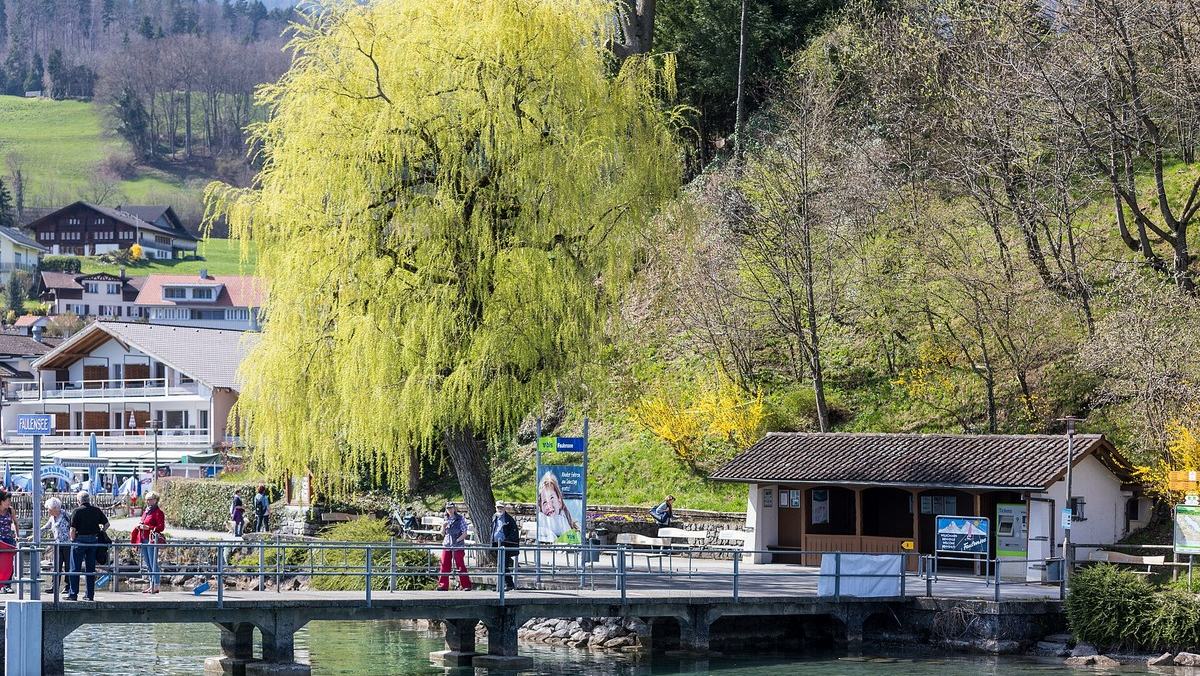
The lead photograph, “Schifflände Faulensee am Thunersee (Kanton Bern, 2017),” was made by JoachimKohler-HB and is available through Wikimedia Commons under Creative Commons Attribution-ShareAlike 4.0. It shows a genuine Lake Thun landing area at Faulensee, rather than a generic Swiss lake. The photograph does not establish the rental station's present equipment, a safe water temperature or the conditions on 23 November 2026. Its original source, creator and licence are recorded. The trip details come from the official Lake Thun tourism website, which remains the appropriate starting point for current operational guidance.
A well-paced Lake Thun plan
Start by choosing a specific station and deciding whether an out-and-back or one-way route is appropriate. Contact staff to confirm the next season's opening, available craft, lifejackets and handover arrangements. Review the official Canoeing Trail map and the local forecast, then choose a distance that leaves ample time for stops and safe return. Pack appropriate clothing, sun protection, water and a dry change. Add a shoreline walk or a visit to Spiez afterwards rather than trying to fill every hour on the water. Lake Thun rewards modest ambitions: the pleasure is in travelling slowly through a remarkably beautiful landscape with a plan that everyone can manage.
Sources and photograph attribution
Official destination and boating guidance: Interlaken Tourism and Lake Thun — Lake Thun Canoeing Trail. Current access, rules, weather and reservations must be checked independently before travel.
Photograph: JoachimKohler-HB — “Schifflände Faulensee am Thunersee (Kanton Bern, 2017).jpg” (CC BY-SA 4.0), via Wikimedia Commons. Resized to JPEG 1200×800 for editorial display. Source: https://commons.wikimedia.org/wiki/File:Schiffl%C3%A4nde_Faulensee_am_Thunersee_(Kanton_Bern,_2017).jpg. Licence: https://creativecommons.org/licenses/by-sa/4.0. Original rights remain with the credited creator or as specified by the source and licence.
