
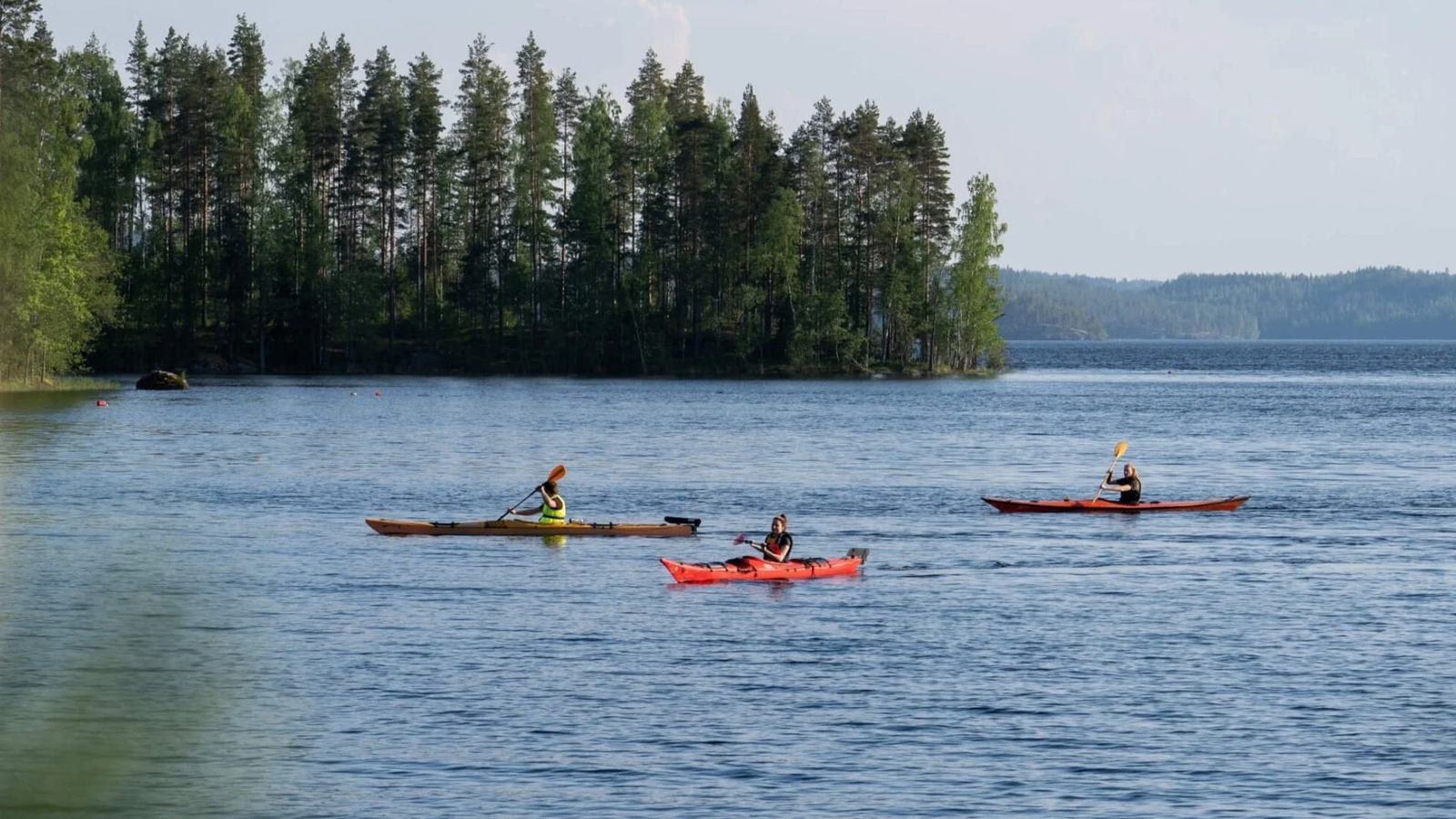
Finland's Lake Saimaa offers a water-level perspective on quiet islands, rocky shores and deep-green forest. Olo Centre's guided paddling activities in the region invite visitors to explore by kayak, canoe or stand-up paddleboard with local support. It is a distinctive way for boating families to experience Finnish Lakeland while keeping wildlife protection and changing conditions in mind.
Seeing Finland's lake country from a smaller craft
Lake Saimaa is a landscape of water, woodland and countless changes in shoreline, so a short paddle can feel surprisingly remote. Forest reflections and the sounds of birds become more noticeable without an engine. The experience is less about distance covered than about moving at a pace that suits the place.
Visit Finland lists guided paddling activities offered by Olo Centre, including kayak, canoe and stand-up paddleboard options in the Saimaa area. The listing provides an official introduction to an operator-led outing, rather than a claim that every stretch of the lake is suitable for an unguided visitor. Choosing a guide makes local route information part of the day.
Kolovesi National Park, within the wider Saimaa lake region, is known for sheltered-looking waterways and forested rock shores. It is also a place where particular conservation rules apply, making advance research more important than spontaneous exploration. A responsible trip begins by respecting the nature of the park before choosing where to paddle.
For travellers who normally take motorboats on holiday, a low craft changes the scale of everything around them. Small ripples feel relevant, water birds are easier to observe quietly, and distant landforms reveal themselves slowly. Paddling can complement a broader boating itinerary rather than replacing every other kind of water activity.
Guides, equipment and an appropriate pace
A guided excursion helps visitors match equipment and duration to their experience. Kayaks, canoes and paddleboards do not feel identical on the water, especially when the wind begins to move across an open reach. Before booking, explain whether the party includes children, first-time paddlers or people who require additional support.
Operator activities may vary by season, group size and prevailing conditions. Rather than depending on an old price or timetable, check the current Olo Centre listing and ask where the actual meeting place will be. In a lakeland region, the stated destination and the launch point are not necessarily the same address.
A comfortable outing starts with a properly fitted personal flotation device and a simple explanation of what happens if somebody enters the water. Listen to the guide's instructions about spacing, turning and landing, even if the water initially appears flat. Confidence comes from understanding routine decisions rather than pretending paddling is risk-free.
Groups with different levels of fitness should plan for a pace that leaves everybody able to enjoy the surroundings. The strongest participant does not set a useful benchmark for an introductory family trip. Regular pauses allow the guide to adjust the route and provide time to photograph the landscape without neglecting boat control.
Rare wildlife and the need for restraint
Saimaa is associated with the endangered Saimaa ringed seal, one of the region's most remarkable animals. Seeing one is never guaranteed, and wildlife sightings should be treated as a privilege rather than a target to chase. A respectful paddler keeps distance, avoids noise and follows any local restrictions explained by the guide.
The shoreline also provides habitats for birds and other sensitive species, particularly during breeding periods. Even a silent canoe can disturb wildlife if it approaches a resting or nesting area too closely. Observing from a distance is a more rewarding long-term approach than pushing forward for a dramatic photograph.
Ancient rock art is another reason visitors are drawn to parts of the wider Saimaa region. Such places deserve the same care as natural habitats, with no touching, climbing or improvised landing beside protected features. The guide can explain what is appropriate to view and how to recognise signs of a managed conservation area.
Wildlife photographers should choose a stable, weather-resistant setup and accept that animals may remain out of sight. A lightweight dry bag and a camera strap reduce worries about equipment, but they do not justify manoeuvres that make the craft unstable. Sometimes the best image is simply the meeting of pine forest and water.
Clothing and conditions on a northern lake
Finnish summer can be warm, yet lake water and wind can feel much cooler than the air on shore. Dress in layers suited to the forecast, and carry a change of clothing in a waterproof bag when the operator advises it. Cotton clothing that stays wet is rarely the best choice for a long paddle.
Sun protection still matters in northern latitudes because reflected light reaches paddlers from several directions. A hat, drinking water and suitable sunscreen are practical additions to a boat outing. Insect conditions can also vary near woodland and sheltered water, so ask the guide what protection will be useful.
Route selection should take wind exposure, temperature and the group's experience into account. A lake full of islands may offer shelter in one direction and difficult waves beyond the next point. Local knowledge is particularly valuable when a seemingly simple round trip involves crossing open water.
Do not assume that a route offered on one date will be appropriate on another. Operators may change the launch, activity or duration for safety and conservation reasons. A sensible traveller considers those adjustments part of professional guiding rather than an inconvenience to resist.
Building a holiday around the water
A Saimaa paddle works well as one part of a slower Finnish Lakeland stay, with time for forest walks, lakeside meals and rest between activities. Booking a longer holiday around a single paddling session leaves room to adapt to the weather. It also allows companions who do not paddle to enjoy the destination in their own way.
Visitors can use a guided introduction to learn how the landscape connects, then choose future activities according to their confidence and local rules. That approach is more rewarding than renting equipment immediately and guessing which shorelines permit access. Every lake has its own navigation habits, protection zones and seasonal considerations.
The region's appeal lies partly in its quieter moments: a paddle drip, an empty-looking inlet and the texture of rock beneath pine trees. Those details can be missed if the outing becomes a race to cover a set number of kilometres. A guide helps make space for interpretation as well as movement.
Before travelling, confirm the official activity details and the latest access guidance for any national park on the intended route. With an experienced guide and consideration for wildlife, Lake Saimaa can provide a memorable introduction to paddling in Finland. The reward is the opportunity to belong, briefly and respectfully, to its waterside rhythm.