
A guide to small motorboat outings at Lake Minnewanka in Banff, including boat rental, advance AIS inspection rules, prohibited towing and wind safety.
In Banff National Park, the mountains provide a spectacular backdrop to the water, but the freedom to explore them by motorboat is limited by rules designed to protect the lakes. Parks Canada permits motorised boating only on Lake Minnewanka, and even there a private vessel must pass an advance-booked aquatic invasive species inspection before the launch gate is opened. Small open motorboats may also be rented through local operators when services are available. For the visitor who prefers an intimate boat to a large tour vessel, the destination offers remarkable scenery and a chance to experience an alpine lake at water level. Yet this is not a spontaneous launch-and-go holiday. Cold water, sudden winds, prohibited watercraft types and the absence of public docks all demand careful planning. The right preparation allows the scenery to take centre stage without ignoring the park's responsibilities.
An alpine lake with a special status
Lake Minnewanka is the exception to Banff's general restrictions on motorised recreation. The Parks Canada boating page separates lakes and rivers into zones with distinct rules, and identifies Minnewanka as the only permitted location for motorboats. That matters to people touring the national park with a trailerable vessel, because a beautiful lake visible from the road does not automatically permit launching. The motorboat rules apply to both petrol and electric propulsion, so a quiet electric tender is not exempt merely because it makes less noise. A suitable boating holiday should begin by choosing the permitted water rather than searching for an unregulated launch. Protecting the park's ecological health is part of the attraction of visiting such a landscape.
Why the invasive-species inspection matters
Parks Canada requires a formal aquatic invasive species inspection for private motorboats entering Lake Minnewanka. The agency says inspections are offered by appointment only, with a locked gate at the top of the unloading ramp. Access is granted after the vessel successfully passes the process. This is a more controlled arrangement than a public ramp where a boater simply pays a launch fee. Visitors must reserve their inspection in advance, prepare their craft as required and allow time for the procedure. Arriving without an appointment could make the outing impossible, even if the weather is ideal and the boat is otherwise in excellent condition. Current instructions and appointment availability should be obtained from Parks Canada before travelling.
Clean, Drain, Dry and Certify
The park's protection measures use the principles of cleaning, draining, drying and certification to reduce the risk of transporting harmful aquatic organisms. A motorboat may carry unwanted material in a bilge, livewell, trailer or hard-to-reach compartment without any obvious sign from the outside. The correct procedure is to follow current official guidance for the entire vessel and its equipment, not just rinse the visible hull. A boater who visits several lakes during a road trip should recognise that transferring a craft between waters creates environmental responsibilities. A successful inspection is not merely a formality; it supports the continuing health of the lake. The process may require different actions depending on where the vessel has been used previously.
A rental may simplify the logistics
Parks Canada notes that small open motorboats can be rented at Lake Minnewanka, offering a possible alternative for visitors who do not wish to tow their own craft. The availability of rental boats, their operating periods and any instruction or licence requirements should be confirmed with the legitimate operator. The park's listing does not mean a suitable vessel is guaranteed at every hour or in every season. People unfamiliar with powered boats should explain their experience before booking and seek the appropriate guidance. Hiring a boat at the lake may reduce the transport and inspection complications of bringing a private vessel, but it does not remove the need to understand navigation, safety equipment and sudden weather changes.
There are no public boat docks
One of the most useful practical warnings on the official page is that Banff National Park has no public boat docks. A visitor accustomed to pulling alongside a marina pontoon for lunch or easy passenger boarding should not assume comparable facilities exist. The location and arrangements for boarding, parking, renting or recovering a boat need to be checked in advance. A vessel with a deep draught or complicated handling characteristics may not suit the available facilities. Even a small open motorboat requires safe loading and unloading, particularly when passengers are unfamiliar with the craft. The absence of public docks also discourages unrealistic itineraries built around mooring at multiple sites as though the lake were an ordinary cruising reservoir.
Prohibited watercraft and watersports
Parks Canada specifically prohibits personal watercraft, including jet skis and similar machines, on Lake Minnewanka. It also bars vessels fitted with ballast systems, tanks or bags, including aftermarket additions, and prohibits towing sports such as waterskiing, wakeboarding and tubing. These limitations are significant for families whose usual boating holiday includes pulling an inflatable toy or towing a skier. A motorboat permitted for scenic travel does not automatically permit every recreational activity associated with powered craft. Travellers should review the exact restrictions before selecting their boat or packing equipment. The right approach is to build the day around lawful sightseeing and controlled boating rather than expecting the park to accommodate all forms of watersport.
The mountain view from the water
One of the pleasures of a small boat on Lake Minnewanka is the change in perspective. Mountains that appear as a wide panorama from shore become a succession of ridges and slopes when the boat travels along the water. A slower pace allows passengers to notice the changing light and the way the shoreline meets the lake. That visual attraction does not justify approaching protected wildlife or travelling into areas where access is restricted. A respectful boat trip remains a temporary presence in a landscape where habitat protection takes priority. The greatest enjoyment may come from a comparatively modest outing that leaves time to appreciate the setting rather than from trying to reach the furthest possible point.
Winds that can change rapidly
The Parks Canada guidance carries an explicit warning about sudden strong winds and waves on Lake Minnewanka, especially during the afternoon. This is an important fact for a small-boat skipper. A boat that feels steady near a sheltered launch may encounter uncomfortable conditions later, and a return journey can become more demanding if the wind shifts or strengthens. The best response is to monitor forecasts, observe conditions continuously and remain within a range that allows a safe return. Boat rental periods and holiday schedules should never pressure a crew to continue when the weather is deteriorating. A mountain lake can produce a powerful experience in good conditions, but it should not be mistaken for a sheltered ornamental pond.
Water temperatures and immersion risk
Parks Canada says Banff's lakes seldom exceed 10°C, or 50°F. That is cold enough to make a capsize or unexpected immersion dangerous even on a bright summer day. Appropriate personal flotation equipment is required for everyone aboard, and clothing should be selected with the possibility of immersion in mind. Warm air can create a misleading sense of security when the water remains cold. A skipper should understand how to assist a person back aboard, what emergency signals to use and when conditions require an early return. Although a powered open boat may be easier to manoeuvre than a paddlecraft in some circumstances, its occupants remain vulnerable if equipment fails or someone falls into the water.
Basic safety equipment for the crew
The official boating page lists a lifejacket or personal flotation device for each person, along with a whistle, paddle, bailer or pump, rope, emergency kit and protected communication device. It also recommends wet-weather gear and a complete change of clothing. The details help visitors distinguish a scenic rental outing from an assumption that the boat's engine alone guarantees a safe return. A small motorboat should be inspected before leaving the launch, and its operator must understand how to use the available equipment. Travellers should also leave word of where they intend to go and when they expect to return. Current federal vessel rules may apply in addition to the park's specific requirements.
The lake is not a private racetrack
A small motorboat outing should be approached as a chance to enjoy the landscape, not to test performance. Parks Canada regulates recreational activities to reduce impacts and protect visitors. A cautious speed can make it easier to notice other vessels and respond to changing conditions, while unnecessary close approaches to wildlife or shorelines can create disturbance. Visitors should not assume that a rented motorboat authorises landing or fishing anywhere along the lake. The rules for fishing, protected areas and other activities must be checked separately. The best trip is one that fits the purpose of the park: responsible enjoyment of a natural landscape with its ecological character intact.
Combining boating with a Banff visit
A lake excursion can form part of a broader holiday that includes walking, interpretation and time spent in the surrounding national park. This flexibility is particularly useful when the weather does not support boating. A traveller should not feel compelled to take an unsuitable motorboat trip because the outing has become the centrepiece of a fixed schedule. It is better to reserve the appropriate inspection or rental, confirm the day's conditions and retain an alternative shore-based activity. Popular mountain destinations can become busy, and parking for boats and trailers is limited according to Parks Canada. Arriving organised and prepared is likely to improve the experience for both visitors and the people managing the site.
An accurately credited photograph
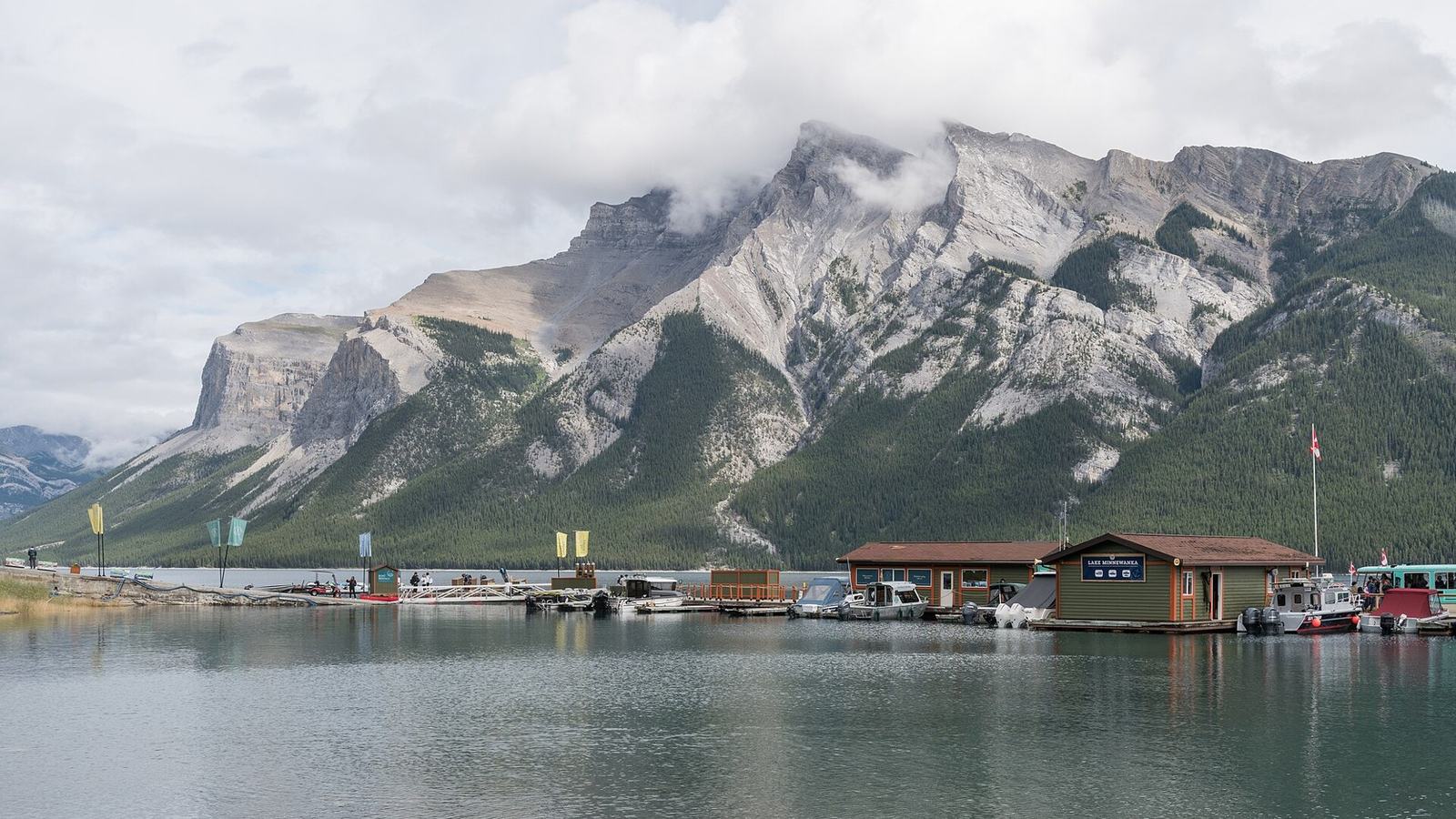
The accompanying photograph shows the real Lake Minnewanka boat pier looking west, taken by Wikimedia Commons contributor DXR in August 2024 and released under a Creative Commons Attribution-ShareAlike 4.0 licence. It illustrates the lakeside setting and the boating access area without claiming that the picture documents a currently bookable service or an active public dock. The image has been resized for editorial presentation and retains its photographer and licence attribution. The article's rules regarding private motorboats, mandatory inspections, prohibited towing activities and cold-water safety are drawn from Parks Canada's boating page, last updated in March 2026. Live appointment availability and local conditions must be verified before travel.
A special destination when the rules are understood
Lake Minnewanka offers a compelling small-motorboat experience for visitors willing to do the administrative and practical work first. The mountain setting is extraordinary, but the lake is permitted boating water precisely within a tightly managed national park. An advance AIS inspection, correct craft type, suitable safety equipment and respect for cold water and wind are all essential. These requirements need not diminish the enjoyment of the journey. They provide a framework in which visitors can appreciate the lake without introducing unwanted organisms or placing themselves at unnecessary risk. A thoughtful outing at alpine-water speed can be more memorable than an ambitious journey that ignores the conditions.
Sources and photograph attribution
Official destination and boating guidance: Parks Canada — Banff National Park Boating. Current access, rules, weather and reservations must be checked independently before travel.
Photo: DXR — “Lake Minnewanka boat pier 20240821 1.jpg” (CC BY-SA 4.0), via Wikimedia Commons; resized and JPEG-converted for editorial presentation. Source: https://commons.wikimedia.org/wiki/File:Lake_Minnewanka_boat_pier_20240821_1.jpg. Licence: https://creativecommons.org/licenses/by-sa/4.0. Original rights remain with the credited creator or as specified by the source and licence.
