
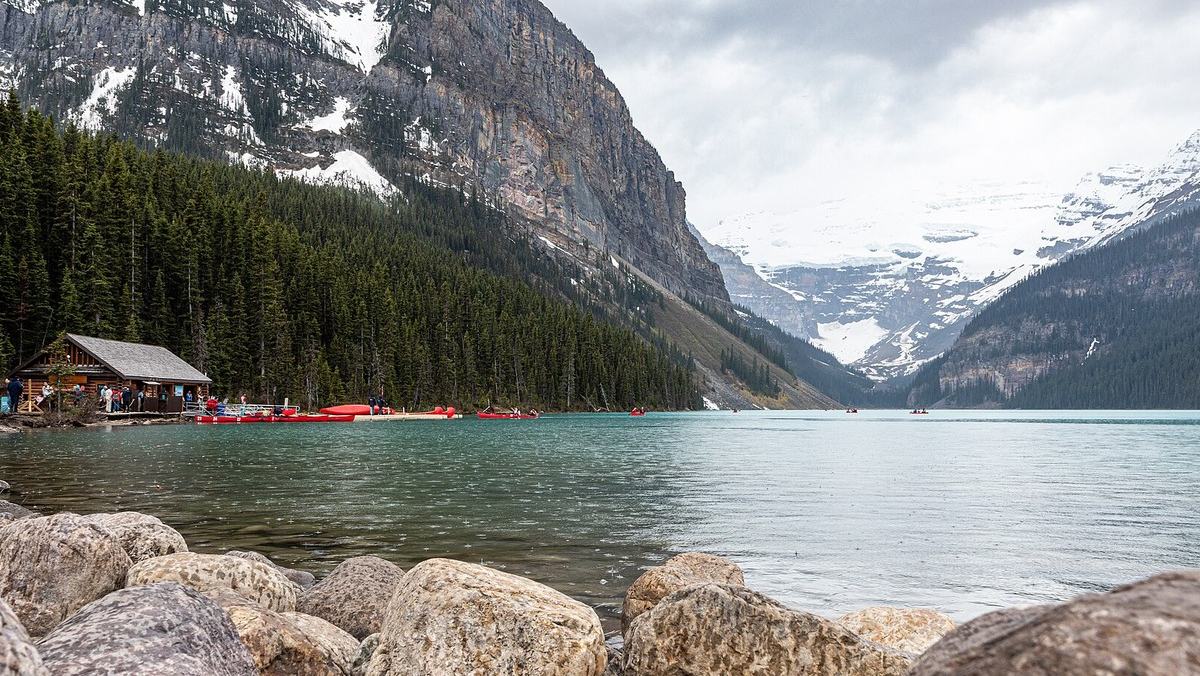
A Banff National Park canoe guide for Lake Louise with the Fairmont Boathouse hire, the 2026 seasonal timetable, Parks Canada access, cold-water safety and family planning.
A short paddle beneath the mountains
Few canoe outings are as immediately recognisable as the journey onto Lake Louise in Canada's Banff National Park. Turquoise water sits beneath steep mountain slopes, and the view from a small boat differs dramatically from the familiar perspective of the shore. The experience is also highly structured. Fairmont Château Lake Louise operates the Boathouse canoe rental, while Parks Canada controls the wider national-park setting, visitor transport and rules affecting private watercraft. Those two organisations are the most useful starting points for planning a real trip.
A date matters here. The hotel's published 2026 summer destination information listed canoeing through 12 October 2026, weather permitting. A reader planning a visit in late November should not interpret a summer photograph as evidence that rentals are currently operating. For the next warm-weather season, confirm the operator's opening arrangements and Parks Canada's current access advice rather than assuming a past timetable will repeat.
What the Fairmont Boathouse actually provides
The hotel's official Boathouse page describes renting a canoe on Lake Louise. The facility is not a general marina selling unrestricted access to a range of powerboats. The attraction is a modest, human-powered craft that lets visitors take in the mountain backdrop at their own pace. The Boathouse also publishes rules concerning payments: debit or credit cards and room charges for eligible hotel guests are accepted. Travellers should verify the latest terms, inventory and rental duration directly.
Booking and queuing arrangements can change with demand and the season. A visitor should ask whether rentals are taken on arrival or can be arranged ahead, and what happens if a weather closure intervenes. Those details matter more than a generic claim that canoes are available at the lake. A short excursion should be planned around the actual operating hours, with enough flexibility to spend time ashore if rentals stop.
The view from the centre of the water
The draw of a canoe is the chance to place distance between the boat and the busy shore without sacrificing the sense of place. As the craft moves away, the perspective opens toward the mountain slopes and the water's striking colour. A quiet paddle gives the crew time to notice small changes in light, reflections and the shapes of the valley. There is no need to approach a distant glacier or reach the far end to appreciate why Lake Louise has become an iconic landscape.
A modest route is especially appropriate for beginners. The canoe should remain within the provider's designated area, and the party should agree on when to turn back before departure. Even a relatively sheltered-looking mountain lake can become uncomfortable if the wind rises. The moment when everyone is still enjoying the activity is generally the right moment to begin returning.
Understanding the 2026 canoe season
Fairmont's 2026 summer programme described canoe outings as available through 12 October, subject to weather. That establishes the season advertised by the responsible operator, not a promise that the same closing date will apply in 2027 or that every day within the advertised period was suitable for paddling. Mountain conditions can interrupt services unexpectedly. An early spring thaw or a warm autumn day does not by itself establish that the Boathouse is open.
Prospective visitors should check the hotel's current page shortly before travel and confirm that lake conditions allow canoeing. If a holiday depends upon a particular date, discuss alternatives in advance. A sightseeing walk or other permitted park activity may be a satisfying substitute when the water is unsuitable. The most dependable itinerary treats canoeing as a weather-sensitive part of a mountain visit rather than a guaranteed appointment.
Reaching the lake without a stressful arrival
Access to Lake Louise can be one of the trip's greatest practical challenges. Parks Canada operates visitor shuttles, manages parking and publishes rules that vary by season. In 2026 the paid-parking and shuttle period was advertised from 15 May to 12 October, which is a historical reference rather than a future reservation or assurance of availability. A family should plan transport before the day, especially if everyone intends to arrive during the same popular morning window.
Travellers should distinguish between getting to the lake as a passenger and transporting their own equipment. Parks Canada's visitor FAQ says shuttles can accommodate some non-motorised craft, including inflatable paddleboards, packrafts, inflatable kayaks and smaller hard-sided kayaks, depending on available space. This is not a guarantee that every rigid canoe or lengthy craft will fit, and it does not provide a reservation for equipment carriage. Ask the park service before attempting the trip with a private boat.
Bringing a private craft requires additional checks
The existence of a public waterfront does not automatically permit the launch of any boat at any point. Banff National Park has aquatic invasive species controls, and private watercraft can be subject to inspection, self-certification, drying and other requirements. Rules can vary by craft type and change as conservation risks are assessed. A visitor should consult current Parks Canada guidance for Lake Louise and the particular equipment involved rather than rely on general Canadian boating advice.
A hired canoe managed by the Boathouse is a simpler option for many travellers, because it avoids transporting a separate hull and arranging suitable access. Nevertheless, hire does not exempt the passengers from appropriate conduct on the water. If the crew chooses a private inflatable kayak or paddleboard, it must make sure that park transport rules, launch permissions and current aquatic invasive species requirements are met before departure.
Canoe handling for inexperienced visitors
A canoe's gentle appearance can conceal the challenge of coordinating two paddlers. At the start, learn how to position weight, hold a paddle, turn and stop. One person should take the lead in communicating directional changes, particularly if a child or inexperienced adult is sharing the boat. Avoid sudden standing or leaning to take photographs. A shift in balance can create an uncomfortable wobble or an unexpected capsize.
Passengers should remain seated as directed by staff. A short rehearsal near the launch is useful before travelling toward open water. The boat's capacity must be respected, including the weight of bags and other equipment. If the person in the stern is doing most of the steering, agree in advance how the group will handle a stronger breeze or fatigue. A holiday paddle is not a race against other canoes.
Cold water deserves serious respect
Lake Louise is an alpine lake, and its water can be dangerously cold even when the sun makes the shore pleasant. Dress for the possibility of immersion, not just for the air temperature on the hotel terrace. Every passenger needs appropriate flotation equipment fitted correctly. Do not treat a swimming ability developed in a warm pool as adequate protection against an unexpected cold-water incident.
Keep hands and feet inside the boat while moving, and avoid trying to stand for a better photograph. Secure phones, glasses and other essentials. The group's route should reflect the consequences of an accidental capsize, not merely the ease of paddling on a calm day. Ask staff about current conditions and follow instructions if a wind-related or safety closure is announced.
Wind changes the return leg
A canoe that travels easily away from the Boathouse with a following breeze may face a considerably harder journey back. Check wind direction before launching and observe the surface continuously. If the water becomes choppy or any passenger feels uncertain, return promptly. An additional photograph at the far end is not worth the risk of reaching the dock exhausted or in deteriorating conditions.
A conservative route makes the trip more accessible to mixed-ability groups. Avoid assuming that a published hire period should be spent entirely moving outward. Leave time for a controlled approach to the Boathouse, which may be shared by other customers preparing to depart or return. Courtesy and patience around the landing area make a busy operation safer.
A national park is not a private photo studio
Lake Louise is one of Canada's most visited landscapes. A boat crew may share the water and shore with visitors from many countries, some of whom are using a canoe for the first time. Maintain a lookout, give other boats room to manoeuvre and avoid positioning the hull where it blocks departures. Photographing a dramatic mountain backdrop is enjoyable, but passengers should remain seated and keep their movements predictable.
Environmental respect is equally important. Do not feed birds, throw food into the lake or approach wildlife for a closer image. No one should land on a bank merely because it looks quiet. The surrounding national park is managed for conservation as well as recreation. Follow any posted restrictions and return all rubbish to the shore.
Making the most of a short hire
A useful itinerary can begin with a prearranged transport plan, a look at the conditions and a clear conversation with the Boathouse about the hire. After receiving the safety briefing, take a short trip that permits relaxed observation of the scenery. The return can be timed so that the group has energy to walk along the shore or enjoy another authorised park activity. This is often a better experience than attempting to fit an ambitious canoe voyage into a crowded sightseeing day.
If members of a larger party do not want to paddle, arrange a meeting location on land before splitting up. Avoid relying on immediate phone access if signal or battery life becomes limited. A family can enjoy the mountain panorama together without every person being aboard the same boat. Good organisation reduces pressure and leaves room for the unexpected.
Photography without disturbing the boat
The best images may be the simplest: the canoe bow on quiet water, reflected slopes or a view back toward the shoreline. A waterproof cover or secure pouch helps protect a camera, but nothing replaces stable positioning. Take photographs from a seated position with the boat moving slowly or stopped appropriately in open water. Never place the vessel close to an obstacle just to recreate a composition found online.
If a companion is taking the picture, the paddler should know beforehand that the camera will be used. Unexpected twisting or leaning can unsettle the canoe. Keep other boats in sight and avoid drifting into active traffic. A brief pause to enjoy the place without a camera can be every bit as satisfying as an album of photographs.
What should be checked before departure
The official Fairmont Boathouse information confirms canoe rental, while Parks Canada explains travel access and rules relating to non-motorised craft. Before committing to a trip, verify the current operating season, the actual weather, payment and equipment requirements, arrival arrangements and any national-park rules affecting private boats. In particular, do not reuse the 2026 shuttle dates as if they were an automatic entitlement for a later year.
A traveller who already has a park shuttle reservation should still ask about carrying a personal craft; the transport arrangements for passengers and equipment are not necessarily identical. If using the hotel's boats, establish the rental process separately from any restaurant or accommodation booking. Keeping those details clear makes the visit easier and more enjoyable.
A memorable journey of modest scale
Lake Louise demonstrates how a simple canoe can create a distinctive experience in a world-famous place. There is no need for horsepower or an elaborate itinerary. The mountain landscape supplies the drama, while the boat allows the crew to move at a human pace. With appropriate equipment, a conservative route and a clear understanding of the season, a short paddle can become the highlight of a Banff holiday.
The central lesson is that beauty does not remove responsibility. Cold water, changing weather and conservation requirements remain important even where a boat is hired from an established operator. Respect those limits and the experience becomes both relaxed and memorable: a few quiet strokes across turquoise water beneath the Canadian Rockies.
Sources and photograph attribution
Official destination and boating guidance: Fairmont Château Lake Louise — The Boathouse. Current access, rules, weather and reservations must be checked independently before travel.
Photograph: Dietmar Rabich — “Banff National Park (AB, Canada), Lake Louise -- 2022 -- 2197.jpg” (CC BY-SA 4.0), via Wikimedia Commons. Resized to JPEG 1200×800 for editorial display. Source: https://commons.wikimedia.org/wiki/File:Banff_National_Park_(AB,_Canada),_Lake_Louise_--_2022_--_2197.jpg. Licence: https://creativecommons.org/licenses/by-sa/4.0. Original rights remain with the credited creator or as specified by the source and licence.
