
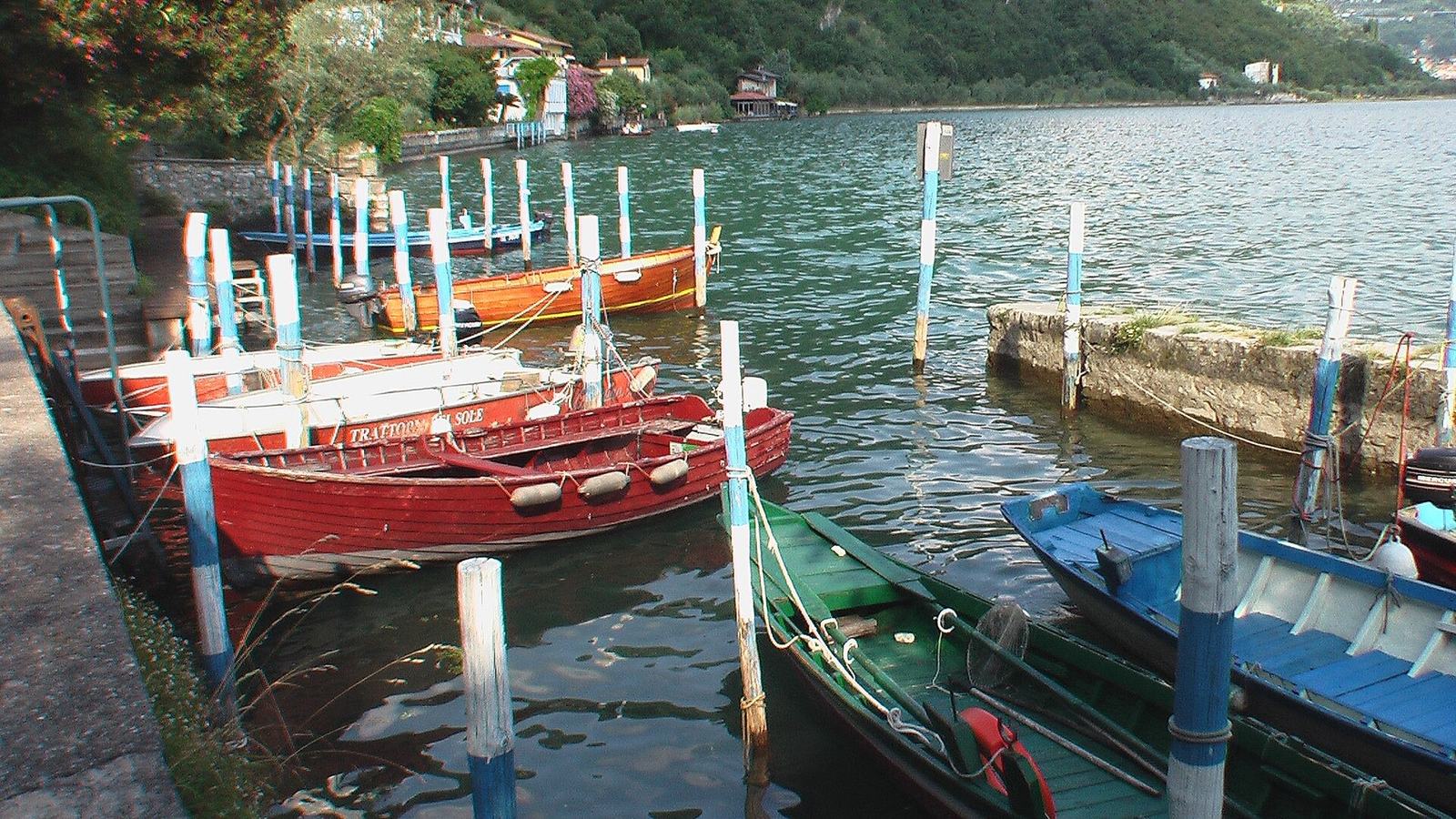
A Lombardy paddling holiday guide to Lake Iseo and Monte Isola, with canoe hire, village shorelines, responsible wildlife observation and ferry awareness.
Lake Iseo in northern Italy offers a beautifully varied setting for a canoe or kayak holiday, with hillside villages, rocky shores and the large island of Monte Isola rising from the water. The official Visit Lake Iseo tourism organisation promotes canoeing as a way to see reeds, small ports and stretches of shoreline that can be difficult to appreciate from land. Local providers offer lessons, organised excursions and equipment rental, making the lake accessible to visitors who arrive without their own boat. For a small-boat traveller, the attraction is a gentler view of Lombardy, but the setting remains a large lake with wind, commercial traffic and local rules that deserve careful preparation.
A lake best appreciated at water level
From shore, Lake Iseo's landscape is a combination of village buildings, wooded hills and water framed by mountains. From a canoe, the view becomes more immediate: reflections shift as the paddle enters the lake, small harbours reveal their details and the shoreline can be examined without travelling quickly. The official tourism portal suggests the value of this low viewpoint, particularly near reeds and inlets. A well-chosen short route may provide a richer experience than an ambitious crossing. The primary aim should be to enjoy the place safely, not to prove how many kilometres can be paddled. Wind and local navigation constraints should shape the itinerary.
Monte Isola gives the lake a focal point
Monte Isola is one of Lake Iseo's defining features, rising prominently above the surrounding water and giving visitors a natural landmark for orientation. The island's waterfront settlements and shoreline architecture provide appealing views from a boat, while its position also means that water traffic and crossing routes require attention. A paddler should not treat the apparent closeness of an island as permission to cross open water in all conditions. The actual distance, boat routes and wind exposure must be assessed carefully. Viewing the island from a suitable shore route can be satisfying even without attempting to land. A trip ashore should be planned separately using recognised access points and transport.
What the official tourism office recommends
Visit Lake Iseo identifies canoeing and kayaking as established recreational activities and notes that schools and associations offer courses, excursions and hire equipment. Its destination information explains that reeds and small harbours are particularly interesting from a paddler's perspective. That provides a useful basis for planning, but the tourism descriptions should not be confused with a universal safe route. Equipment providers can recommend the right location according to experience and weather. A first-time paddler can benefit from joining a professionally guided outing rather than deciding independently which part of the lake is least exposed. The aim is to make the distinctive scenery available without unnecessary risk.
Short guided excursions versus independent hire
A guided canoe trip can take away some of the uncertainty about where to launch, how to navigate near traffic and which shoreline is suitable for the group. The official tourism site lists experiences with instructors and small groups, while other local operators rent canoes and stand-up paddleboards. For visitors with little experience, instruction may be more valuable than an extra hour on the water. Those who prefer independent hire should ask the operator about approved boundaries, wind conditions, emergency contacts and the return procedure. An organised excursion is not automatically risk-free, but it can provide a clearer plan and local knowledge than hiring a boat without understanding the lake.
Choosing an appropriate launching point
A kayak trip should begin at a recognised access location with enough space to prepare equipment safely and enter the water without interfering with other people. Lakeside towns and commercial operators may have their own arrangements, while some shorelines are unsuitable because of stones, reeds, steep banks or heavy boat traffic. Do not assume that any attractive waterside path is a public launch area. A local club or rental company can explain available facilities and whether a particular launch is appropriate for a visitor bringing their own craft. Parking, toilets, secure storage and the ease of carrying a canoe may matter more than the launch's position on a map.
The attraction of small harbours
Lake Iseo's waterfront villages provide a close-up view of boats, moorings and historic lakeside buildings. A canoe can move slowly enough to notice details that pass too quickly during a powered trip. But small harbours are working spaces, not obstacle courses for visitors. Paddlers should stay clear of manoeuvring vessels, ferry landing areas and any restricted zones. Do not weave between moored boats or assume that an empty berth is available for a temporary stop. A quiet view from outside a harbour may be more enjoyable than entering it. Navigation etiquette is an important part of the experience, especially when the person paddling is unfamiliar with the local language or signage.
Reeds, wildlife and quieter shores
The tourism organisation draws attention to the reeds that can be reached or viewed from a kayak, and such areas can be among the lake's most atmospheric natural spaces. They may also provide important habitat for birds and other wildlife. The ability of a shallow-draft craft to get close should be used responsibly. Avoid pushing into reedbeds, landing in fragile vegetation or approaching animals that appear to be nesting or resting. A good pair of binoculars can reveal more than a closer approach. Paddlers should follow local conservation notices, keep noise low and leave natural objects where they are. The pleasure of travelling quietly should not become disturbance disguised as nature appreciation.
Weather on an enclosed-looking lake
A lake surrounded by hills can appear sheltered even when wind conditions make parts of it challenging. Gusts may follow different directions along valleys, and the return leg can be much harder than the outward paddle. Beginners should seek current local advice on the forecast and on the time of day most suitable for a chosen route. An easily visible village on the opposite shore is not necessarily within a safe crossing distance for a small craft. Wind, boat wash and tiredness can combine to make progress unpredictable. A conservative plan includes a clear turnaround point and does not depend on conditions remaining exactly as calm as they were at launch.
Safety equipment for canoe and kayak visitors
A suitable, properly fastened buoyancy aid or lifejacket belongs on everyone in a small open craft. The crew should also carry water, appropriate clothing and a secure way to contact help if needed. A phone in a waterproof pouch is useful only if it has a reliable signal and the operator knows whom to contact. Paddlers should understand basic manoeuvring, be able to stop and turn the craft, and have a response plan for a capsize. Inexperienced visitors should not assume that water close to shore is always shallow or warm. Local instructors can explain conditions and equipment requirements more accurately than assumptions based on a summer holiday photograph.
Combining kayaking with a village visit
A Lake Iseo holiday does not need to consist of continuous paddling. The waterfront towns offer opportunities to stop and enjoy a meal, look at local architecture or spend time on a lakeside path. An itinerary that alternates activity with time ashore may be particularly pleasant for families or mixed-experience groups. The important planning detail is to use authorised landing or rental return points rather than improvise a stop along a protected bank. If the group wants to visit an island settlement, a scheduled ferry may be more appropriate than arriving by privately hired canoe without confirmed access. Being flexible about transport keeps the holiday relaxed.
Ferry traffic deserves deliberate space
Lake Iseo has regular passenger boat services, particularly involving Monte Isola and the surrounding towns. Ferries and other commercial vessels operate to schedules and may have limited room to manoeuvre near docking points. Kayaks and small canoes are difficult to see at a distance, so their crews should remain alert and avoid established ferry approaches. Crossing in front of a vessel that appears far away can be dangerous if speed and distance are misjudged. Consult current navigation guidance, keep to appropriate areas and do not assume that all boats will be able to alter course around a drifting paddle craft. A cautious route makes more sense than trying to navigate through a busy crossing simply for a closer photograph.
Lessons can improve the whole visit
A short introductory lesson may cover effective strokes, safe entry and exit, turning, balance and what to do if the kayak capsizes. These skills help visitors enjoy the scenery instead of spending the entire trip struggling to keep the craft on course. The official tourism portal lists canoeing schools and associations on the lake, making instruction a realistic option rather than an abstract suggestion. Families should ask whether activities are suitable for their children's ages and whether tandem boats are available. People with mobility limitations may need particular equipment or assistance at the launch. A provider able to discuss such needs before booking is more valuable than one advertising only a scenic route.
Kayak and bicycle combinations
Visit Lake Iseo also describes experiences that combine cycling with kayaking in the upper lake area, giving travellers a way to enjoy the landscape from both water and land. The tourism material refers to places such as Pisogne and Lovere in describing these combined outings. Such activities can be appealing to visitors who want a varied day without spending hours paddling the same shoreline. However, the practical details matter: equipment pickup, shuttle arrangements, fitness requirements and the way the group returns to the starting point should be confirmed directly with the operator. An advertised itinerary is an organised product with specific conditions, not a freely reproducible route for every visitor.
The limits of a hired craft
Rental operators may set boundaries on where their kayaks can travel, especially if conditions change or parts of the lake are busy with other vessels. Visitors should establish those boundaries before paying and respect instructions about staying within sight of the base or returning at a specified time. The experience is not diminished by a smaller permitted area; a sheltered shoreline with small harbours and reeds can provide plenty of interest. A visitor carrying their own kayak still needs to know the local rules and safe launching arrangements. Familiarity with boating somewhere else does not automatically transfer to a new lake in a different country.
A summer holiday requires early planning
Canoe hire and guided experiences may be popular during the warmer months, while outside the main season some operators work on reduced schedules. A visitor should check the current availability of instructors and equipment rather than assume a service listed on a tourism website is running daily in November. Weather conditions may also make a planned outing unsuitable, and a good booking arrangement should explain how cancellations are handled. Plan an alternative land-based activity, particularly if travelling with children. The lake's village streets, paths and waterfront views can still make for a worthwhile day when launching is not advisable. Flexibility is an asset rather than a compromise.
Taking photographs without disturbing the scene
The combination of colourful boats, small harbours and hillside settlements makes Lake Iseo naturally photogenic. A canoe provides a low-angle viewpoint that can be hard to achieve from a promenade. But cameras should not distract the operator from keeping the craft under control. Do not stop in an approach channel or drift into moorings while taking photographs, and avoid moving close to wildlife simply to fill the frame. Secure equipment so it cannot be lost overboard and share the task of photography with another crew member where possible. The best image from a paddling holiday is one made without creating a hazard for anyone else using the water.
A quieter approach to Lombardy
Lake Iseo rewards visitors who let the water establish a slow rhythm. A kayak can reveal reed-fringed margins, little waterfront details and the striking presence of Monte Isola while keeping the crew closely connected to the landscape. The sensible way to enjoy that experience is to begin with the official tourism information, choose a guided or independent outing suitable for the group, and give wind and ferry traffic proper attention. No ambitious crossing is necessary to make a meaningful visit. For small-boat enthusiasts, a short well-planned paddle followed by an afternoon among the lakeside towns may offer an especially satisfying introduction to this part of northern Italy.
Sources and photograph attribution
Official destination and boating guidance: Visit Lake Iseo — Official Canoeing and Kayaking Guide. Current access, rules, weather and reservations must be checked independently before travel.
Photograph: Joergsam — “MonteIsolaBoote2011.jpg” (CC BY-SA 3.0), via Wikimedia Commons. Resized and converted to JPEG for editorial display. Source: https://commons.wikimedia.org/wiki/File:MonteIsolaBoote2011.jpg. Licence: https://creativecommons.org/licenses/by-sa/3.0. Original rights remain with the credited creator or as specified by the source and licence.
