
A responsible boating guide to Lake Inari, Finnish Lapland, with Sámi Village's canoe and kayak rentals from Nellim, indicative rates, advance booking and wilderness safety.
Lake Inari in far northern Finland is a wilderness boating destination unlike the busy summer lakes of central Europe. Its complex network of islands and wide reaches creates extraordinary scenery, while the midnight sun can extend a traveller's sense of the day. At Nellim, on the eastern shore, a business called Sámi Village advertises summer rentals of kayaks, canoes, rowing boats and stand-up paddleboards, with direct access to Lake Inarijärvi. Its first-party information states that visitors can hire equipment for a day or a week, but should reserve at least one day ahead. The possibility of a quiet paddle from an established shore base is appealing, although the lake's cold water, remoteness and cultural significance demand a particularly thoughtful approach.
A vast northern lake should be approached modestly
Lake Inari is one of Finland's largest lakes, with numerous islands, open sections and a character shaped by northern climate and seasons. From a canoe, the landscape may seem almost uninhabited, but apparent emptiness should not be mistaken for an absence of people, hazards or rules. A beginner's outing should focus on a manageable stretch of shoreline close to an authorised launch. The skills and equipment needed for a multi-day journey are entirely different from those required for an hour of gentle paddling. The best first visit may involve only a short route and time ashore appreciating the forest and northern light.
Nellim provides a defined starting point
Sámi Village publishes its summer activity information for Nellim, on the eastern side of Lake Inari. The accommodation and activity business describes guests being able to paddle directly from the shore, rather than needing to transport their own craft along a remote road. This convenience is valuable, especially in a region where distances between services can be significant. Travellers should confirm the actual pickup point, parking or accommodation arrangements and available equipment before leaving Ivalo or Inari village. A remote landscape is much easier to enjoy when the first and last steps of an outing are clearly arranged.
Several types of craft are advertised
The operator's website lists a single-seat open kayak, a lake canoe for two people, a more manoeuvrable two-person river canoe, a two-person rowing boat and a single-person SUP board. These distinctions matter because a lake canoe and river canoe may behave differently in open water or when loaded with bags. A traveller should not assume that every craft on a list is suitable for a long journey among islands. Ask the provider which model is appropriate to the intended route, the passengers' experience and the forecast. Even a short hire should include correct seating, flotation equipment and an understanding of how the boat is handled.
A day rate does not imply a day-long route
Sámi Village advertises a rate of €50 per day and €250 per week for the listed equipment, according to its published summer activity page. Those figures are useful for preliminary planning but need confirmation for the intended date and any additional services. A day of rental access does not mean the group should spend the entire day on the water. Paddling conditions, stamina and available daylight should determine the actual route. In northern summer the sun may remain above the horizon for much of the night, but fatigue still accumulates and can compromise judgement. Return times and equipment handover must be agreed before setting out.
A prior reservation is an important requirement
The operator requests bookings at least one day ahead and provides a telephone contact for shorter-notice enquiries. This is especially relevant in a remote area where turning up unannounced may result in no suitable boat being available. Travellers should specify the number of participants, experience level and desired craft rather than simply asking for a canoe. It is also worth clarifying what safety equipment is included, whether a deposit is required and what happens if wind makes the planned outing unsuitable. A clear booking confirmation is far more valuable than a vague assumption based on a summer webpage.
The midnight sun changes the atmosphere
During northern Finland's summer, exceptionally long daylight provides a special setting for outdoor activity. The lake may reflect a low sun late in the evening, giving the shore and islands a different appearance from the bright middle of the day. Yet daylight should not be confused with limitless safe paddling time. People still become tired, weather can change and help may be harder to obtain when services are closed. An evening outing should be arranged with an operator who understands the group's intended route and return time. The experience can be magical without requiring an unplanned night on open water.
Cold water is the defining safety concern
Even when the air is warm in Lapland, Lake Inari's water may be cold enough to make a capsize a serious event. Correctly fitted flotation equipment and clothing suited to immersion risk are essential. An unfamiliar paddler should ask whether additional thermal protection or a guided session is recommended. The ability to swim in a warm pool does not guarantee a safe response to sudden cold water. A route close to a suitable landing is preferable to an exposed crossing, particularly for families and visitors who have not practised self-rescue. The operator's advice and the day's conditions should determine whether to launch at all.
Islands offer beauty but also navigation complexity
The many islands of Lake Inari can make a route look sheltered while also creating confusing channels and repeated shorelines. A paddler may travel around a wooded point and lose sight of the original launch, with other islands appearing similar from water level. A reliable route plan, suitable mapping and a communication arrangement are therefore important even on modest journeys. Ask where landing is permitted and whether particular islands are protected or culturally sensitive. A short out-and-back trip with a clear reference point may be wiser than trying to form an ambitious circular route through unfamiliar water.
Lake and river canoeing require different judgement
Sámi Village's listing distinguishes a lake canoe from a river canoe. That is a reminder that not all canoe designs or routes are interchangeable. A lake boat may be chosen for open, relatively calm water, while a craft designed for narrower moving water can have different handling characteristics. The correct choice depends on the planned activity and operator instructions. Visitors should not attempt rapids or downstream travel merely because a river canoe is available. A river route introduces current, obstacles and possible one-way logistics, which differ from travelling close to the lake's shore and returning to the same launch.
A rowing boat offers a slower alternative
The advertised two-person rowing boat may appeal to travellers who prefer to sit and enjoy the scenery rather than paddle a canoe. Rowing can feel straightforward, but steering, turning and managing the boat in wind take practice. Passengers should learn how to board without destabilising the craft and how to handle oars safely near a jetty. The relatively simple equipment does not eliminate the effects of cold water or an exposed shoreline. A modest route and a planned return time are as important in a rowing boat as in a kayak. The value lies in experiencing the northern landscape at a human pace.
Stand-up paddling has particular limitations
A single-person SUP board is also on the operator's summer list. Boards provide an unusual upright viewpoint but can become difficult to control in wind, particularly for beginners. Recovery after a fall should be practised in an appropriate sheltered area with an instructor or clear operator guidance. The correct leash and buoyancy arrangements depend on the craft and local conditions. A calm beach in a photograph should never be taken as a reliable forecast for Lake Inari's broad reaches. For some visitors, a canoe or rowing boat may provide a more comfortable first introduction than a stand-up board.
Northern landscapes deserve respectful exploration
Lake Inari lies within an area of longstanding Sámi cultural significance. Visitors should avoid treating the name of a commercial accommodation or activity provider as proof that every service is a traditional cultural experience. If interested in Sámi history and contemporary life, seek information from Sámi-led cultural institutions and the relevant local sources. Do not approach private homes, fishing equipment or culturally important locations without permission. Natural scenery and human heritage are connected, and thoughtful travel recognises that a place can be a home and working landscape rather than simply a wilderness playground.
Fishing activity and other boats share the water
Lake Inari is also used for fishing, transport and other local activities. A visiting canoeist should watch for lines, nets, powered craft and authorised access routes, remaining predictable near working boats. It is unwise to assume a vessel has noticed a low kayak against a dark shoreline. Bright or reflective clothing may help visibility but does not replace maintaining a lookout. Ask local providers about areas to avoid and what to do when a larger vessel approaches. A quiet paddling holiday is compatible with other uses only when visitors remain attentive and courteous.
Wildlife viewing should not cause disturbance
Northern waterbirds and lakeside vegetation can be fascinating to observe from a small craft. A quiet approach may give visitors a better view, but it should not lead to pursuing animals or paddling into nesting areas. Remain at a respectful distance, use binoculars and avoid unnecessary landings. Carry all food wrappers and other waste back to shore. Equipment should also be cleaned appropriately before moving between different lakes or rivers to reduce the risk of transporting invasive organisms. Preserving the lake's ecological character is part of what makes a paddling experience rewarding for future visitors.
An overnight expedition is a separate undertaking
The availability of weekly rentals may tempt experienced travellers to consider multi-day journeys. Such a trip requires much more than simply hiring a canoe for longer. Participants need appropriate navigation, weather awareness, shelter, food, emergency communication and an understanding of permitted camping and protected areas. Lake Inari's size and remoteness make assistance and recovery planning especially important. The operator should be consulted about whether the proposed journey is suitable and what equipment or guiding is recommended. Inexperienced holidaymakers should begin with a short, supported outing before considering a journey that depends on independent wilderness skills.
Weather and temperature can alter every plan
Wind can build difficult waves on exposed reaches, while fog or low cloud can reduce visibility across islands. A flexible schedule makes it easier to postpone when conditions are unfavourable. Do not allow a desire to see the midnight sun from a kayak to override a weather-related safety decision. Choose a conservative turnaround point and return before fatigue or worsening wind makes progress difficult. Keeping dry clothing at the base can provide welcome comfort after a short trip, and travellers should let someone know their route and expected return. In a northern landscape, ordinary preparation is particularly valuable.
The lead photograph records Lake Inari
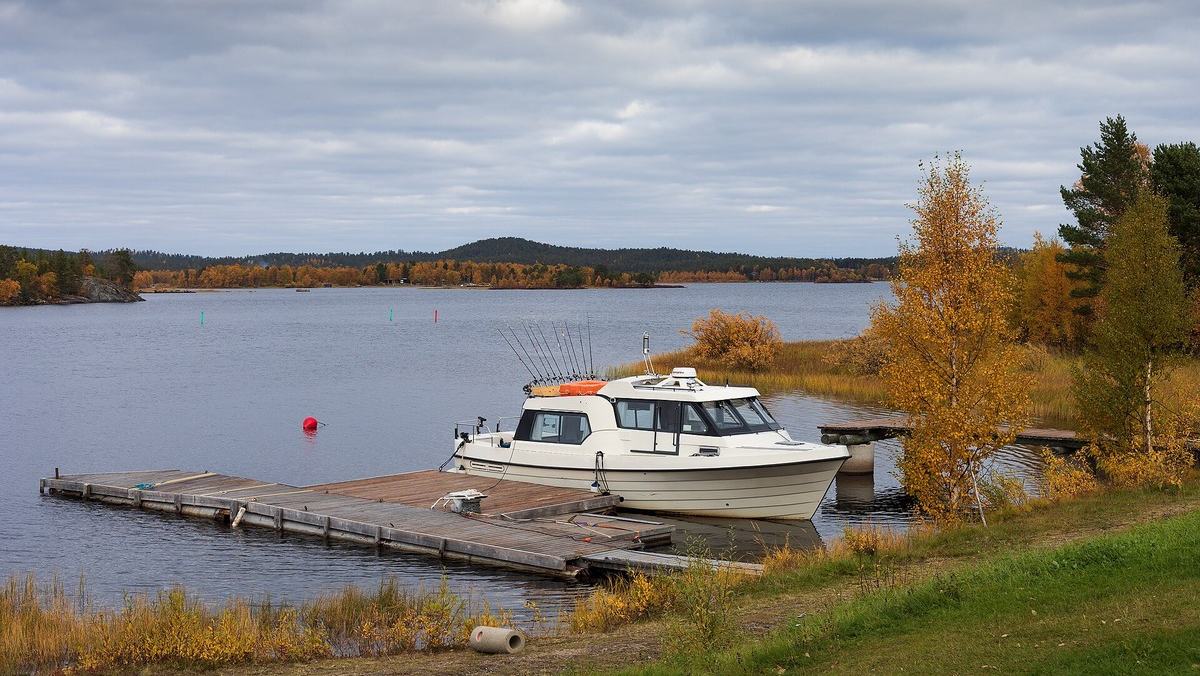
The accompanying photograph, “Pier and motorboat at Inari village, Inari, Lapland, Finland, 2021 September,” was taken by Ximonic (Simo Räsänen) and published on Wikimedia Commons under Creative Commons Attribution-ShareAlike 3.0. It documents the real northern Finnish lake and a small-boat landing, not a different Lapland destination. The image is not represented as a photograph of Sámi Village's present rental fleet or its Nellim launch. Photographer attribution and original licensing are retained, while rental equipment, duration and booking information come from the business's first-party summer activity description.
A manageable first itinerary from Nellim
Contact Sámi Village to confirm the intended date, current equipment, price and safety arrangements. Choose a boat appropriate to the least experienced member of the party and ask for a short route near the launch, with a clear return time and a reliable way to seek assistance. Review wind, visibility and water temperature before setting out, and leave time to explore Lapland on land as well. A summer paddle on Lake Inari can provide a rare sense of space and light, but it is most enjoyable when the lake's scale is treated with respect and the journey is planned around what the group can safely manage.
Sources and photograph attribution
Official destination and boating guidance: Sámi Village — Lake Inari Summer Paddling and Rental Equipment from Nellim. Current access, rules, weather and reservations must be checked independently before travel.
Photograph: Ximonic (Simo Räsänen) — “Pier and motorboat at Inari village, Inari, Lapland, Finland, 2021 September.jpg” (CC BY-SA 3.0), via Wikimedia Commons. Resized to JPEG 1200×800 for editorial display. Source: https://commons.wikimedia.org/wiki/File:Pier_and_motorboat_at_Inari_village,_Inari,_Lapland,_Finland,_2021_September.jpg. Licence: https://creativecommons.org/licenses/by-sa/3.0. Original rights remain with the credited creator or as specified by the source and licence.
