
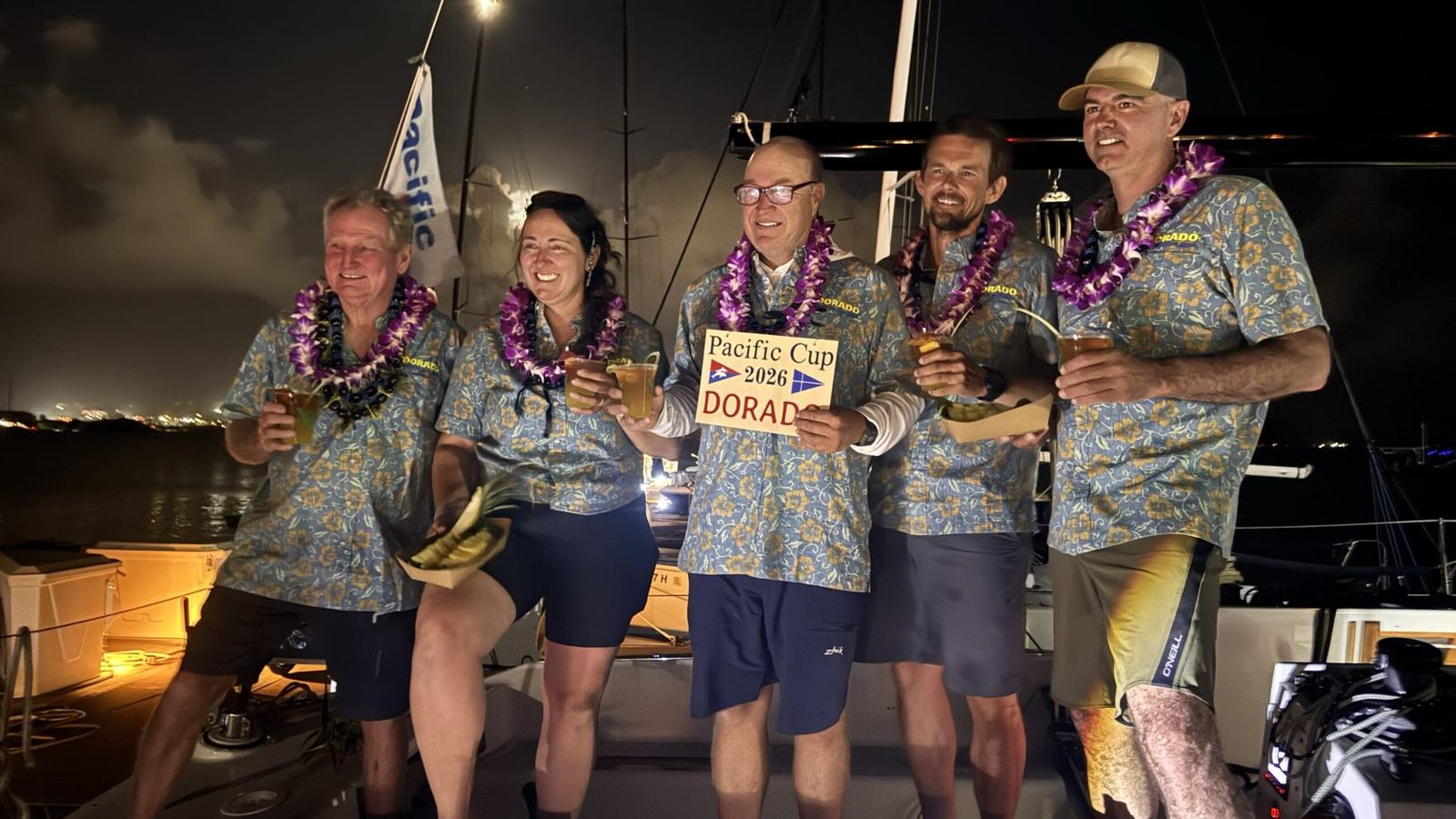
American Sailing profiles Kira Maixner, part of the five-person crew aboard the Express 37 Dorado that won its ORR4 class in the 2026 Pacific Cup to Hawaii.
A 37-foot boat crosses the Pacific
Kira Maixner was part of the five-person crew aboard Dorado, an Express 37 skippered by Brendan Huffman, in the 2026 Pacific Cup. The crew raced from the San Francisco area toward Hawaii, finishing in Kaneohe after just over eleven days at sea.
American Sailing interviewed Maixner about the challenges of the offshore race and the preparation required. The story centres on a comparatively modest sailing yacht rather than an extreme superyacht.
Class victory comes on corrected time
Dorado completed the crossing in eleven days, eleven hours and fifty-four minutes. After the event's corrected-time calculations, the team won the ORR4 division.
Handicap racing allows boats with different characteristics to compete within organised classes. A fast elapsed passage does not automatically determine the winner until the relevant rules and ratings are applied.
Weather does not always follow the plan
The Pacific Cup is a roughly 2,100-nautical-mile passage, with changing winds and sea states that can alter the best route. Competitors make decisions about sail selection, watch systems and navigation over many days.
Maixner described adapting to the conditions the boat actually encountered. Offshore teams need to maintain safety and morale rather than rely on an ideal forecast.
Five crew members share responsibility
Life aboard a smaller offshore racing yacht can be demanding because sailing duties, rest, food and maintenance must fit into restricted space. Good communication is particularly important when crew members are tired or changing watch.
The Dorado victory highlights the value of preparation and an effective team. It should not be seen as encouragement for an inexperienced crew to attempt the passage without training and support.
An inspiration for club sailors
Maixner's story links ordinary sailing experience with success in an international offshore event. Skills acquired through smaller trips and instruction can develop gradually toward more ambitious voyages.
The Pacific Cup remains a demanding ocean race with formal entry and safety requirements. Recreational sailors can draw motivation from its lessons without needing to enter the same competition.
Preparing a small offshore raceboat for a long passage
An Express 37 is a capable offshore design, but a crossing to Hawaii still requires careful preparation. The crew needs to review rigging, steering, navigation systems, safety equipment and the condition of sails before starting. A race is not simply a coastal outing with more hours added; every piece of equipment must survive sustained use in conditions that may be difficult to reproduce close to home.
Weight and space are also limited on a 37-foot yacht carrying five racers. Food, water, personal equipment and spares must be chosen with the boat's stability, storage and access in mind. Preparing a workable inventory is an exercise in deciding which supplies matter most when a repair service or chandlery is thousands of miles away.
Watchkeeping affects speed and safety
Racing crews have to balance sail performance with the need for rest. On an offshore passage, people may be tired, wet or uncomfortable yet still required to steer accurately and respond to changes in wind direction. A sensible watch system gives each member an opportunity to recover and makes expectations clear before exhaustion affects judgement.
The exact arrangement depends on crew experience and the demands of the race. Communication between watches is essential so nobody takes over without understanding sail configuration, nearby traffic, weather developments or equipment concerns. Even on a small racing yacht, a written or verbal handover can prevent important information being lost at the end of a difficult shift.
Choosing a route instead of merely following a line
Ocean racing involves interpretation of forecasts, currents and the performance characteristics of the boat. A route that looks shortest on a chart may not be fastest if the expected wind is weak or the waves make the yacht difficult to drive efficiently. Crew members must compare their plan with the weather actually encountered and remain prepared to change it.
Routing tools can assist, but their recommendations depend on input data that can change. The crew needs to understand why a manoeuvre or course change is proposed rather than accept every suggestion without question. Navigation and collision avoidance remain essential responsibilities even when the yacht is concentrating on corrected-time results.
Managing equipment through eleven days afloat
Running rigging, sail attachments and deck hardware receive repeated loads during an offshore race. A small defect that appears minor at the start can become serious after days of movement and salt exposure. Regular checks of chafe, fastenings and wear can help the crew identify a problem while there is still time to address it safely.
Repairs on a moving boat bring hazards of their own, particularly in darkness or rough seas. Teams should agree how to secure working areas, which spare materials are available and when a repair is worth attempting. Protecting the crew takes precedence over a marginal improvement in boat speed, even when the race standings are close.
Understanding a handicap-class victory
Offshore race results may be calculated using rating systems intended to compare boats with different characteristics. An impressive elapsed time is an achievement, but the official division result depends on the relevant handicap calculation and race rules. Dorado's ORR4 win should be understood in that context rather than described as the fastest overall passage.
Success at sea can also reflect teamwork, preparation and the ability to manage setbacks. The crew's experience offers lessons to recreational sailors who may never enter a transoceanic race: secure the boat properly, communicate clearly and be ready to change plans when real conditions differ from expectations.
Provisioning offshore involves much more than choosing meals that everybody enjoys. Food must remain safe to store and practical to prepare when the boat is moving, while adequate drinking water is essential. The crew also needs to consider dietary requirements and how cooking tasks will fit around watch schedules so that tired sailors are not forced into unnecessarily complicated galley work.
Personal health is another part of passage preparation. Crew members should discuss any relevant limitations privately with the skipper, carry necessary personal medication and know how medical assistance could be requested. A yacht well equipped for sailing can still become vulnerable if the people aboard are exhausted or unable to care for a colleague who needs help.
The arrival at a distant finish line may be the most visible moment of the race, but the return logistics deserve planning from the start. Equipment, personal travel and the boat’s next voyage all require attention. Choosing what happens after the finish can prevent pressure on a tired crew to undertake a long delivery or complex task without adequate rest.
Maixner’s account of Dorado can inspire owners of comparatively small sailing boats, but it should not encourage casual attempts at ocean crossings. Racing crews rely on preparation, qualified experience and the rules of an organised event. Recreational sailors can apply lessons about teamwork and inspection on local voyages without undertaking the hazards of a transoceanic passage.
Source
American Sailing