
Kenai Fjords National Park offers unforgettable guided sea-kayaking opportunities near glaciers and marine wildlife, but its exposed waters demand experience.
A place where kayaking requires genuine preparation
Kenai Fjords National Park on Alaska's southern coast is renowned for its steep fjords, glaciers and rich marine wildlife. A sea kayak provides a remarkably personal way to encounter this environment, moving quietly across cold water beneath large cliffs. The National Park Service describes paddling here as an opportunity to participate in a long tradition of human-powered coastal travel, while stressing that the waters are not appropriate for unprepared beginners.
The appeal of a glacier photograph should not distract from the realities of the location. These fjords connect with the Gulf of Alaska, leaving many areas exposed to swell, changing winds and difficult landing conditions. A visitor may have excellent experience on sheltered lakes yet still need a qualified local guide to enjoy Kenai's coast safely.
Seward as a natural starting point
The town of Seward is a practical base for exploring Resurrection Bay and the surrounding coastal region. Travellers can arrange shorter paddling experiences in more sheltered areas or use local operators to reach selected locations farther into the park. A guided trip offers an opportunity to learn about the landscape without immediately undertaking the logistics of a wilderness expedition.
The Park Service cautions against trying to paddle directly from Seward into remote parts of the park because long stretches between Callisto Head and Aialik Cape offer few safe landings. The waters around the cape can be particularly challenging. A short route close to suitable access or one arranged with a guide can be a more realistic choice for a visitor with limited time.
Why the sea conditions deserve respect
The fjords contain relatively few naturally protected coves, and the National Park Service warns that afternoon breezes can produce surf at landing beaches. Summer storms can also send significant ocean swell into the area, adding complexity to a journey even when rain and visibility appear manageable near departure.
Cold water increases the consequences of a capsize, so appropriate clothing and rescue arrangements are necessary. Paddlers should understand the limitations of their equipment and avoid making safety decisions based only on a general weather forecast. Experienced guides assess local conditions, select routes and may cancel an outing when the environment is unsuitable.
Guided experiences serve different abilities
The Park Service lists companies with Commercial Use Authorizations that offer sea-kayaking experiences. These can range from shorter outings in the Seward region to longer excursions and more involved journeys into the park. Travellers should confirm the operator's permitted locations, guide qualifications and equipment before booking rather than assume every kayak tour provides an identical experience.
A newcomer should explain their paddling background honestly. A local company may advise an introductory trip in Resurrection Bay instead of an exposed route near a tidewater glacier. Choosing a modest outing can leave more time to appreciate marine wildlife and scenery while learning how to manage a sea kayak in cold coastal conditions.
The attraction of tidewater glaciers
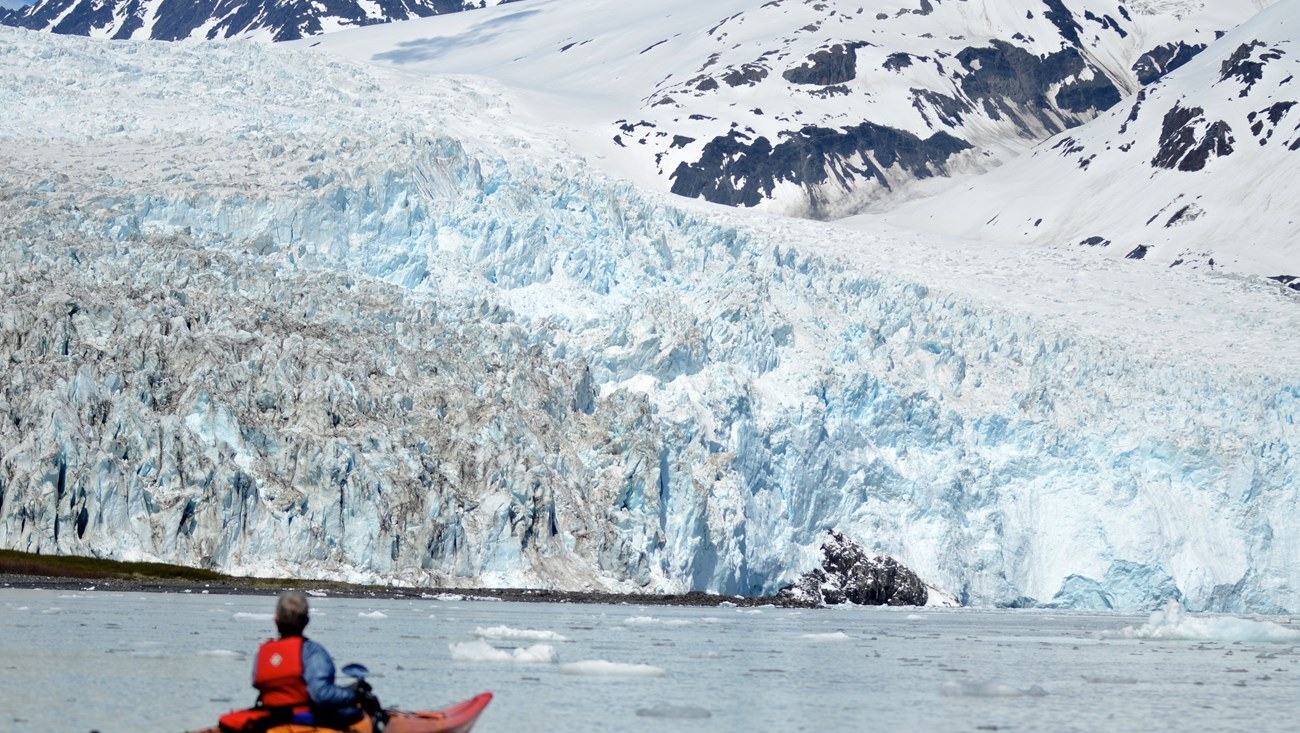
The official National Park Service photograph shows a kayaker in front of the dramatic Alaskan landscape with a glacier in the distance. Such scenery is central to the region's appeal, but approaching active ice requires specialist knowledge. Glaciers can release large pieces unexpectedly, creating waves and floating hazards far from the visible face.
Visitors should follow the separation distances and instructions established by their authorised guide, keeping away from unstable ice and areas where calving could affect the water. A seemingly calm photograph records only one instant. No visitor should treat it as permission to paddle close to ice cliffs or other hazards to obtain a similar image.
Wildlife observation from a low craft
The waters support seabirds and marine mammals within an interconnected coastal ecosystem. A kayak can provide a quiet perspective on those animals without the noise of a motor, but the responsibility to avoid disturbance remains. A guide may explain which behaviours indicate animals are feeding or resting and why it is important to keep a suitable distance.
Paddlers should not chase a whale, approach haul-out areas or encourage wildlife to move for the sake of a photograph. Binoculars can provide a more satisfying view while leaving animals undisturbed. The same principle applies to birds and smaller creatures along the coast, where sensitive habitats can be damaged by careless landings.
Traditional qayaq heritage deserves recognition
The National Park Service highlights the history of the qayaq, an important vessel used for travel by Sugpiaq/Alutiiq communities of the Chugach region. A collaboration with Chugachmiut Heritage Preservation documented construction of a traditional qayaq by master builder Joseph Tabios and his son Kris, connecting contemporary visitors with the longstanding relationship between people and these waters.
This history adds depth to an outing because the kayak is not simply a modern leisure invention. It is connected to generations of skilled boatbuilding and coastal knowledge. Visitors can learn more at the park visitor centre in Seward, where the traditional craft has been displayed, and approach the landscape with greater respect for its cultural significance.
Equipment needs to match the environment
A suitable sea kayak, personal flotation device, immersion protection and dependable communication are central to safe paddling here. The specific arrangement should be established with the guide and adjusted for the season, route and conditions. A light waterproof jacket designed for warm-weather kayaking elsewhere is not necessarily appropriate for Alaska's cold water.
Travellers should also consider whether their level of fitness and balance suits the planned itinerary. Several hours in a kayak may be tiring, especially when the boat has to be manoeuvred in current or chop. A reputable operator can explain whether the trip is suitable and help visitors understand what experience or training is required.
A wilderness holiday that rewards flexibility
Kenai Fjords can provide a remarkable memory even when a group chooses a shorter and safer route than originally imagined. The sight of seabirds, glacial water and rugged mountains can be meaningful without a long crossing or a close approach to active ice. A flexible itinerary also leaves room to enjoy Seward and the park's interpretive activities if weather cancels the kayaking day.
The official National Park Service guidance and authorised local guides should form the basis of planning. Real conditions and crew ability must determine the route, not the ambition to reproduce a striking travel photograph. The reward is an informed, respectful encounter with one of Alaska's great coastal landscapes.