
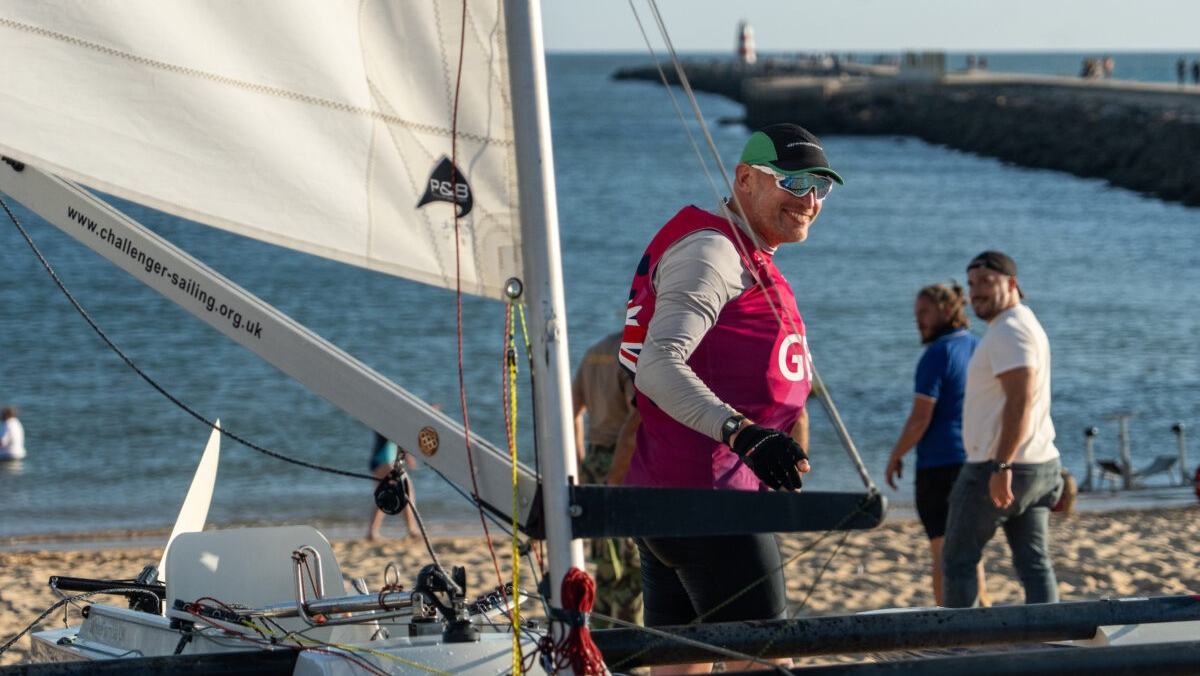
Welsh sailor James Coxon has returned to international competition in a Challenger trimaran after setting four recumbent-cycling world records, renewing an early passion for sailing.
An unexpected return to a lifelong interest
Welsh sailor James Coxon has returned to international sailing after several years spent achieving remarkable results in another sport. His appearance at the October 2026 World Sailing Inclusion Championships in Portugal brought him back to the experience of wind, waves and competitive tactics that first attracted him to racing as a young sailor.
Coxon began his sporting life in Laser dinghies and progressed into the British sailing squad, before eventually stepping away from serious competition after university. He later faced a very different set of circumstances when a rare form of motor neurone disease affected the function of his left arm.
The return to sailing is a human-interest story rather than the announcement of a new production boat or training qualification. For people who enjoy recreational boating, it highlights how an old enthusiasm can be revisited with different equipment and a new perspective on what makes time on the water worthwhile.
Four world records on two wheels
When Coxon moved into recumbent cycling, he brought the same determination that had previously shaped his sailing. World Sailing reports that he established four world records, including an age-group one-hour performance achieved only weeks before the Portimão championship.
His training schedule at times involved fifteen to twenty hours of exercise a week, much of it spent alone on a stationary trainer. That level of dedication demonstrates the effort required in elite endurance sport, but it also illustrates why a competitive athlete might eventually seek a different kind of physical and mental challenge.
Cycling offered precise measurements of speed and progress, allowing Coxon to work towards clearly defined goals. Returning to sailing exposed him again to something less predictable: a changing natural environment in which preparation matters, yet every shift in the wind can demand a fresh decision.
Why the sea offers a different experience
Coxon has described sailing as a welcome change from the repetitive concentration of indoor training. The boat responds to the wind and to the movement of the water, requiring the sailor to remain engaged with conditions rather than follow a fixed programme.
For a recreational sailor, that relationship with the surroundings is familiar even without the pressure of international competition. An afternoon spent adjusting sail trim, watching a cloud line or choosing a sensible route across a bay can be absorbing in ways that are difficult to replicate on land.
The activity should not be promoted as a replacement for medical or professional support, and each participant needs suitable equipment and training for their own circumstances. Its value lies in offering another enjoyable form of participation, with opportunities for challenge, social connection and personal achievement.
A Challenger trimaran provides a fresh challenge
For his return, Coxon chose a Challenger trimaran, a small multihull class suited to accessible sailing and one that he found exciting to handle. He was attracted by both the supportive class community and the performance of the boat in stronger conditions.
At Portimão, racing took place outside the harbour in deep waves and changing breezes, a setting that challenged the fleet with more than a straightforward short course. World Sailing reported that Coxon recorded a second place followed by two race wins on day three, lifting him to the head of the single-person multihull standings.
The boat’s appeal should not be confused with a guarantee that every trimaran is suitable for every sailor. The correct craft, access arrangements and safety systems depend on a participant’s abilities, training and the conditions in which the vessel will be used.
Community makes the return more rewarding
Coxon spoke positively about meeting competitors with a wide range of backgrounds and participation needs during the inclusion championships. An international regatta brings people together who may have found their way to sailing through different experiences, yet share an enthusiasm for learning and for the challenge of racing.
This community aspect can be just as important at an ordinary yacht club. A friendly introduction, patient instructor and willingness to help somebody find appropriate equipment can determine whether a new participant returns for a second outing.
Owners who want to support more inclusive opportunities can begin by asking local clubs about their existing programmes and volunteer needs. Assistance should be organised through qualified people who understand safety, safeguarding and the practical requirements of different boats.
What his experience can teach leisure boaters
Coxon’s story suggests that there is no single route into—or back into—boating. Some people discover the sport as children, others begin after retirement and many return after a long gap when they find a boat or a local programme that suits them.
An individual who learned to sail years ago may discover that training, equipment and teaching methods have changed. A short refresher course or supervised trial is often a sensible way to rebuild confidence before taking responsibility for a boat or joining a demanding race.
The important point is to match ambition to a realistic plan. Whether the goal is an international podium or a peaceful passage with friends, the satisfaction comes from developing the knowledge and judgement needed to enjoy the water safely.
A lasting bond with sailing
The report from Portugal describes Coxon as energised by both the competition and the wider atmosphere of the event. He retained his desire to win, but also recognised that sailing offers a form of enjoyment that cannot be measured through a record or a final score alone.
That combination of competitive energy and affection for the sea will be recognisable to many recreational sailors. Even those who never race may be drawn to the feeling of a boat responding to a small movement of the helm or the satisfaction of completing a passage through changing weather.
Coxon’s return demonstrates that past experience and new learning can meet in the same activity. For a person considering whether to come back to boating, his example is encouragement to explore the available options, seek sound advice and rediscover the simple pleasure of being afloat.
Source
World Sailing