
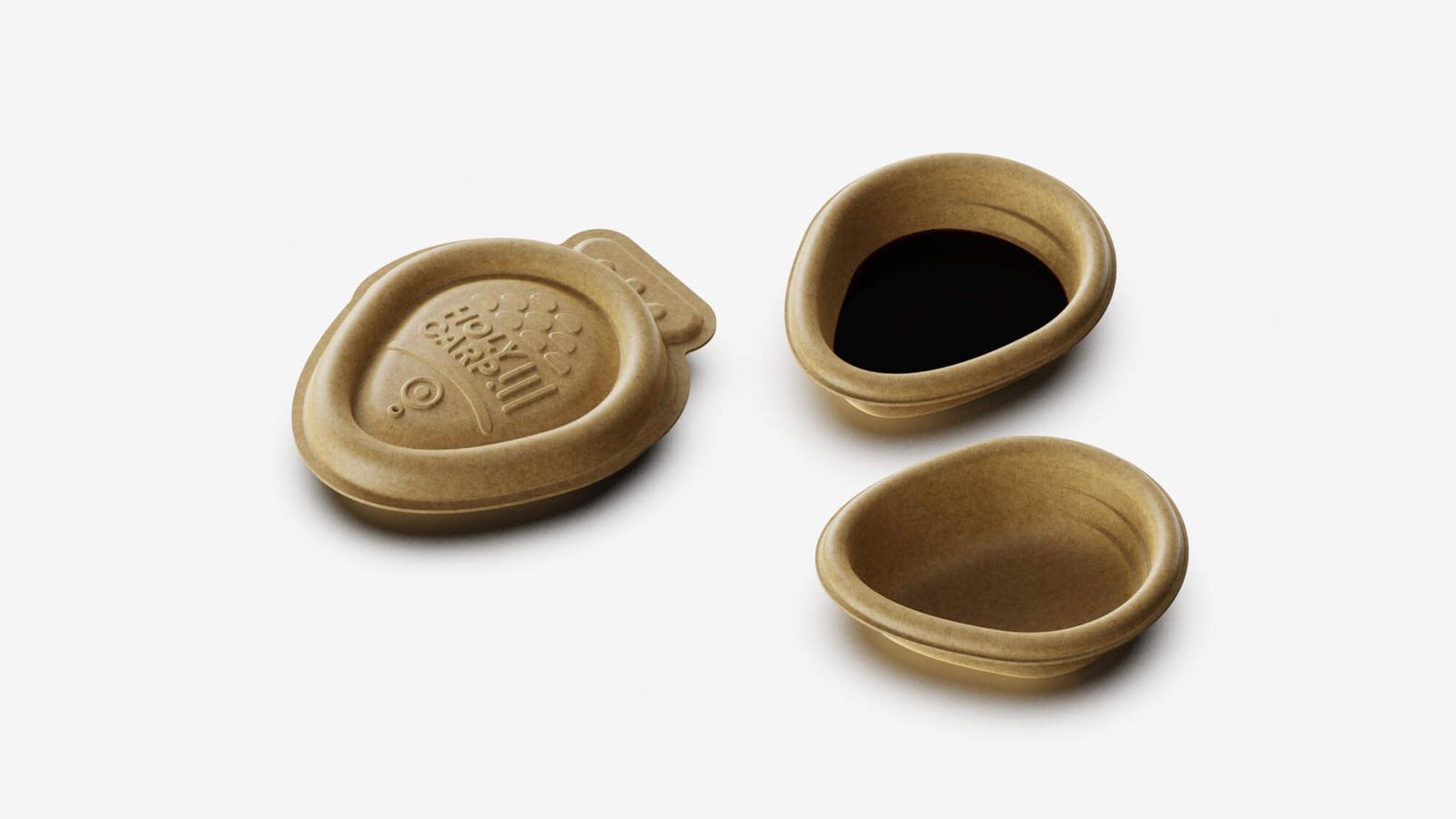
Australia's award-recognised Holy Carp condiment dispenser reimagines the familiar plastic soy-sauce fish with moulded plant fibre and in-store filling.
A small fish with a very large footprint
The tiny plastic fish that delivers soy sauce with takeaway sushi is a familiar sight at beach picnics, marina cafés and city lunch counters. It is also a remarkably durable container for a product used in moments. Australian designers Heliograf and Vert Design have responded with Holy Carp, a plant-fibre alternative recognised in the 2026 Australian Good Design Awards.
The project is not a boat accessory, but its connection with life around the water is direct. Lightweight packaging can escape into drains, rivers, harbours and the sea, where collecting each individual item is difficult. Reconsidering one small, common object offers an accessible way to examine how everyday choices upstream contribute to the litter seen around our cruising grounds.
Keeping the familiar squeeze
The design team did not simply propose removing the fish-shaped dispenser. It sought to preserve the convenience and personality that made the plastic version popular. Holy Carp retains a fish-like form, with a flexible top and a small dispensing opening that allows a diner to apply soy sauce in drops.
That continuity is an important part of designing for behaviour. People do not adopt a replacement merely because it is presented as environmentally preferable; it must also be pleasant and practical to use. The challenge is especially sharp when a conventional item is cheap, widely distributed and so deeply embedded in food-service routines that few customers think about it.
Made from moulded plant fibre
Holy Carp replaces conventional plastic with moulded plant fibre that incorporates bagasse, a byproduct of sugar processing. The official design entry describes a food-safe additive intended to improve moisture resistance without plastic coatings or PFAS additives. The chosen construction supports the project's aim of creating a home-compostable dispenser.
The designers describe their product as plastic-free and home-compostable, while noting that certification to the Australian AS 5810 home-compostability standard was still underway at the time of their submission. That distinction matters. A material concept and a completed independent certification are not identical claims, and local disposal facilities may handle compostable products differently.
Why the filling method had to change
A central insight of the project is that packaging and distribution cannot be designed separately. The conventional plastic fish is often filled long before it reaches the customer, making extended storage a routine requirement. Holy Carp instead proposes filling its containers at the food outlet, reducing the need for materials that preserve soy sauce across a lengthy supply chain.
The developers say this model has been tested in Hobart, Tasmania, where restrictions on some single-use plastics have shaped experimentation. It is a useful reminder that an object can be redesigned by changing the service around it. More sustainable materials alone may not work unless preparation, handling and customer expectations evolve alongside them.
Eight millilitres of careful detail
The container includes fill indicators for four and eight millilitres, allowing outlets to choose a serving size. A slightly raised edge forms part of the closure, while a textured underside is intended to improve grip. The fish's tail helps with opening and the curved body retains the playful identity of the original.
The design team also points to practical limits. Holy Carp is intended for relatively immediate use after being filled, and it recommends consuming the sauce within 48 hours for freshness. It should not be treated as a long-term sealed storage vessel or assumed to be interchangeable with every industrial packaging line.
The challenge of protecting marine life
The connection between plastic litter and the marine environment is a principal motivation of the project. Small condiment containers can be mistaken for harmless disposable details, yet once discarded they can break down into persistent fragments. Their size and buoyancy make them a particular nuisance where food is eaten near beaches, boat ramps and waterfront promenades.
Holy Carp cannot solve the wider problem of litter entering waterways on its own. A replacement still needs proper disposal, responsible handling and a supply chain that achieves its stated goals. Nevertheless, eliminating a plastic item at source is a distinct strategy from trying to retrieve the same item after it has escaped into a river or harbour.
What boaters can learn from a takeaway counter
For cruising families and leisure boat owners, the relevant lesson is less about this single brand than about checking the packaging attached to ordinary provisions. Marinas, charter operators and waterfront cafés handle large numbers of small containers, cutlery sets and snack wrappers during busy weekends. Each offers an opportunity to reduce pieces that can become windblown waste.
The practical first step remains straightforward: store rubbish securely aboard, avoid unnecessary single-use packaging where feasible and dispose of it through appropriate facilities ashore. Compostable packaging is not a licence to discard anything overboard. Its claimed advantages depend on controlled collection and end-of-life treatment, not on exposure to seawater.
Designed for adoption, not display
An award-winning object may attract attention because it looks different, but the strongest design work goes further. Holy Carp addresses the way the fish is held, opened, squeezed, filled and discarded. Such decisions determine whether food outlets and customers find an alternative acceptable during a busy service.
The teams' use of familiar proportions is particularly interesting. Instead of asking diners to learn an entirely new ritual, the project offers a recognisable replacement with materials chosen for a shorter lifespan. That is an approach other product designers could apply wherever an everyday convenience leaves a disproportionately long material legacy.
A modest but meaningful coastal intervention
The 2026 award entry presents Holy Carp as a response to a small but visible source of avoidable plastic waste. The project is still part of a larger transition, and its claims about compostability, scale and long-term environmental benefit should be evaluated as the product moves through wider real-world use.
For the boating community, that caution does not diminish the central idea. Cleaner harbours depend on the things people do both afloat and ashore. A rethink of a disposable soy-sauce fish cannot transform the ocean, but it illustrates how considered design, service changes and better disposal habits can help prevent waste before it reaches the water.