
Grape Island offers a quieter private-boat destination in Boston's Hingham Bay, with wooded trails, tidal beaches and the 1775 Grape Island Alarm, but few visitor services.
A quieter Boston Harbor island reached by private boat
Grape Island lies in Hingham Bay off the coast of Weymouth, south of central Boston, and offers a different experience from the better-known ferry destinations of Georges and Spectacle. Its wooded trails, rocky beaches and picnic areas make it appealing to boaters who want a relatively simple day close to home rather than a major excursion. Unlike the islands with regular public passenger services during the peak season, however, Grape is principally a destination for people able to arrange private vessel access.
The island is managed by the Massachusetts Department of Conservation and Recreation as part of Boston Harbor Islands National and State Park. Its size changes significantly with the tide, from roughly 54 acres at high water to about 101 acres at low water. This variation is not merely an interesting geographical fact. It affects the coastline visible to a visiting skipper, the exposure of shoreside areas and the way a walking route appears at different stages of the tide.
Grape Island may be open for daytime visits outside the summer ferry season, but services and suitable landings must be checked in advance. The park partnership warns that drinking water, toilets and visitor support are not normally available outside ferry operating hours. A small-boat visit should therefore be planned on the assumption that it is a self-sufficient outing, with reliable equipment, supplies and a safe way to return to the mainland.
Wooded paths, wildlife and an exposed shoreline
The National Park Service describes Grape as a wildlife haven where berries provide food for birds and other animals. Early-successional woodland and shrubs have established themselves across its low hills, with staghorn sumac, gray birch and quaking aspen among the species found there. This makes the island a pleasant contrast to the more developed public recreation landscapes nearby, particularly for people interested in watching birds or photographing vegetation.
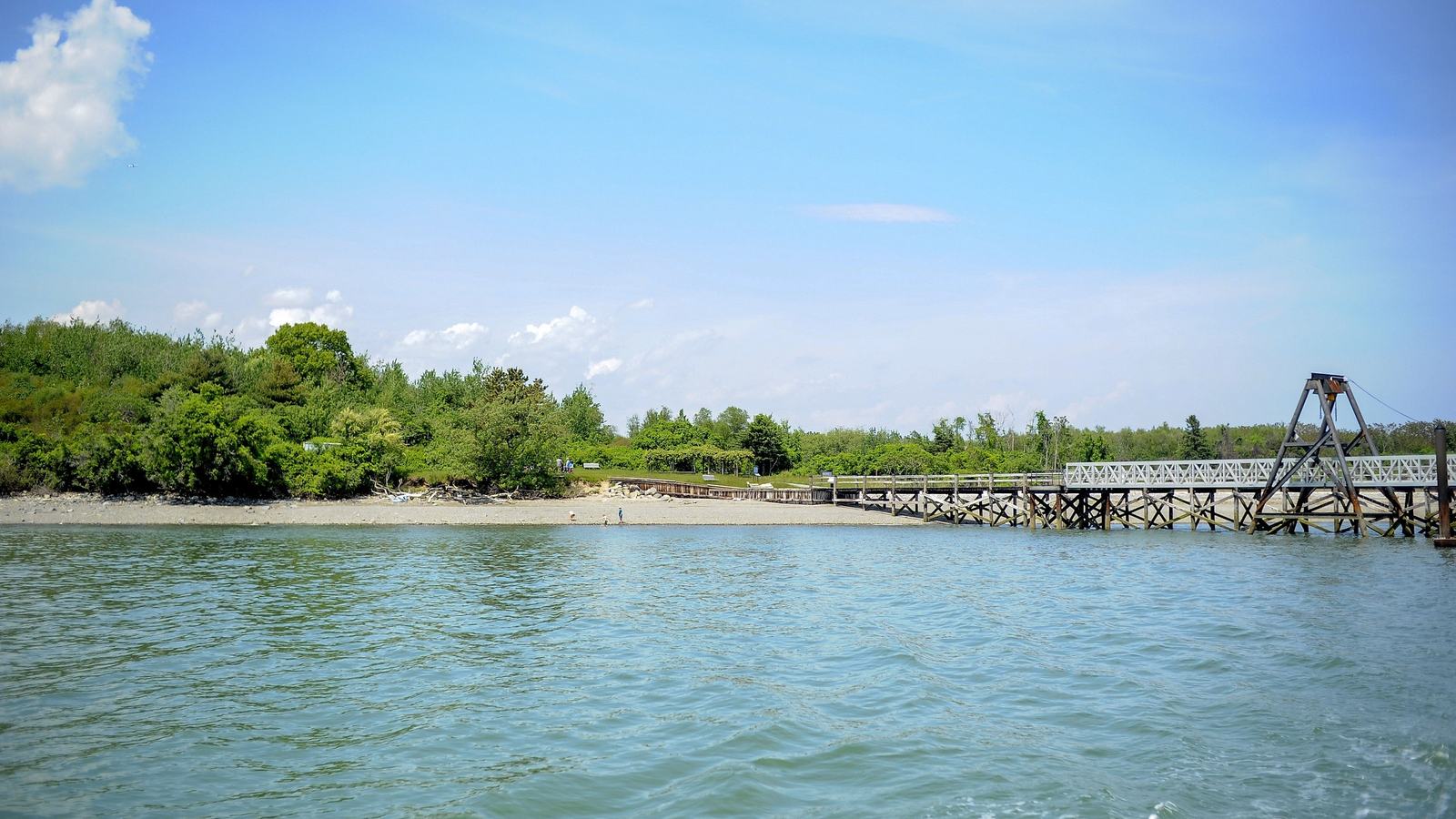
Walking trails lead through the woods towards the rocky beaches and open views of Hingham Bay. A visitor need not have specialist hiking equipment, but appropriate shoes remain important where trails are uneven or damp. The island is not an urban promenade, and weather can make exposed shorelines less comfortable than expected. A family should choose a route that leaves enough time to return to the landing rather than attempting to circle every visible headland.
The shore can also provide opportunities to observe changing tidal habitats. Visitors should avoid disturbing wildlife or removing natural and historic objects from the beach. A quiet private-boat excursion has the potential to be less intrusive than a large organised event, but that advantage is lost if passengers approach nesting birds, enter sensitive areas or leave rubbish. Respecting the island's ecology is part of enjoying its relative isolation.
The Grape Island Alarm of 1775
The island played a small but memorable role during the opening stages of the American Revolutionary War. On 21 May 1775, British forces attempted to remove hay from Grape Island while nearby colonial communities watched their movements. Local militiamen sounded the alarm, and a confrontation followed in which people from Weymouth, Braintree and Hingham crossed the water to challenge the British presence.
The incident is often called the Battle of Grape Island or the Grape Island Alarm, despite its limited scale compared with the major battles of the Revolution. Abigail Adams, who lived nearby, described the community response in correspondence with her husband John Adams. Her account offers a sense of how a seemingly ordinary agricultural resource could become a focus of military tension during the siege of Boston.
Grape Island never developed into a large military fortification. Its significance lies instead in this episode of local mobilization and the relationship between farming communities and the harbour. Visiting today can therefore provide a different historical perspective from the fortifications on Georges Island or the lighthouse heritage of Little Brewster. An independent visit is more rewarding when the landscape is understood as part of that broader coastal history.
Docks, moorings and the realities of a landing
The National Park Service lists a dock at Grape Island but does not identify conventional visitor boat slips or park moorings. The published island fact sheet also indicates that water and staffed services are unavailable. A dock shown in a photograph should not be treated as a guaranteed place to leave a vessel, and arrangements must follow the rules for visiting private boats. The park partnership advises boaters to give way to any park ferries and recognise that not all islands have suitable protected anchoring.
Reaching the island requires the same attention to navigation as other passages in Hingham Bay. A skipper should consult current charts, tidal information and weather forecasts, with particular attention to shoal areas and the changes brought by low water. A small boat that can approach comfortably on one tide may have very different options several hours later. A safe return plan is more important than reaching the shore at a particular time.
Private craft should not assume that an apparent landing point gives permission for extended docking, camping or an overnight stay. Daytime access rules, the condition of the dock and any seasonal restrictions should be checked with the park operator. Because there may be no staff on the island, visitors should carry appropriate drinking water, first-aid supplies and communication equipment rather than expecting help to be immediately available.
Camping and a practical future visit
Grape Island has historically offered ten small campsites and a group camping area, along with picnic tables and composting toilets. However, published descriptions of those facilities are not proof that reservations are currently offered. The Massachusetts park system and Boston Harbor Islands partnership should be consulted for the actual camping programme, applicable permits and any restrictions in the desired season.
A responsible day trip might involve an early departure in suitable weather, time on the wooded paths and a picnic overlooking Hingham Bay. Visitors should plan to carry everything they need back to the boat, including waste. Those hoping to spend the night need to establish whether camping is legally available and whether a vessel can remain safely secured during the entire stay. Seasonal park services should not be assumed outside the summer period.
Grape Island illustrates why the less-developed parts of Boston Harbor can be so rewarding. It offers birds, tidal shorelines, a notable Revolutionary-era story and the chance to escape the busiest ferry routes. Its relative simplicity, however, makes preparation essential. By choosing suitable conditions, verifying access and leaving the island undisturbed, recreational boaters can enjoy a distinctive destination close to a major American city.