
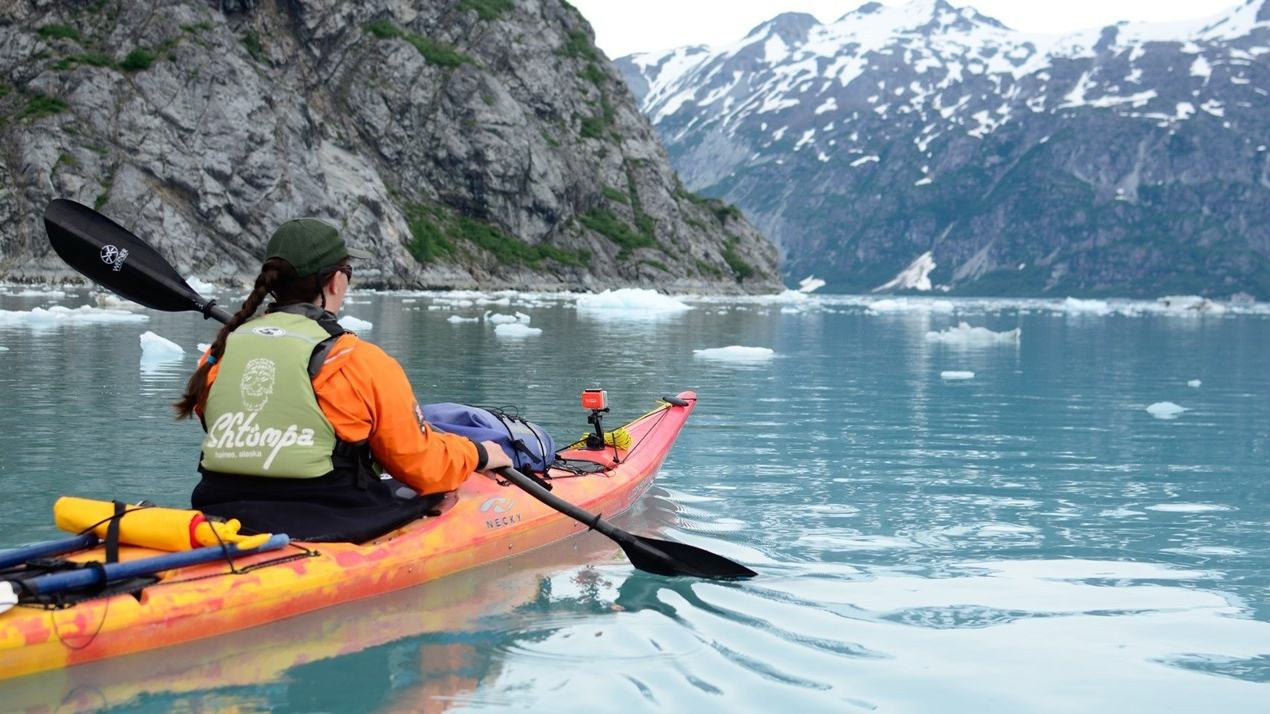
Glacier Bay can be explored in a sea kayak with appropriate experience and planning, beginning at Bartlett Cove or with a designated camper drop-off service.
A small craft in an immense Alaskan landscape
Glacier Bay National Park and Preserve in Alaska offers one of the most striking contrasts in paddlesports: a single sea kayak travelling through water framed by steep mountains and ice. The National Park Service presents kayaking as a way to experience the area's solitude and wilderness on a more personal scale than a large tour boat provides. The appeal is extraordinary, but the park's remoteness and cold water make it an expedition to plan rather than a casual extension of a holiday.
The official NPS photograph of a paddler beneath snowy peaks shows an actual kayak in the landscape, not a staged illustration. It also hints at the scale that can be difficult to judge in a picture. Distances on the water, the availability of safe landings and the consequences of bad weather must be considered with more care than during a short recreational paddle on a warm lake.
Bartlett Cove is the principal starting point
The Park Service identifies Bartlett Cove as a place where kayaking trips can originate, with access to information about conditions, permitted camping and the wider park. For a visitor new to the area, it is the logical location for learning what current routes might be appropriate. A guided day trip can provide an introduction without requiring the experience or equipment needed for several nights in the backcountry.
Local kayak rental and guide services operate through authorised businesses, with advance arrangements particularly important in the peak summer season. Equipment should be matched to the trip, and a customer should establish what safety instruction or support is included. A rental does not mean the park has assessed an individual's readiness to paddle independently in remote conditions.
Camper drop-offs open a more remote option
During the summer, kayakers may be able to arrange a designated camper drop-off farther up Glacier Bay using the daily tour boat operated through Glacier Bay Lodge. This approach can shorten some long approaches from Bartlett Cove and place experienced paddlers closer to the park's dramatic scenery. The NPS notes that the boat can carry only a limited number of kayaks, making advance booking advisable.
A drop-off also removes some of the security of being close to a staffed base. Once left at a remote landing, a group must be capable of carrying out its own route and responding to changing conditions. Booking a place on a vessel is only one part of the planning; launch conditions, permitted camps, collection times and alternative arrangements all require explicit confirmation.
Tides can change a shoreline dramatically
The Park Service warns that tides in Glacier Bay can vary by as much as approximately twenty-five feet over six hours. Such movement can transform a landing beach, expose extensive intertidal areas and alter the strength of currents. A site that seems convenient at one state of tide may be difficult or unsafe when the group returns after an excursion.
Paddlers therefore need to understand the local tide table and the implications for travel, camping and gear storage. A kayak left carelessly near the waterline may be stranded far from shore at low tide or moved by rising water. Planning should include secure storage and an awareness of how far the sea may advance or retreat at each intended stop.
Bear precautions are part of backcountry travel
Both black and brown bears inhabit the park, creating requirements that differ from many more developed camping destinations. The National Park Service instructs backcountry visitors to store food and other scented items in approved bear-resistant canisters, which the park makes available without charge. The issue is not merely protecting a picnic from scavengers but avoiding interactions harmful to people and wildlife.
A paddling group should learn proper food handling and campsite selection before beginning an overnight journey. Waste, toiletries and cooking equipment all need attention. Wildlife should be observed from a distance without attempting to attract animals for photographs, and a party should be prepared to alter its route or campsite when conditions require.
Permits and orientation have specific seasonal rules
For overnight backcountry use between May 1 and September 30, Glacier Bay requires registration, an annual orientation and a free backcountry permit. The park describes a short orientation at the Bartlett Cove Visitor Information Station that addresses important local considerations. Travellers should confirm current arrangements with the NPS, including options for submitting forms and any different requirements outside the stated season.
That timing is important for a reader planning in October. Summer services and weather windows may have ended, and a trip should not be assumed immediately available because the scenery looks inviting. Planning the following season gives time to learn the park's rules, choose suitable equipment and arrange authorised transport or guiding.
Equipment should reflect cold water and distance
Sea kayakers in Glacier Bay need equipment appropriate to immersion in cold water, dependable clothing and a comprehensive plan for self-rescue and communication. A personal flotation device is essential but cannot prevent cold-water shock or provide warmth by itself. Many visitors will be better served by a guide with local experience rather than attempting to learn these skills during the journey.
Loading should also be considered. A kayak carrying shelter, food and safety supplies handles differently from one used for a short afternoon paddle. Heavy equipment needs secure positioning and the boat must remain within its recommended capacity. Trial outings on less demanding water can reveal practical problems with packing, balance or access to equipment.
Enjoying the wilderness without overstating its ease
Glacier Bay's attraction is not the promise that anybody can reach a glacier with minimal effort. It is the opportunity to encounter a remarkable landscape when the route, weather and crew are genuinely suited to it. Even a short guided excursion can offer meaningful insight into the bay's geology, wildlife and changing ice environment without the scale or demands of an unsupported expedition.
The NPS kayaking information is the appropriate place to begin planning, and it should be consulted again immediately before travel for updated access and service arrangements. With the right support, a small sea kayak becomes a powerful way to experience the park. A successful trip is one that balances the beauty of the scenery with the respect that Alaskan waters deserve.