
Garmin's marine audio guide brings together speakers, subwoofers and control systems. We look at the practical decisions behind fitting better sound aboard without compromising comfort or safety.
Start with the places people actually listen
The right marine sound system is less about filling a brochure with impressive components than understanding where people spend time aboard. A small dayboat with one open cockpit has very different needs from a family cruiser with a saloon, an aft dining area and a separate forward lounging space. Before comparing speakers, owners should sketch those listening areas and consider where wind, engine noise and conversation will compete. The result is a more useful specification and often a tidier installation.
Garmin's September 2026 guide to marine audio presents a range of loudspeakers, subwoofers, head units and amplifiers under its JL Audio and Fusion brands. Rather than treating every item as a mandatory upgrade, the guide is best read as a set of possible building blocks. A modest boat may need only suitable speakers and a straightforward control unit, while a larger layout benefits from clearly defined zones. Matching equipment to the vessel avoids the frustration of loud sound in one seat and indistinct music in another.
Why marine speakers are different
Domestic speakers are generally designed for stable, sheltered rooms, but a boat regularly encounters damp air, spray, vibration and changing temperatures. Marine-grade designs address those environmental exposures through suitable materials and construction, although the exact protection still depends on each product and its installation. That distinction is important because a speaker in an enclosed saloon may be relatively sheltered, while a unit in an open cockpit can face weather directly. A product should be chosen for the actual exposure, not merely for the word marine in its description.
Garmin highlights its JL Audio M3 and M6 speaker families, describing purpose-designed woofers and tweeters intended to provide controlled bass and clear higher frequencies. Those details matter most when comparing models of similar size that must fit the same mounting opening. Better components cannot compensate for a speaker installed in a weak panel or an unsuitable cavity. Before ordering, inspect the proposed location for clearance, access behind the mounting surface and the possibility of water intrusion.
Speaker position has a surprisingly large effect on what passengers hear. Units mounted low and facing knees may struggle to carry voices and detail over an idling engine, while speakers pointed directly towards a fixed helm position can work at more sensible volume. Aboard a family cruiser, the aim should be comfortable, balanced listening rather than sound that reaches the next anchorage. Think about the usual seating positions before drilling permanent holes, and consult a competent marine installer when the structure or wiring is uncertain.
Deciding whether a subwoofer is needed
Many owners expect more bass simply by installing larger standard speakers, but bass reproduction depends on more than diameter. A dedicated subwoofer can take lower-frequency work away from the other speakers and improve the perceived balance of a system at moderate volume. Garmin's overview includes JL Audio M3, M6 and M7 subwoofer choices, with some designs intended to work without a conventional sealed enclosure. That possibility is useful in a boat where spare cabinet space is limited, but the manufacturer's installation requirements still apply.
The challenge is finding a suitable space that does not become a rattle box or create a new service problem. A subwoofer mounted against a locker full of loose gear may make every crossing sound like a percussion exercise, even when the audio equipment is operating correctly. Installation should also preserve inspection access, ventilation and the integrity of compartments serving other purposes. If the music already sounds balanced at reasonable volume, adding a larger bass unit may deliver less improvement than securing or repositioning the existing speakers.
Amplification, processing and sensible power
Digital signal processing, usually shortened to DSP, lets a sound system adjust how different frequencies and channels are handled. In Garmin's account, modern marine amplifiers can incorporate filtering, equalisation and other adjustments that help components work together. These tools can be valuable when a speaker is forced into a less-than-ideal mounting position or when several listening areas have different characteristics. They are not an excuse to make an unsuitable installation or to exceed a component's specified electrical limits.
Matching amplifier output to speaker requirements is more useful than pursuing the largest power number on a product sheet. The published ratings need to be compared on like-for-like terms, including continuous power, impedance and the way the system is configured. Cable sizing, circuit protection and the condition of the boat's electrical supply also influence reliability. Those questions justify professional advice when an upgrade moves beyond a simple replacement, particularly on vessels where other critical electronics share the same energy budget.
Garmin describes its JL Audio XDM and MVi amplifier ranges as options for installations requiring additional control and power, with the latter offering more extensive signal processing. For a casual listener that flexibility may be unnecessary, while a more demanding installation could benefit from tuning at the end of the job. The test of a successful system is whether music remains enjoyable across the boat without constant adjustment. A demonstration at realistic levels is more revealing than listening to the equipment at maximum output in a showroom.
Head units and the question of separate zones
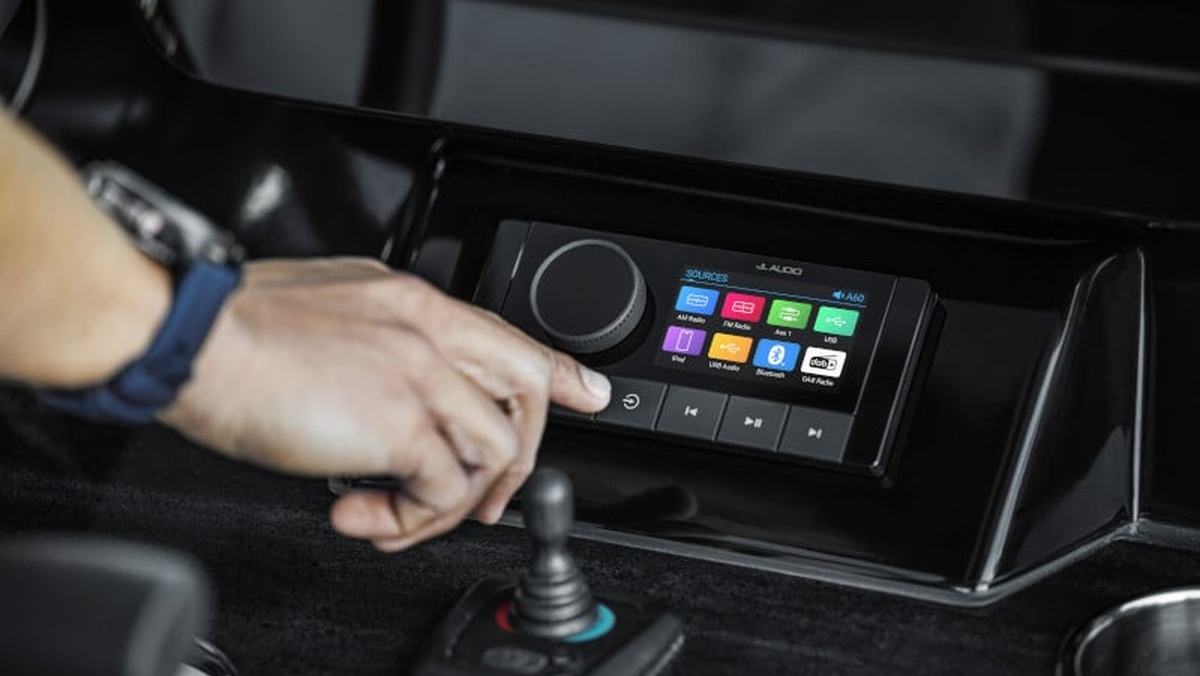
The head unit is the part owners interact with every day, so ease of use deserves equal weight with the specification. The Garmin article identifies the JL Audio A60 and Fusion Apollo MS-RA800 among current options, offering routes to control multiple listening areas and stream from compatible devices. That might let a family enjoy quiet music in the saloon while the cockpit remains silent during a conversation. It also means guests should know how to lower the volume instantly if a call or navigational instruction needs attention.
On a longer boat, separate zones make practical sense because the people aboard may be doing different things at once. The helm must remain a place where alarms, radio traffic and crew communication are clearly heard, irrespective of what is playing elsewhere. A system that relies on phone control alone should still have an accessible, reliable means of turning sound down. Test its behaviour after power interruptions and confirm that no unexpected reconnection resumes playback at an unsuitable volume.
Fit, test and maintain the finished installation
Careful planning should extend to the small details that are easy to miss in a catalogue. Mounting hardware, sealing, cable runs, drip paths and corrosion-resistant connections are essential to a long-lived marine installation. Wiring should remain separate from areas where it could interfere with steering, fuel systems, essential controls or emergency access. A neat visible grille is little consolation if the installation creates a hidden leak or makes future maintenance difficult.
After installation, test the sound from each regular seating position with the boat both stationary and, when conditions safely allow, operating normally. Listen for vibration, harshness, uneven volume and the need to shout over the music. Revisit the settings after the crew has used the boat for a few outings, because real habits differ from a quick trial at the dock. Periodic checks of grilles, fixings and connections will do more to preserve the experience than continually changing the equipment.
Garmin's marine audio guide makes clear just how many routes there are to a sophisticated system, but the sensible choice starts with a simpler question: who needs to hear what, and where? For the majority of leisure boats, good placement, appropriate weather resistance, sound electrical work and straightforward controls matter more than an extravagant component list. The best onboard audio is easy to enjoy and easy to silence when the sea or the skipper requires full attention.