
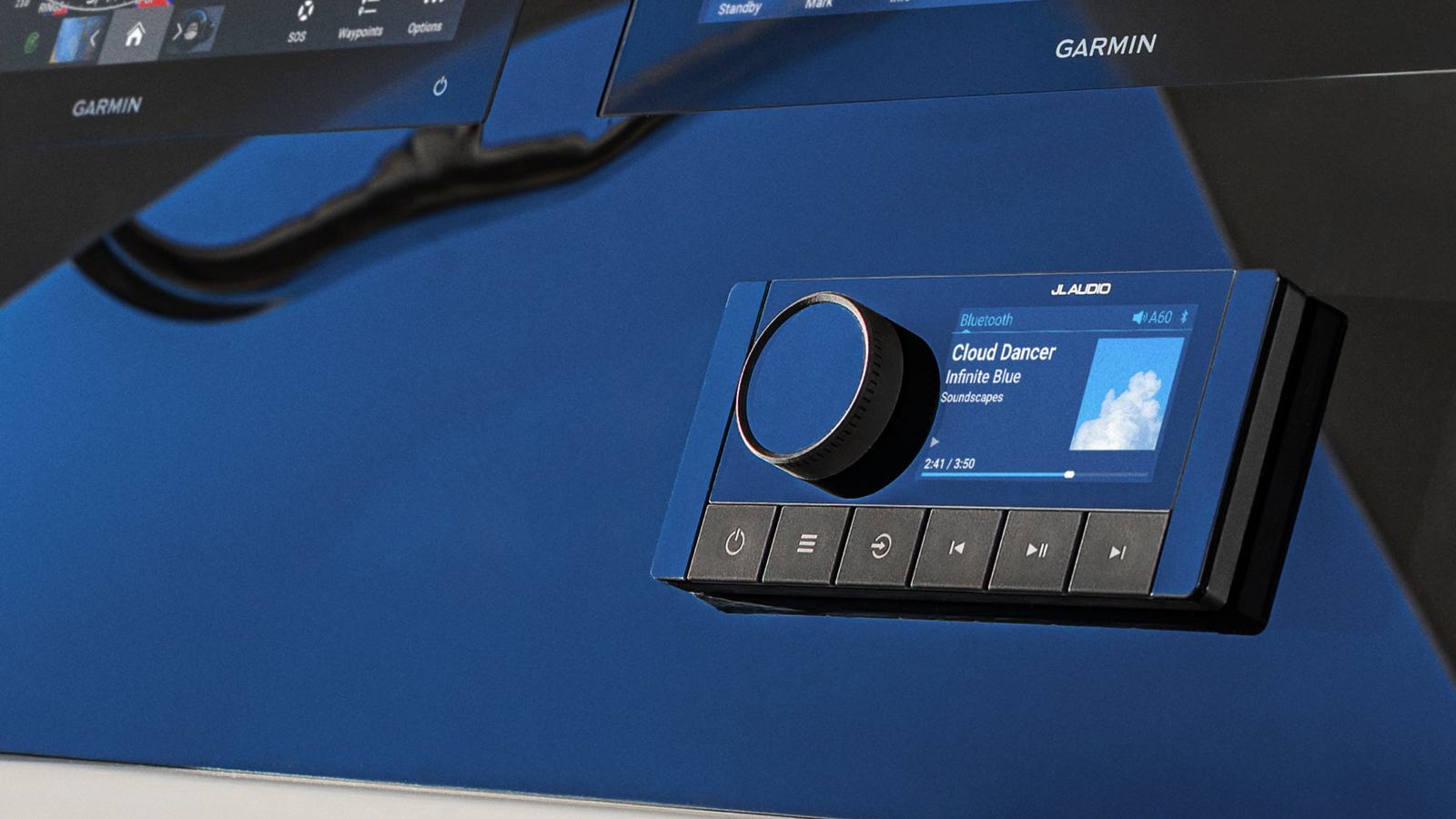
Garmin's JL Audio A60 and A60-H offer four-zone sound and connected controls for leisure boats. We explain the onboard lifestyle benefits, equipment considerations and sound etiquette.
The sound of a good day afloat
Music can make a family boat feel wonderfully relaxed, but a loudspeaker system that suits a car or a living room may behave very differently on the water. Open decks, engine noise, nearby berths and people moving between cockpit and cabin make thoughtful audio control more useful than headline volume.
Garmin's JL Audio A60 marine head units, introduced in September 2026, offer a useful case study in how equipment makers are responding to that challenge. Their defining convenience is separate control over four listening zones, allowing a boat owner to shape the atmosphere without asking everybody aboard to hear the same thing at the same level.
What four zones actually provide
A zone is an individually managed group of speakers rather than a promise that four different songs can always play independently. On the A60 system, owners can adjust sound levels in four areas, making it practical to lower the cockpit volume while people talk near the helm or inside the saloon.
For a dayboat, the important division might be between the main seating area, the stern and a small cabin. On a larger leisure boat, a foredeck lounge, flybridge and main salon can each have different acoustic needs even if all are connected to the same audio installation.
A head unit or a discreet hideaway
Garmin lists two forms of the system: the JL Audio A60 with a built-in colour display, and the A60-H, which is designed to be integrated more discreetly behind a helm or elsewhere on board. The screened unit uses a 2.95-inch colour interface, while the hideaway variant relies more heavily on connected controls.
That choice is about the boat's layout as much as technology preference. A compact helm may benefit from a clean multifunction-display arrangement, whereas a boat with enough panel space could make use of a separate stereo control without repeatedly switching the chartplotter's view.
Digital signal processing is more than an acronym
The A60 line includes digital signal processing, or DSP, and Garmin's Easy Tune features for configuring the audio system. DSP can help balance the output and manage what reaches speakers and subwoofers, which is valuable where one part of a vessel is exposed to open air and another is enclosed.
It does not remove the need to choose suitable speakers, place them carefully or set appropriate levels. A powerful amplifier and good software cannot overcome poor wiring, damaged drivers or mounting positions that direct sound straight towards neighbouring boats.
Controlling music away from the helm
Garmin says owners can use its audio app, compatible marine smartwatches and connected remotes to control the system without standing at the main display. Optional hardware includes an R5 volume controller and an NRX-300 remote, giving different ways to adjust levels without reaching for a phone.
This is especially convenient when the person entertaining guests is not the skipper. Controls should still be arranged so that they do not distract the helmsperson or encourage anyone to operate a touchscreen at an unsafe moment.
The role of NMEA 2000
The JL Audio equipment supports NMEA 2000 networking, allowing compatible marine electronics to participate in the installation. On suitable Garmin multifunction displays, owners can therefore manage audio without dedicating another large section of the dashboard to a separate screen.
Compatibility needs checking component by component, particularly on boats mixing displays and equipment from several generations. An installer should confirm the network power arrangement, supported interfaces and software versions rather than assuming any product bearing a marine label will communicate automatically.
Streaming, radio and connection choices
The line supports Bluetooth LE audio, and Garmin also describes a DAB radio tuner among its features. Digital radio usefulness varies by country and coverage, so owners should check the availability of broadcasts in their cruising area before treating that function as a reason to upgrade.
Streaming from a phone is convenient close to shore or at anchor, but the music itself may already be downloaded or may depend on a data connection. Reliable entertainment plans are generally simple: prepare playlists in advance and make sure everyone knows how to operate volume and source selection.
Built for a marine environment, still requiring care
Garmin lists IPX6 and IPX7 protection for the new head units, reflecting the splashes, moisture and changing conditions familiar aboard leisure craft. Such ratings apply under specified test conditions and should not be interpreted as permission for careless high-pressure washing or poorly protected electrical connections.
A proper installation also needs suitable cable routing, fuse protection, ventilation where specified and access for future maintenance. Salt, vibration and condensation can challenge accessories long before the core electronics show a problem, so regular checks remain sensible.
Good etiquette in shared water
An elegant stereo installation lets owners enjoy music while respecting the setting that attracted them to boating in the first place. Sound travels readily across quiet anchorages and marinas, where another family's evening or a crew's early departure may be disturbed by relatively modest onboard volume.
The useful habit is to reduce sound before approaching a berth, switching to lower levels in quiet anchorages and avoiding the temptation to overpower engine noise with increasingly high volume. Multi-zone control supports that courtesy by letting the social area become quieter without turning off everything inside.
A practical upgrade rather than a status symbol
The A60 and A60-H show how a contemporary marine audio system can make entertaining easier through zoning, integrated controls and more flexible installation. Before buying new hardware, owners should list the speakers they already have, note each zone's requirements and ask whether a replacement head unit is compatible with existing wiring and amplifiers.
The best result may be a carefully adjusted modest system rather than the biggest installation available. On a well-used boat, effortless operation, respectful sound levels and reliable performance across an entire season matter more than how impressive the stereo looks on the equipment list.