
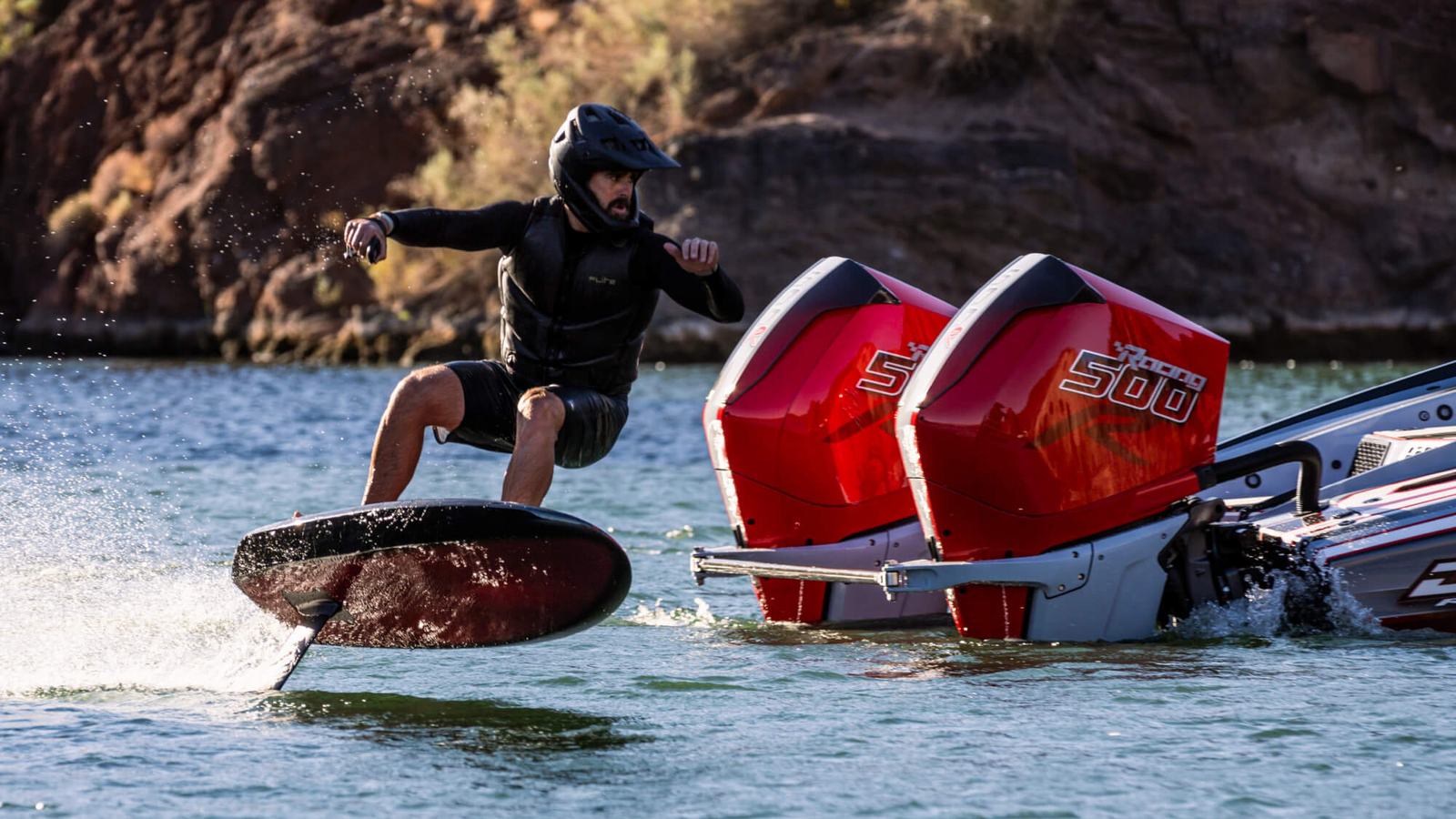
Fliteboard RACE has earned a 2026 Australian Good Design Award. We look at the specialist hull, propulsion and rider-position decisions behind the electric race foil, and what recreational boaters should know.
A different brief for an electric hydrofoil
A leisurely electric-foil session and a competitive run across a racecourse may take place on the same stretch of water, but they demand different equipment. Fliteboard RACE makes that distinction explicit. The Australian-developed board is aimed at more experienced riders who prioritise accurate turns, tracking and speed over the easygoing versatility of a first eFoil.
The design received a 2026 Australian Good Design Award in the Product, Sport and Lifestyle category. That recognition is a useful prompt to examine how racing changes the shape of a watersports product, and what boat owners and families should consider before choosing the most aggressive board in a range.
Why the hull shape matters
The Fliteboard design team has given RACE a longer, narrower hull than a general-purpose eFoil. According to the award entry, this geometry is intended to reduce drag and help the board maintain its direction at elevated speeds. Those goals are familiar to powerboat designers, although an eFoil has to balance them while carrying a standing rider above the water.
Raised rails and a refined rocker are designed for moments when the board touches the surface rather than remaining on its foil. A clean recovery matters because a race run is not simply a straight-line speed test; the rider must keep moving through acceleration, corners and changing water conditions. The design does not remove the need for judgement or technique.
Positioning the rider for control
One of the more revealing details is the recessed deck, which places the rider lower relative to the board. The design team says the lower centre of gravity helps balance and turning precision. That reflects the central challenge of high-performance foiling: movement that feels small at leisure speeds can become much more consequential as the pace increases.
An integrated kicker tail provides a physical reference for foot placement, especially during turns. Such tactile details are easily overlooked when comparing boards online, yet they can shape how confidently a familiar rider repositions their weight. RACE also uses lightweight carbon construction to combine stiffness with low mass, an approach directed at performance rather than casual durability claims.
A propulsion partnership with Mercury Racing
Fliteboard developed the race-oriented propulsion system with Mercury Racing. The project description identifies a custom impeller intended to produce greater thrust and support high-speed operation, together with a re-engineered mast position selected for efficient flat-water performance. It is the combination of hull, foil, propulsion and rider position that defines the concept.
This does not mean every recreational rider needs race hardware. A family buying its first eFoil may be better served by a more forgiving platform, straightforward handling and instruction from a qualified operator. The manufacturer itself positions RACE towards intermediate and advanced users, so experience should be part of the buying decision rather than an afterthought.
What modularity means to an owner
The award submission describes compatibility with several Flitecell battery options. In practical terms, this gives an owner choices around equipment weight and the amount of time they wish to spend on the water, although the right configuration depends on the manufacturer's current specifications and approved combinations. No single range figure should be assumed across all batteries and riding styles.
Compatibility across parts of the Fliteboard system can also matter when an owner already has equipment from the brand. Before buying a different board, however, check the exact generation, battery, wing and propulsion compatibility with the manufacturer or dealer. A headline claim about modular design is not a substitute for a verified parts list.
How a race board fits into boating life
For smaller-boat owners, an electric foil may be one of several activities carried for a sheltered anchorage or a calm-water day. Storage dimensions, lifting weight, charging arrangements, secure transport and the presence of swimmers all affect whether it makes sense aboard. A specialised competition board should be considered alongside those practical limits, not solely on its performance claims.
Launching from a boat also requires a clear separation between the foil rider, propellers, fishing lines and people entering the water. Keep the support vessel stationary where appropriate, follow local operating rules and use the protection and instruction recommended by the equipment maker. Water conditions and other traffic can change faster than a session plan, especially near a busy marina entrance.
What the award tells us—and what it does not
The Good Design Award recognises a deliberate, integrated product design. Its published account describes prototypes tested with accomplished riders, adjustments to the mast and hull, and efforts to make the board's response understandable at racing speeds. That design process is interesting even to someone who has no intention of entering an eFoil competition.
It is not, by itself, an independent guarantee of top speed, runtime, safety or suitability for a particular customer. The published award entry does not establish one universally comparable performance figure for all conditions. Prospective buyers should seek current specifications, trial opportunities and advice on training before comparing RACE with other boards.
An expanding choice for watersports enthusiasts
Electric foiling has developed beyond the question of whether a board can lift clear of the water. Manufacturers can now differentiate between easy learning, surf-oriented riding and specialist racing, much as a boatbuilder separates a relaxed family cruiser from a competition-focused craft. Fliteboard RACE provides a particularly clear example of that split.
For experienced riders, the attraction is the attention paid to tracking, cornering, propulsion and rider feedback. For everyone else, the important takeaway may be that a purpose-built performance board is not automatically the most suitable board for a holiday. The full 2026 award project sets out the design decisions, while Fliteboard's official range and dealer information can help narrow down an appropriate choice.