
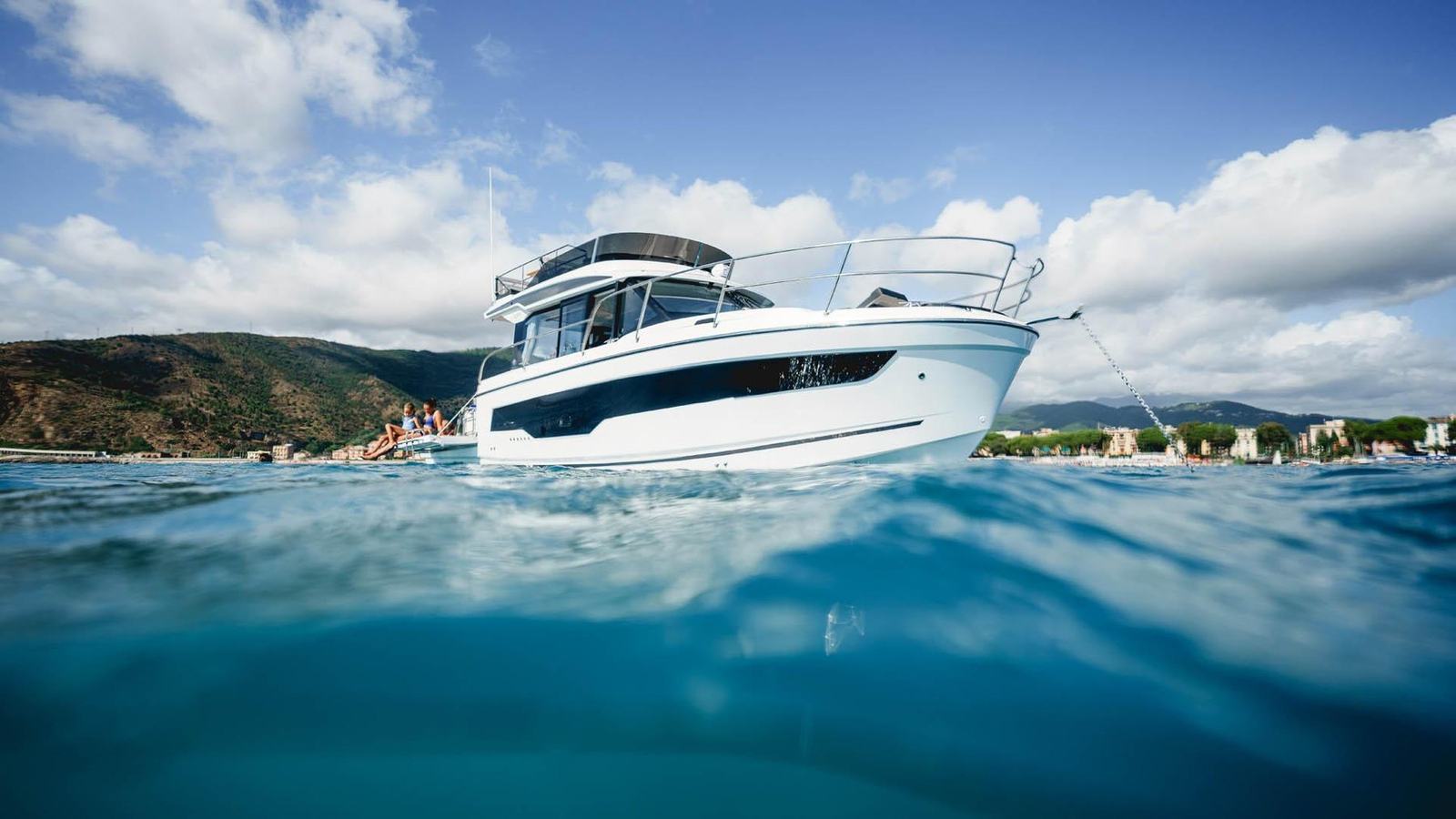
The Jeanneau Merry Fisher 1095 Fly is arranged for family days and overnight stays, with a second outdoor living area on the flybridge, three cabins, a sheltered saloon and a deployable waterside terrace.
Why a second deck changes the family day
The attraction of a family cabin cruiser is rarely confined to speed or a catalogue of optional extras. More often, it lies in the ease with which the boat can adapt when some people want to swim, others want a quiet lunch and someone needs a comfortable place to rest. Jeanneau's Merry Fisher 1095 Fly takes that everyday puzzle seriously. It adds an outdoor flybridge above a sheltered main-deck saloon, giving a relatively compact cruiser two different social spaces and making the transition between travelling and staying at anchor feel more natural.
Jeanneau markets the current model for weekend escapes and visits to coastal towns, a realistic pattern of use for a boat that offers proper cabins without the scale of a large yacht. The design encourages an unhurried itinerary: a short passage in the morning, a swim or lunch at anchor and an overnight stop somewhere new. The point is not that every family will use the extra deck continuously, but that separate spaces allow different activities to happen without competing for the same seat or table.
The flybridge as a second living room
On the upper deck, Jeanneau positions facing benches around an area intended for relaxed conversation and outdoor meals. The forward space can convert into loungers, so the flybridge works for a morning cruise and then for a quieter afternoon at anchor. It also changes how guests see the coastline, since the elevated position offers broader views than a cockpit close to the water. For families who enjoy being outside together, that extra perspective can become as memorable as the destination itself.
A flybridge is most useful when everyone understands its limitations. Movement between decks requires care, especially in choppy conditions, and parents should consider access steps, handholds and appropriate seating before inviting younger children upstairs. Weather can also change the value of an exposed upper deck, so the enclosed saloon below remains important. The smartest weekend plan uses both spaces deliberately: the flybridge when conditions suit and a readily accessible sheltered area when the wind picks up or a longer passage becomes tiring.
A forward lounge and a larger swimming platform
The bow is treated as a real destination rather than simply a working foredeck. Jeanneau describes integrated sun loungers, opposing seating and safe access routes designed for moving about with family members of different ages. The exact way this area is used will depend on whether the boat is underway or safely secured, but the intention is obvious: create places where people can sit together while still feeling close to the sea. A sheltered bay turns the forward seating into somewhere to read, talk or take in the view.
Aft, the builder specifies a deployable 1.75-metre terrace that opens out at anchor, increasing usable space near the water. That can simplify swimming sessions, boarding a tender or simply sitting at the edge of the boat after a hot afternoon. Families should establish how the mechanism is operated, how it affects the boat's clearance and which safety procedures are needed before children approach the water. The feature is attractive because it expands the useful part of the weekend without demanding a much larger permanent hull.
A saloon that stays part of the conversation
Jeanneau has arranged the galley lengthways, extending it towards the cockpit with a bar that supports shared meals and easier serving. This is more than a style decision. A galley tucked away in a separate compartment may keep cooking out of sight, but it can also isolate whoever is preparing food from the people enjoying the trip. An arrangement connected to the cockpit lets breakfast, cold drinks and evening meals become part of the same social gathering, while making it simpler for a small crew or family to move between spaces.
The main-deck pilot seat can be specified with a rotating function, helping the helm area join the saloon when the boat is at rest. Jeanneau also lists an integrated television, although the outside views and the ability to open up the space may be more compelling on a good day. Owners should judge sightlines, ventilation, storage for food and safe movement around the cooking area in person. The practical test is whether someone can make a simple meal while others pass through the cabin without creating confusion around the helm or galley.
Three cabins for flexible overnight plans
The model's published layout includes three cabins, which distinguishes it from dayboats that ask everyone to sleep in one converted saloon. The owner's cabin has a berth accessible from both sides and direct access to the head compartment, while a separate cabin provides twin beds that can suit children or two guests. Jeanneau also emphasises natural light, considered storage and finishes meant to make the sleeping areas more inviting. When the family is spending several nights afloat, a dedicated berth becomes much more useful than one that has to be dismantled every morning.
Accommodation on a boat of this size still requires realistic packing. Soft luggage, sensible clothing choices and a place for damp towels can make an enormous difference to the mood of a weekend. The builder lists a 160-litre water capacity with an additional option, so owners should plan around actual tank specifications and consumption rather than assuming endless freshwater. Families contemplating longer stays may wish to consider refrigeration, charging arrangements, ventilation and the available shower facilities together. Comfortable cruising is often the sum of many modest practical decisions.
Planning routes around the boat, not the brochure
Jeanneau's model page gives 10.45 metres overall length, 3.37 metres beam and a 0.66-metre published draft, together with fuel capacity in two 370-litre tanks. These are the current online figures for the stated model page; editions, markets and optional equipment may carry different specifications, so the actual dealer sheet and builder's plate should be used for passage and berth planning. The stated CE ratings include Category B for seven persons and Category C for ten, and operators should understand the limits that apply to their own boat and waters.
A useful family itinerary begins with realistic time under way, dependable weather and a comfortable place to spend the night if plans change. An elevated flybridge creates wonderful cruising memories, but it does not remove the need for navigation preparation, safety equipment or supervision near the water. The Merry Fisher's value lies in offering flexible spaces for the ordinary pleasures of boating: shared meals, safe swimming, afternoon reading and a peaceful night's sleep. It is a compact reminder that a successful weekend afloat depends more on how the boat is used than on the number of features advertised.
Official boat information and photograph: Jeanneau — official Merry Fisher 1095 Fly model information. Check equipment and current specification with Jeanneau or an authorised dealer.