
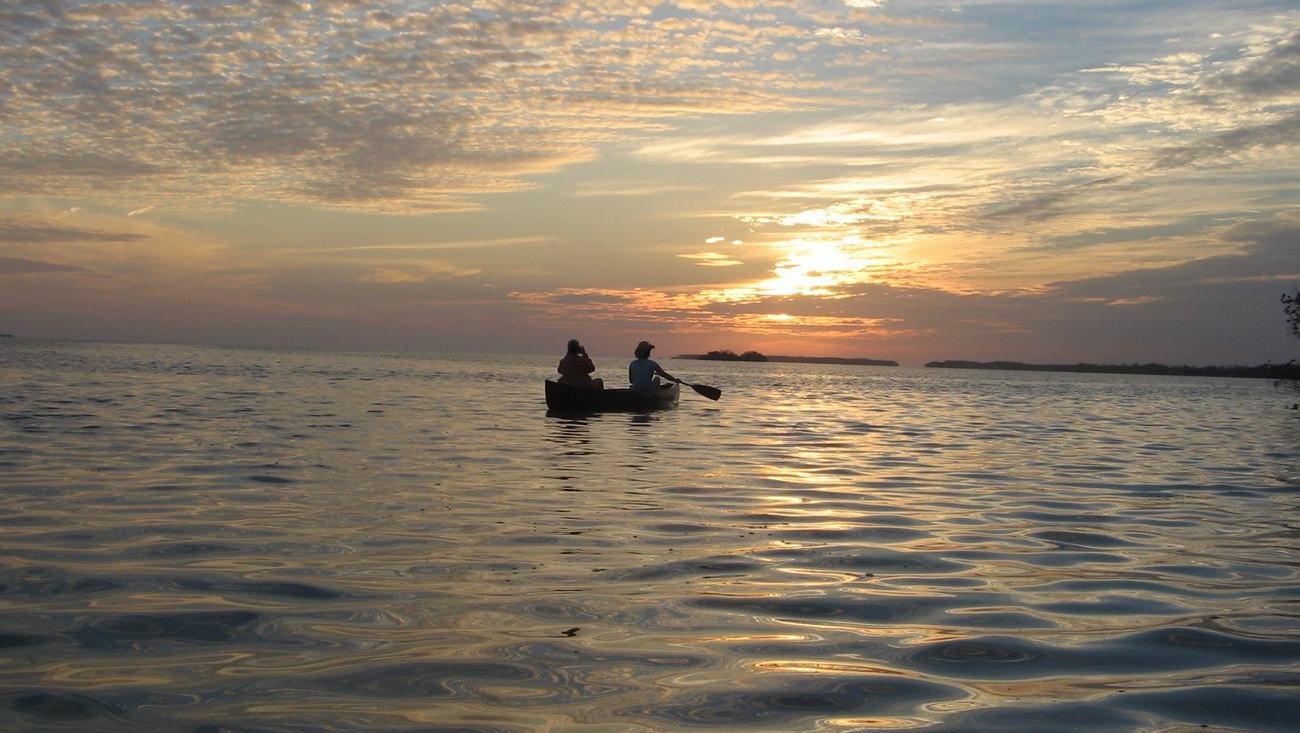
Everglades National Park offers paddling among freshwater marsh, mangrove tunnels and Florida Bay, with routes varying enormously in difficulty and exposure.
A different way to experience Florida's wetlands
The Everglades are often pictured as a vast landscape of grass and slow-moving water, but a canoe reveals far more variety than that image suggests. Paddlers can explore freshwater marsh, mangrove passages, open bays and the remarkable maze of islands along the Gulf Coast. The US National Park Service identifies opportunities ranging from short outings to multi-day journeys, allowing visitors to choose a route that suits their experience rather than committing to one ambitious itinerary.
A small craft is especially valuable here because the environment is made of narrow waterways, shallow stretches and expansive open water rather than one continuous channel. It can also be demanding. Heat, insects, changing water levels and the difficulty of recognising a route in dense vegetation all require planning. The park should be approached as a living ecosystem rather than a theme-park ride.
Flamingo provides several starting possibilities
The Flamingo area lies approximately 38 miles from the park entrance near Homestead and offers access to a selection of marked canoe and kayak trails. Some explore mangroves and sheltered water, while others lead toward the much broader setting of Florida Bay. The Park Service publishes details of designated trails, and the current route information should guide the choice of launch and destination.
Flamingo also offers rental options through its concession arrangements, while private businesses around Everglades City may supply equipment for outings near the Gulf Coast. Visitors without the right skills can book a permitted guide, gaining useful local knowledge while reducing the temptation to navigate unfamiliar water alone. Hiring a guide is not a guarantee of perfect weather, but it can simplify the practical decisions.
Nine Mile Pond illustrates the quieter side
Nine Mile Pond is one of the park's well-known paddling environments, where marked routes can give visitors a closer view of marsh vegetation and sheltered waterways. The experience differs greatly from a wide coastal crossing: movement may be slow, and the interest lies in the details of the environment rather than in speed. A canoe offers a natural platform for observation when the crew moves calmly and follows the permitted route.
Water levels and maintenance of trail markers can change how straightforward a journey feels. An older map may not reflect recent conditions, particularly following storms or seasonal variations in freshwater flow. Paddlers should consult the park before departure and take appropriate navigation equipment rather than relying entirely on the visibility of the next marker.
Florida Bay demands broader-water awareness
The photograph published by the National Park Service shows a canoe silhouetted on Florida Bay near sunset. It captures the attraction of the place, but an appealing view should not encourage a late return by an inexperienced crew. Florida Bay is open and shallow in many areas, with wind capable of producing difficult conditions for a small paddlecraft even when the coastline is not far away.
Tides, submerged banks and the effects of wind all influence safe passage. A person familiar with paddling on a sheltered lake may find the bay more challenging, especially if the route crosses open water without nearby landing options. Planning should be conservative, with an early turning point and a reliable means of contacting assistance if needed.
The Ten Thousand Islands invite careful navigation
On the Gulf Coast side, a network of mangrove islands and tidal channels can create a sense of exploration unlike a simple lake circuit. It is also easy to underestimate the complexity of the area. Similar-looking passages may lead in different directions, and changing currents can complicate the return. A guided trip is an excellent way to experience this landscape when the visitor is new to coastal navigation.
Some travellers use the area as part of a multi-day paddling adventure. That level of journey requires more than ordinary day-trip supplies: camping rules, drinking water, food storage, waste arrangements and communication plans must all be considered. An experienced local outfitter or park ranger can help identify permitted camps and explain the particular hazards of the chosen route.
The Wilderness Waterway is not a casual extension
The park also describes the 99-mile Wilderness Waterway, a demanding backcountry route that can take several days. Its scale is a reminder that the Everglades contain very different forms of recreation within one protected area. A family visiting for the weekend should not regard such a route as the next step after a brief trial paddle without gaining substantial experience first.
An extended journey needs careful assessment of campsites, weather, tides and supplies, with permits where required. Emergency support may be distant and mobile coverage inconsistent. For most first-time visitors, choosing a shorter designated route or a guided trip provides a richer and more relaxed introduction to the landscape.
The wildlife should set the pace
Birds, fish and other animals are part of the attraction, and a quiet canoe can make observation possible without engine noise. That advantage brings responsibility. Visitors should avoid approaching or feeding wildlife and never assume an alligator or other wild animal will remain motionless merely because it appears calm. Maintaining distance is safer for both the paddler and the animal.
Shallow marsh and mangrove vegetation also need protection from careless landings and dragging a hull through sensitive areas. A small boat can still cause damage when its crew is impatient. Photographs are best taken from a secure seated position with a lens suitable for distance, keeping hands and feet inside the craft.
A memorable visit begins with a modest plan
The Park Service's canoe and kayak guidance is the correct source for current trail details, access and authorised rental providers. A visitor should check that information immediately before departure and study the latest local forecast. Suitable flotation devices, sun protection, water and a float plan are essentials even on a route that seems short on a map.
The Everglades reward a quieter mindset: listening, watching and accepting that movement through wetlands takes time. A well-chosen route can reveal scenery and wildlife that are difficult to appreciate from a road. The best small-boat holiday here is not the one covering the greatest distance, but the one that allows the paddlers to return safely with a better understanding of the place.