
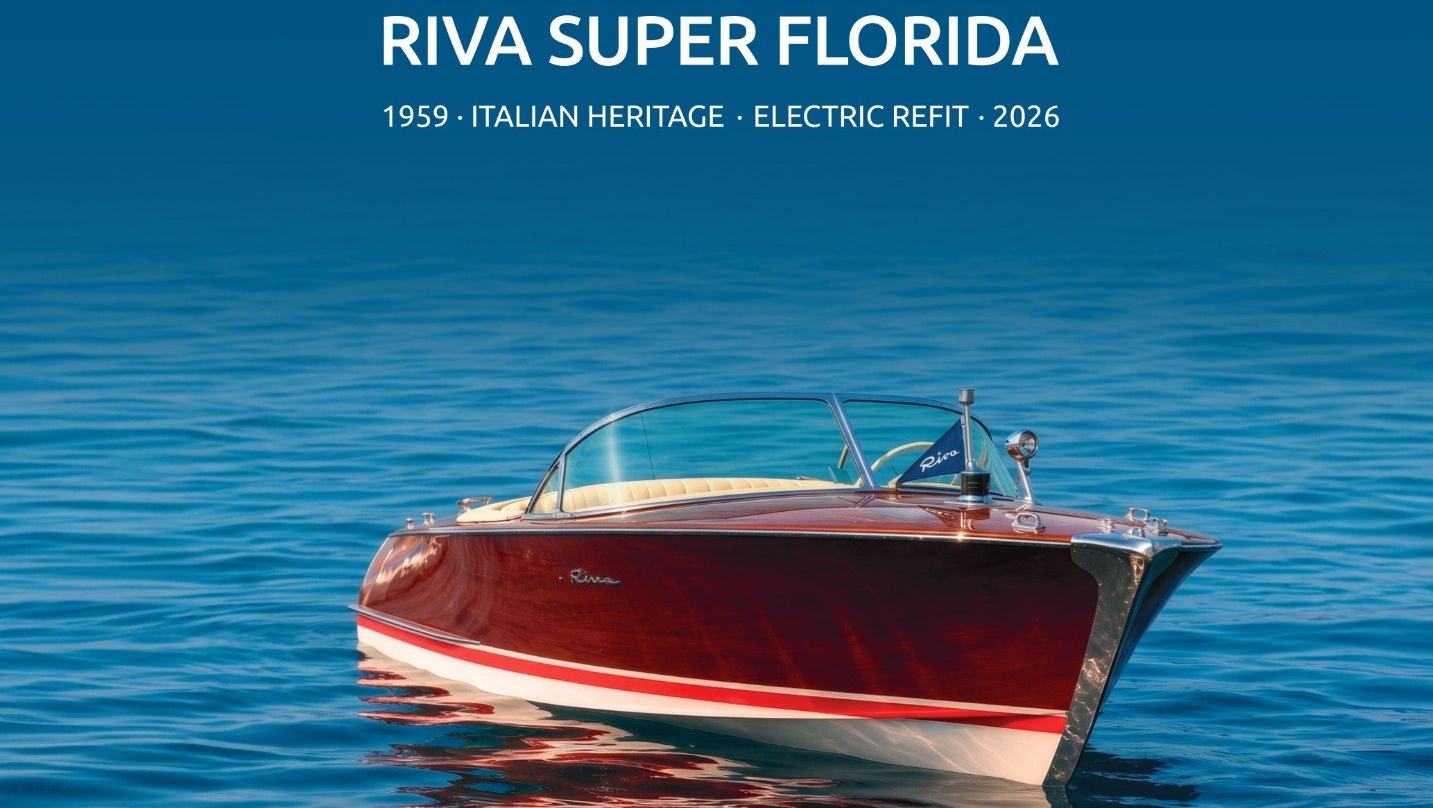
The electric conversion of a 1959 Riva Super Florida at Valencia Boat Show offers a revealing case study in refitting an older boat: careful surveying, mass distribution, propulsion integration and charging plans.
A 1959 boat with a very modern powertrain
A varnished wooden runabout is not the obvious starting point for an electric-propulsion demonstration. Yet at Valencia Boat Show in October 2026, engineering company ISER e-Marine presented EM-001, a converted 1959 Riva Super Florida, as an example of how a classic boat can retain its visual character while using a new source of power. The project concerns hull number 402, a six-metre boat whose original six-cylinder engine has been removed. In its place is an electric system, described by the event organiser as a 50-kilowatt motor supported by 46 kilowatt-hours of batteries. It is a striking change, but the practical lessons extend far beyond the polished exterior.
The useful idea for owners is that repowering a classic is an engineering project, not simply a search for a motor with a matching shaft. ISER says it treats the boat as a connected system of propulsion, energy storage, electrical distribution and controls. Any successful conversion must respect existing structure, the way the hull sits in the water and the boat's normal operating pattern. A short-distance harbour launch, a long-range coastal cruiser and a weekend fishing boat would require different solutions. The Riva shows one carefully described approach, not a kit that can be copied directly into every hull.
Start with the boat that actually exists
According to ISER founder Jaime Cardells in the show organiser's 30 October report, the team first scanned the Riva and produced detailed plans. The purpose was to design the installation around the individual boat and preserve its handling characteristics and centres of gravity. That is an important sequence for any older vessel. Original drawings may be missing, prior repairs may have altered internal spaces and decades of modifications can leave the actual weight distribution different from factory assumptions. A qualified marine survey, documentation of structure and existing systems, and a measured weight inventory should precede a decision about batteries or motor power.
The survey should also consider how a new installation might affect access for maintenance. Owners should document the condition of wiring, fuel systems, shaft bearings, mounts, ventilation and hull penetrations before removing anything. The goal is not to modernise every original detail automatically. It is to understand what can remain, which components need replacement and what changes must be reversible or recorded to protect the boat's heritage and future serviceability.
Weight and balance are more than calculations on paper
Replacing an internal-combustion engine and fuel tank with a motor, batteries and power electronics changes the distribution of mass. Even when the total weight looks reasonable, concentrating batteries farther forward, higher or to one side can alter trim and stability. Cardells specifically identifies the preservation of the Riva's centres of gravity as part of the design brief. That is why a conversion should be assessed using an actual weight-and-balance calculation, including people, gear and the usable battery system, and followed by appropriate inspection and handling trials by competent professionals.
The battery enclosure and its supporting structure matter just as much as the motor's nominal output. A historic hull cannot be assumed to have mounting points designed for modern high-energy packs. The installer must consider secure retention in rough water, protection from spray and immersion, temperature management, isolation, electrical fault response and service access. A tidy motor room photograph is encouraging, but cannot show how these requirements were satisfied. Before signing a contract, an owner should ask for drawings, equipment documentation and a clear statement of which safety standards and approval procedures apply to the finished boat.
Energy capacity is not the same as range
The project's published figures are 50 kilowatts of electric propulsion and a 46-kilowatt-hour battery bank. Those quantities answer different questions. Motor power describes the propulsion system's rated output; battery capacity describes stored energy. Neither gives a reliable number of nautical miles on its own. Range will depend on hull speed, propeller and drivetrain efficiency, wind, current, load, usable battery capacity and the reserves an operator keeps for unexpected delay. For an older planing runabout, energy demand can change sharply across the speed range, making one headline range figure particularly misleading.
Classic-boat owners considering electric propulsion should request a trial programme with measured consumption at several realistic cruising speeds. Ask what happens with a headwind, a full complement of guests or a return trip against current. How much energy remains when the indicated battery percentage reaches the recommended minimum? Is a reduced-power mode available, and how will a crew know that it has been activated? The performance case becomes credible when it includes a repeatable test load and a conservative reserve policy. The Valencia presentation gives a useful hardware example, but the sources reviewed do not publish independently tested range or recharge times for this Riva.
Charging should be designed into the ownership plan
An electric refit changes daily routines ashore as well as the experience underway. Before work begins, the owner needs a realistic place to charge, compatible shore connections and an understanding of available electrical capacity. A boat that spends nights at a marina slip may have a different charging plan from one on a trailer or mooring without power. The installation needs protection appropriate to the marine environment, clear operating instructions and a method for monitoring charging safely. A technician should confirm shore-power compatibility, isolation and fault protection for the specific system rather than assume a domestic electrical arrangement is sufficient.
The financial case requires more than comparing the price of electricity with fuel. A responsible budget includes the engineering survey, motor and batteries, mechanical adaptation, charging work, certification, insurance, maintenance training and eventual component replacement. The owner should also establish who will support the installed equipment if the original converter is unavailable years later. Reduced local exhaust during operation is a genuine distinction of electric propulsion; a broader environmental assessment must also account for electricity production, batteries and the longevity of the preserved boat.
Preserving the character, proving the result
ISER's own EM-001 project page records the old engine, the transition work and the integrated electric equipment. Its emphasis is on keeping the Riva's identity while changing the way it moves. That is a different ambition from fitting the highest possible motor output to a modern hull. Heritage boats need sensitivity to their proportions, weight, materials, original fittings and the historical significance of the machinery being removed. A specialist owner may wish to retain the original engine and associated components for archival purposes, subject to practical storage and preservation arrangements.
The Riva Super Florida conversion was shown at Valencia's 2026 exhibition as ISER e-Marine's first seagoing project after work on fishing boats in the Albufera lagoon. It deserves attention as a documented example of integrated engineering, but the public presentation is not a substitute for independent inspection, sea-trial evidence or owner-specific calculations. Anyone contemplating a similar refit should begin by choosing a qualified surveyor and experienced marine electrical integrator, then establish the intended use before ordering components. The most respectful modernisation is one that preserves a classic's essential character and leaves the crew with a safe, understandable boat they can genuinely use.
Sources: ISER e-Marine EM-001 project and the Valencia Boat Show organiser report. The conversion described is one case study. Marine-electrical design, vessel approval and sea trials should be addressed by qualified specialists.