
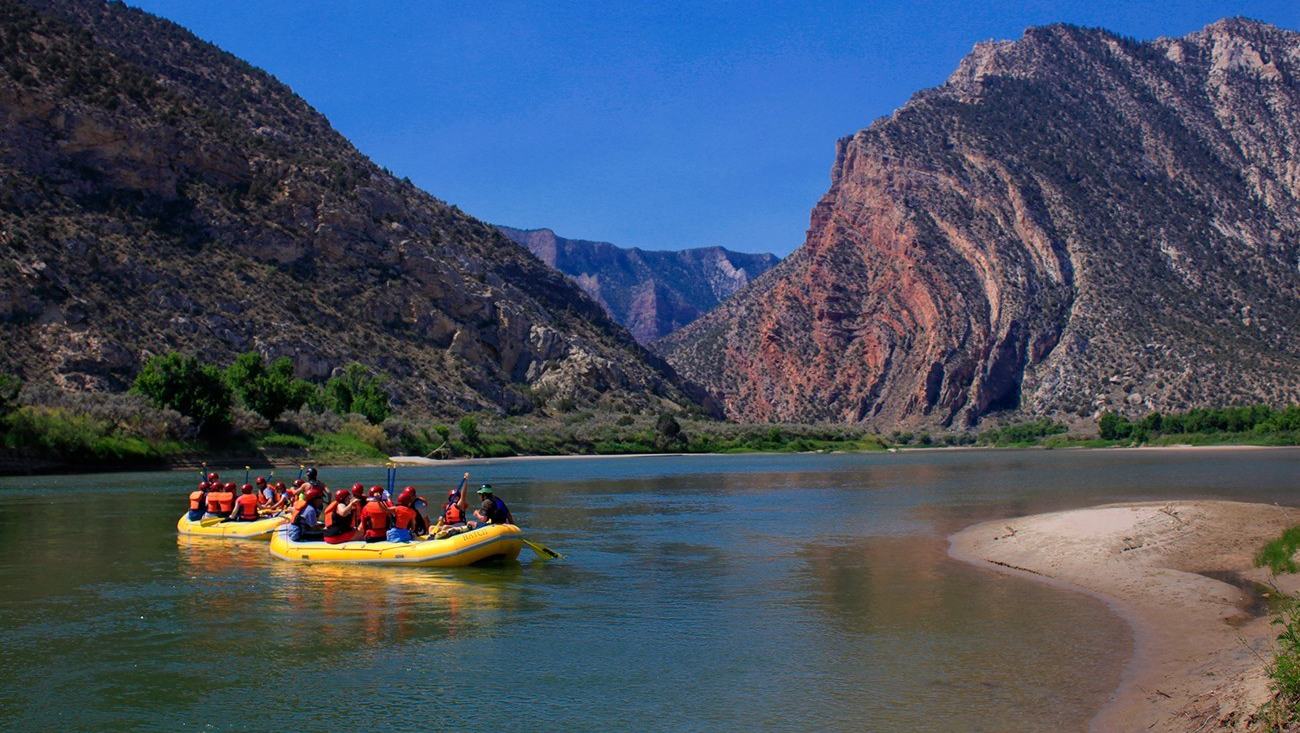
Dinosaur National Monument offers memorable guided rafting through the Green and Yampa River canyons, with one-day and multi-day options for different visitors.
Red canyon country seen from the water
Dinosaur National Monument spans parts of Utah and Colorado, where the Green and Yampa Rivers cut through remote canyon landscapes. Rafting offers visitors a way to appreciate the cliffs, quiet beaches and changing river conditions from a small craft rather than a viewpoint above the water. The National Park Service presents guided river trips as one of the most memorable ways to explore the monument.
The experience can be peaceful in one stretch and demanding in another. These are not uniformly placid rivers, and the character of a trip depends on the chosen section, water level and guide. A visitor should think about the group's comfort with moving water and the amount of time available before choosing between a single day and a multi-day journey.
A one-day introduction through Split Mountain
The Park Service identifies authorised one-day trips that generally begin around Rainbow Park and follow the river through Split Mountain Canyon. These excursions provide an opportunity to experience the canyon without spending several nights away from developed facilities. A guide manages the route and explains the paddling and passenger arrangements, leaving visitors more time to enjoy the surroundings.
A one-day booking still requires appropriate clothing and a willingness to follow instructions. Whitewater activity can involve splashes, sudden movement and periods of physical effort, even when the crew is not expected to steer the raft independently. Travellers should confirm the age, swimming and health requirements of the specific authorised outfitter before booking.
Longer journeys from Gates of Lodore
Multi-day guided trips may launch from Gates of Lodore or Deerlodge Park, moving through canyon sections that are difficult to visit by road. These journeys can combine time on the river with overnight camping, allowing travellers to appreciate how light and weather change the appearance of the cliffs. Their greater length also introduces practical decisions about food, shelter and group comfort.
A multi-day adventure may be rewarding for people who enjoy camping and the rhythm of river travel, but it is not the automatic best choice for every family. Travellers should ask what equipment and supplies are included, how toilets and waste are managed, and whether the overnight arrangements meet their needs. Extra time does not eliminate the physical demands of rafting.
Authorised guides make a significant difference
Dinosaur National Monument permits commercial river operators to lead groups through specified sections. The NPS maintains information about companies authorised to provide these experiences, helping visitors identify operators working under the park's management arrangements. Guides bring river-reading skills, local knowledge and established safety procedures that can be especially valuable to first-time guests.
The correct operator should be able to explain the route's likely difficulty, the seasonal range of flows and the reasons a trip might be cancelled or altered. Passengers should not feel pressured to take a more demanding itinerary than they are comfortable with. A responsible guide's judgement is part of the value of an organised excursion.
Private rafting requires a different level of preparation
The Park Service allows noncommercial river trips under a permit system, but notes that trip leaders must have experience on comparable rivers. Certain rapids can reach demanding classifications depending on water level, and private groups must provide the necessary equipment and safety capacity. This is fundamentally different from a visitor booking a seat with an authorised guide.
Permits are required for river trips within the monument, with particular arrangements for day and multi-day journeys and some opportunities allocated through a lottery. Anyone contemplating an independent trip should study the full NPS regulations and avoid assuming that owning an inflatable raft confers the experience needed to operate it in a remote canyon.
Water level shapes the journey
Flow affects current speed, the position of hazards and the technical nature of rapids. A calm-looking section in a photograph may be quite different when the river rises or falls, while another part of the journey may become harder as submerged obstacles emerge. Guides use current conditions and the capability of their group to decide how to navigate.
Seasonal weather can also influence the comfort of passengers and the logistics of reaching a put-in. Travellers should pack clothing appropriate to being wet and exposed, protect essential items and establish what rescue equipment is supplied. A float on a warm afternoon should not be planned around the assumption that every rapid will be gentle.
A protected landscape deserves care
The river corridors contain geological, cultural and ecological resources that are central to the monument's significance. Rafting groups should use permitted landings and campsites, carry out waste and avoid damaging vegetation or disturbing wildlife. Camping in a remote canyon is an opportunity to appreciate quiet surroundings, not a reason to leave a visible trace behind.
The National Park Service manages permit numbers and group requirements partly to protect these resources. Visitors benefit from that stewardship because the experience remains closer to wilderness than a heavily developed tourist attraction. Following guide instructions on beaches, campfires and sanitation contributes to preserving the landscape for later travellers.
A small raft in a vast landscape
The official NPS photograph shows real rafts moving beneath tall coloured canyon cliffs, precisely the sort of scene visitors may encounter on a suitable guided trip. It is a genuine record of the activity, not a diagram or unrelated illustration. Its beauty should be viewed together with the knowledge and preparation needed to make the journey safe.
For a holidaymaker, the simplest next step is to consult the park's commercial guided-trip guidance and choose an authorised operator with an itinerary suited to the group. Dinosaur National Monument offers a memorable combination of small-boat activity and canyon scenery. The strongest experience leaves room to appreciate both while accepting that the river, not the travel brochure, determines the conditions.