
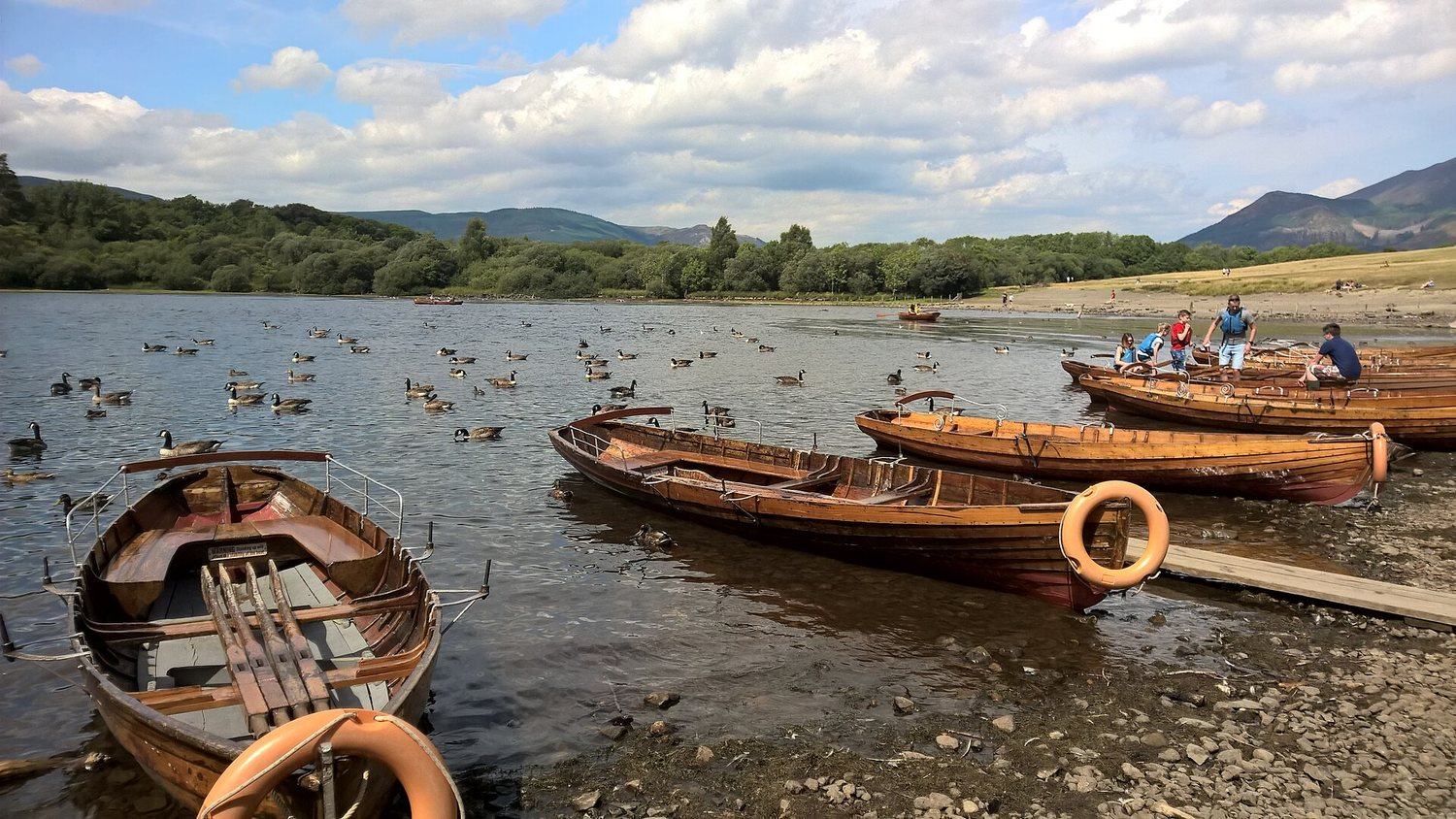
Derwentwater rewards small-boat visitors with Keswick's accessible waterfront and Lake District scenery, but the islands are closed to public access.
A modest lake with extraordinary scenery
Derwentwater sits immediately south of Keswick in the English Lake District, framed by fells, woodland and the well-loved view from Friar's Crag. It offers one of the most inviting settings for a small boat in the national park, particularly for people who prefer a rowing boat, sailing dinghy, kayak or quiet motorboat to a powerful cruiser. The lake is large enough for an interesting afternoon yet manageable if the skipper chooses a modest route. Enjoyment depends on weather, safe access and a realistic understanding of the shared water.
Boating here should not be approached like taking a fast craft across an unrestricted reservoir. Official information places a ten-mile-per-hour limit on powered boats and states that the lake's islands are not open for visitor access. Those two details change how a trip should be imagined. An island may make a striking subject for a photograph but should not automatically become a picnic landing. The best plan concentrates on the open water, views and authorised shore facilities.
Keswick is a useful starting point
Keswick provides convenient amenities close to Derwentwater, and its waterfront is associated with rowing boats and the Keswick Launch passenger service. Visitors do not necessarily need to transport a private boat to enjoy an outing. For a short holiday, hiring a craft can reduce concerns about trailer access and storage while keeping the experience focused on the water. Each hire operator may have specific operating boundaries, weather restrictions and boarding arrangements. Ask for a clear safety briefing even when the boat looks simple to control.
Owners bringing a trailer must not assume that a public footpath to the shore is also an approved launch site. Identify the permitted access, any fee and the parking arrangements before setting off. This is especially important with larger vehicles on the narrow roads around the lake. Consider how long recovery will take if wind rises during the afternoon. A simple, calm launch followed by a short journey often produces a better day than a complicated itinerary that consumes most of the available time.
Ten miles per hour is a ceiling, not a target
The National Park's Derwent Water byelaws set a maximum speed of ten miles per hour for power-driven craft, apart from defined exceptions. This is an ordinary miles-per-hour rule, not a nautical-mile figure or a suggestion to use full throttle whenever the route appears empty. A vessel under engine power is a powered boat even if it also carries sails. Skippers should check the published rules before operating and remain alert to any current local notices or designated constraints.
At a landing stage or near a paddleboarder, a responsible speed may be much lower than ten miles per hour. Wake can unsettle a rowing boat and spoil the experience for visitors in small craft. Keep a predictable course and leave generous room for turning passenger boats. The quiet nature of Derwentwater rewards skippers who travel without rushing. If a trip cannot be completed comfortably within the speed limit and forecast, shorten it rather than trying to recover time later.
Do not plan an island landing
The Lake District National Park's activities guide clearly states that there is no access to islands in Derwentwater. The rule is a vital distinction from lakes where small craft can use islands as informal stopping places. Islands may contain sensitive habitats or be managed for conservation. A low-draught dinghy able to reach a shallow shoreline does not confer permission to land. Visitors should admire the islands from the water and select an authorised mainland stopping point if their outing includes a walk or picnic.
An island should also not be treated as a reliable emergency refuge without considering the actual situation and applicable rules. Safe passage planning means knowing where permitted landing facilities are located and keeping the distance within the crew's capabilities. If unexpected wind or illness makes the return difficult, alert the relevant service or emergency responder instead of improvising a landing that could create further risk. Good preparation respects both personal safety and the special character of the place.
The Keswick Launch is part of the waterway
Passenger launches operate scheduled trips around Derwentwater, with stops including Keswick, Ashness Gate, Lodore, the Brandelhow area and Hawes End when services are running. The route offers an attractive alternative for visitors who want to experience several views without controlling a boat. For small private craft, the launches are another reason to take care around approaches, jetties and narrow passages. A large vessel committed to a landing may have limited ability to avoid a dinghy crossing close ahead.
Commercial stopping points are not automatically public moorings for privately owned boats. Check the operator's current route and access arrangements, particularly outside the main holiday season. If a shore excursion matters more than spending time at the helm, the passenger service may be the sensible choice. A skipper who plans to remain afloat can still enjoy the changing shore scenery without trying to reproduce a commercial schedule in a much smaller craft.
Friar's Crag and the southern views
The view near Friar's Crag is among the enduring images of Derwentwater, combining open water and mountains beyond the wooded shoreline. From a small boat, familiar landmarks become part of a changing panorama rather than a single framed photograph. A relaxed course along a suitable part of the eastern or southern shore can give the crew time to watch the light shift over the fells. There is no need to approach the bank closely to enjoy the scenery.
Keep a safe distance from swimmers, submerged rocks, other boats and any sensitive vegetation. Take particular care if a camera distracts passengers from sitting securely. In an open rowing boat, somebody reaching over the side can alter balance unexpectedly. If the purpose of the day is photography, let another person handle the camera while the skipper concentrates on navigation. Good views are not worth a grounding or a collision.
Lake wind can surprise a small crew
Surrounding fells can channel gusts over the surface, making an outward rowing or paddling leg deceptively easy and the return much harder. A crew may be close to a developed town on the map but still be exposed to cold water and difficult conditions in the middle of the lake. Check the forecast, note the direction of prevailing wind and decide how far the least experienced passenger can reasonably travel. Keep enough reserve strength or propulsion to return against unfavourable conditions.
Buoyancy aids or lifejackets should be appropriate and worn, particularly in open dinghies and kayaks. The water can remain cold even on a pleasant summer afternoon. Carry warm clothing in waterproof storage, know how to raise the alarm and give somebody ashore a proposed return time. The decision to turn back early is especially sensible when children are aboard. A destination is not a competition, and weather can make a short outing the more skilled choice.
An orderly rowing-boat day
For a first family visit, a rowing boat hired near Keswick can be a good way to experience the lake without complicated equipment. Confirm how the oars are fitted, whether a bailer is provided and how the boat should be returned if the wind becomes stronger. Keep passenger weight balanced and do not let children move from side to side without warning. The skipper should practise turning, stopping and returning to a pontoon before going beyond easy shelter.
An afternoon can be built around a short circuit with time to observe the wooded shore and passing passenger launches. Do not set out for a distant view without accounting for how long the return will take under human power. A dry bag for clothing, water and a protected phone can be useful, but only when it does not overcrowd the boat. A smaller plan leaves more energy for enjoying Keswick after the boat has been handed back.
Respect the lake and other visitors
Derwentwater is within a protected national park used by walkers, paddlers, anglers, residents and holiday visitors. Travel gently near quiet shorelines, avoid creating wake that disrupts other boats and do not disturb birds for a close photograph. Dispose of rubbish ashore and carry away fishing line or damaged equipment. The absence of island landing permission is part of that broader approach to protecting a place valued for its wildlife as well as its scenery.
Private lakeside property should be respected in the same way as on land. A beach that looks reachable may not be available for public use or suitable for landing. Read the National Park's map and activities guidance, and follow instructions at authorised piers. A well-managed shoreline can support many visitors if each crew avoids treating every inviting point as an unrestricted stopping place.
A memorable day without a long route
Derwentwater makes a compelling small-boat destination because of the combination of Keswick's accessibility, beautiful mountain views, rowing and sailing traditions and passenger-launch heritage. Its regulations set sensible boundaries: a ten-mile-per-hour maximum for powered craft and no access to islands. Those facts should shape an itinerary rather than be discovered by accident once the boat is on the water. A short circuit can capture the character of the place without an ambitious crossing.
Before visiting, check the official byelaws, allowed launching arrangements, operator hours and local weather. Wear suitable flotation and plan the return with adequate time and energy. Visitors can then concentrate on the changing scenery and pleasure of slow movement through a dramatic landscape. A successful Derwentwater outing is one where the environment remains undisturbed, the boat is recovered safely and everyone has enjoyed the lake rather than merely travelled across it.
Sources: Lake District National Park Derwentwater byelaws and official lake activities guide. Photograph: rowing boats on Derwentwater by Chris Morgan, Wikimedia Commons, CC BY-SA 2.0; resized for web publication.
