
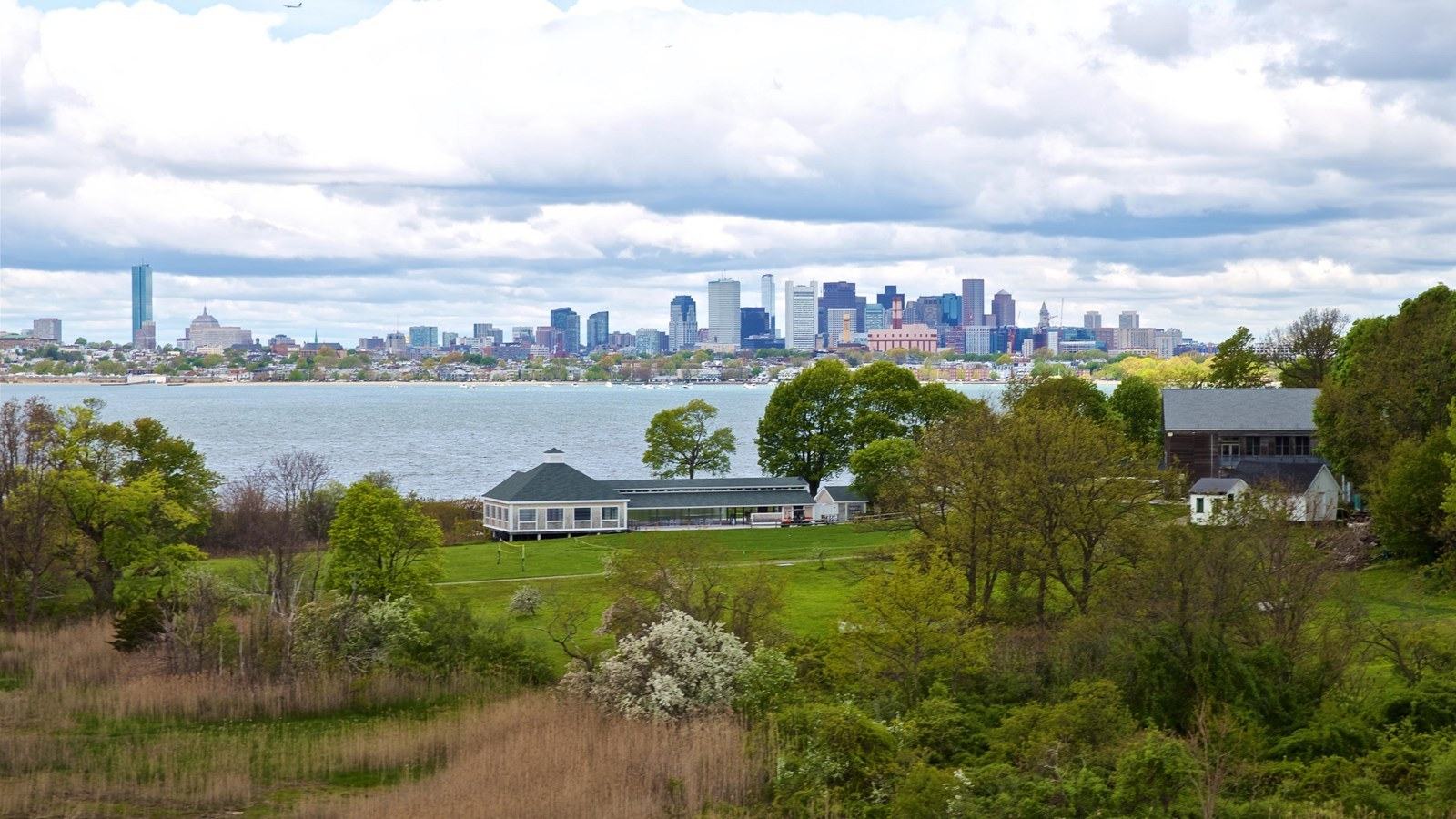
Cathleen Stone Island, also known as Thompson Island, offers an unusual meeting of salt-marsh scenery and educational history in Boston Harbor. Public visits depend on limited seasonal ferry arrangements.
A different side of Boston Harbor
In a harbour celebrated for forts and ferries, Cathleen Stone Island presents a quieter story. Many Boston residents still know it as Thompson Island, but its current name recognises environmental advocate Cathleen D. Stone and the educational work of the organisation based there. From a visiting boat, the island can look more like a green retreat than a developed attraction, with salt marsh, wetland, open grass and a remarkable skyline beyond the trees.
The National Park Service places the island a little under four and a half miles from Long Wharf and records nearly 170 upland acres. It belongs to the Boston Harbor Islands landscape, but is not run like a public beach where people may come ashore whenever they please. Its principal role is as the home of Cathleen Stone Island Outward Bound School, making public access an occasional opportunity that must fit around the island's educational purpose.
The access question comes first
The 2026 visitor information advertised public ferry access on Saturdays and Sundays from May into October, with services arranged directly by the island organisation. That is a seasonal programme, not a year-round commuter service. At the end of October, a traveller should verify whether any remaining public-access day is operating and where the boat actually departs. Older directions that mention a different Boston terminal may describe another year's arrangements and should not be used unquestioningly.
The wider Boston Harbor Islands partnership says these departures are separate from standard Georges and Spectacle Island ferry ticketing. That separation matters: buying a ticket for the main harbour ferries does not secure passage to Cathleen Stone Island. Nor does the presence of a dock imply open guest berthing for privately owned craft. If you want to arrive independently, obtain explicit guidance from the managing organisation before setting a route or assuming a suitable landing.
Landscapes shaped by water
The island's appeal is not confined to one viewpoint. Salt marshes and wetlands demonstrate why the edges of a coastal island can be as interesting as its higher ground, while patches of grass and reminders of former orchards reveal a landscape repeatedly used and changed by people. On a permitted visit, observing these transitions is a rewarding alternative to the usual scramble for the busiest photo location in a harbour park.
A marsh is a living habitat, not simply an empty piece of land waiting for visitors to walk across it. Staying on sanctioned routes protects soft soils, vulnerable plants and the wildlife using the shore. The best photographs may be made from a path or designated gathering area rather than by approaching the water's edge. Visitors should bring comfortable walking footwear and remain attentive to any instructions given by staff or the island's education team.
From trading post to school
National Park Service history records Indigenous seasonal use of the island long before European settlement. It also describes David Thompson's early seventeenth-century trading activity, subsequent farming and a succession of educational uses. In 1833, philanthropists established the Boston Farm School, beginning a period in which island life connected agriculture, residential learning and practical work. These layers give the island a character quite unlike a seaside resort or modern marina.
Over time, the institution changed its educational approach, eventually becoming Thompson Island Outward Bound Education Center in 1988. The later naming as Cathleen Stone Island Outward Bound School honours a supporter of environmental activism and education. For a contemporary visitor, this history explains why the buildings are not simply redundant historic structures and why the island may close to ordinary day visitors when school or group programmes require the space. Respecting that function is central to a responsible visit.
An island outing without assumptions
If ferry access is confirmed, allow time to get to the correct South Boston departure point and return before the final sailing. A half-day island excursion can include quiet observation, a picnic where permitted and the simple pleasure of being on land surrounded by tidal water. Bring drinks and suitable clothing rather than assuming a café or shop will operate. The NPS lists some visitor amenities but does not promise retail service during every public-access window.
Families may find the educational history especially compelling, although a school-based island should not be treated as an open playground. Programmes, guided activities, paths and available facilities can differ by date. Ask in advance about wheelchair access, washrooms and permitted areas if these determine whether the outing will work for your group. Avoid extrapolating from promotional summer photographs to conditions on a windy, late-autumn weekend.
The pleasure of a limited opening
There is something appealing about a harbour destination that does not seek to be busy every day. Cathleen Stone Island is an example of waterfront land serving education and conservation while still offering visitors a glimpse of its setting on carefully chosen dates. From the boat, Boston remains visibly close; after landing, the pace and uses of the island can feel markedly different from those of the downtown shoreline.
The practical takeaway is straightforward: check the island school's current public-access announcement, verify the ferry, and secure any ticket before travelling. An unannounced private-boat arrival is not a substitute. With an authorised visit arranged, this island provides a way to experience Boston Harbor through habitat, history and the continuing work of a school rather than through the fortifications that dominate many nearby itineraries.