
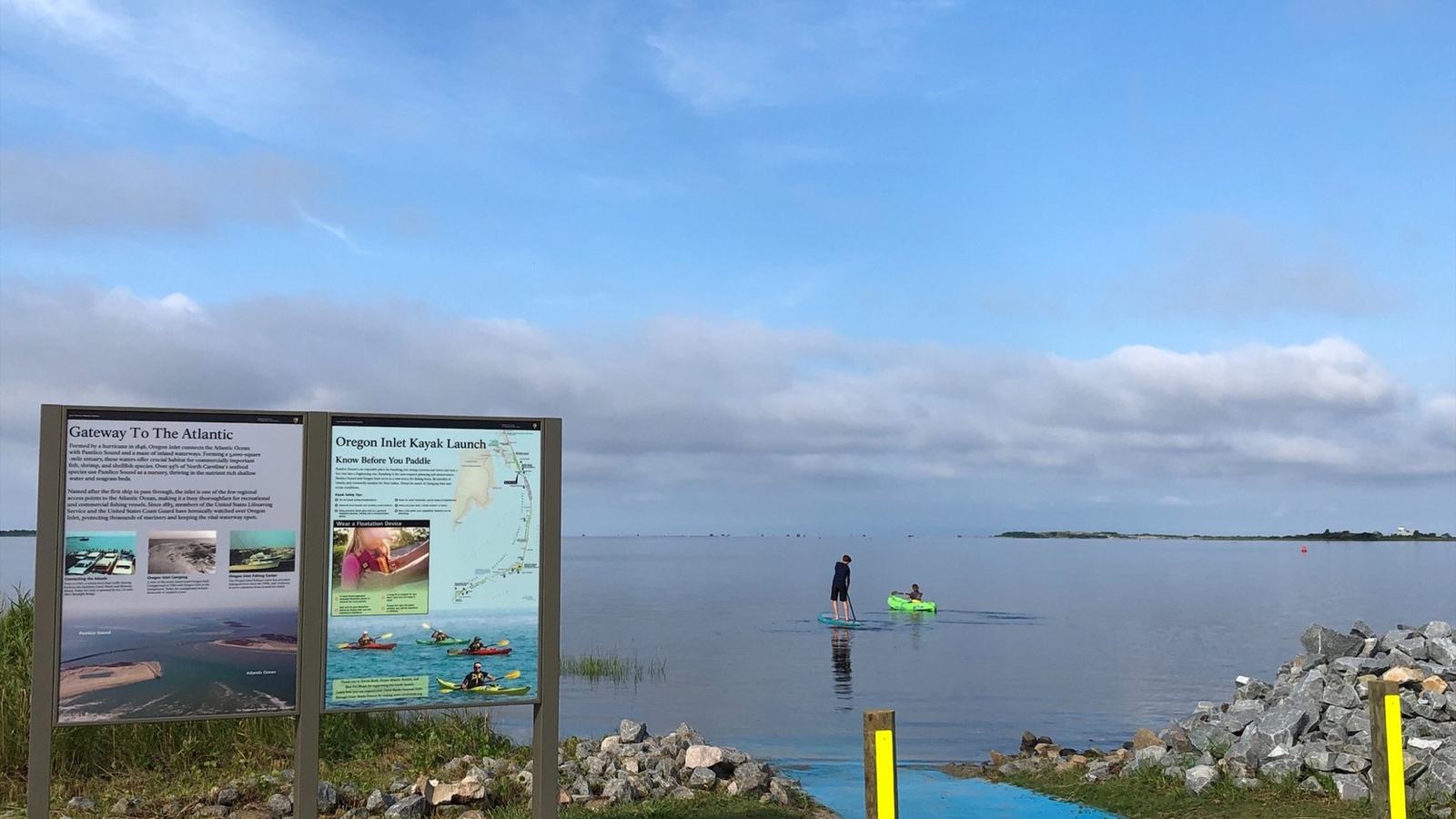
Cape Hatteras National Seashore offers kayaking on the Pamlico Sound side of North Carolina's Outer Banks, with several launch options and changing tidal conditions.
Discover the quiet side of the Outer Banks
Cape Hatteras is associated with Atlantic surf, tall dunes and exposed beaches, but the soundside shore offers another way to experience the Outer Banks. From a kayak, visitors can explore calmer-looking stretches of Pamlico Sound, enjoy changing reflections and observe birds without venturing directly into breaking ocean surf.
The National Park Service describes a series of launch opportunities along Highway 12, making it possible to plan a short outing as part of a longer island holiday. The apparent tranquillity of the sound should still be assessed against real conditions, because wind, current and commercial traffic can change the character of the water.
Oregon Inlet provides a purpose-built launch
The Oregon Inlet Kayak Launch at the Oregon Inlet Fishing Center on Bodie Island provides parking, loading areas and a maintained approach to the water. That infrastructure can make the practical business of carrying a kayak and preparing equipment easier than approaching an unmarked shoreline.
The site is also near an important route for fishing vessels. Small-boat crews must remain aware of powered traffic and wakes, choosing a position that does not obstruct boats manoeuvring toward the inlet. A launch that is convenient on land is not automatically the easiest place to paddle when conditions offshore become rough.
Several Highway 12 access points are listed
Other official options include the Pea Island launch near the New Inlet parking area, Salvo Sound Access, Haulover Sound Access and locations on Ocracoke Island. The park also points to a launch across from the visitor centre in Ocracoke village. Each offers a different perspective on the soundside landscape.
Choosing an access point involves more than finding the nearest marker on a map. Roadside parking, carrying distance, water depth and the prevailing wind can all affect the outing. Visitors should confirm the current status of a site rather than assume that every access listed in an older guide remains unchanged.
Tides can alter the planned return
Pamlico Sound is affected by tide, wind and local channels, which may be unfamiliar to someone accustomed to a small inland lake. A route that is straightforward on the outward leg can become difficult as wind increases or the flow changes direction. Sandbars and shallow edges also need attention.
Check current tide predictions and marine weather information for the relevant section before launching. A simple plan should include a realistic turnaround point and an alternative landing possibility where permitted. The skipper needs to recognise that travelling downwind is easy until the crew must paddle home into a freshening breeze.
Birds and other wildlife reward a slow pace
The shallow waters and marsh edges provide habitat for fish, wading birds and other wildlife. Kayakers may notice turtles and skates in the water when visibility and conditions are suitable, while birds can be watched from a distance without the noise of an engine.
Wildlife observation is never guaranteed, and paddlers should avoid following animals or approaching sensitive nesting places. The attraction is the chance to watch an ecosystem without disturbing it. Pack out litter and keep the boat clear of delicate vegetation along the edge of the sound.
Soundside is not the same as risk-free
The National Park Service warns that strong currents and waves can transform an enjoyable trip into a frightening experience, particularly near Oregon Inlet. Passing fishing vessels can create significant wakes. A group should understand how its craft behaves in moving water and how to respond if someone capsizes.
Kayaking during thunderstorms is unsafe and should be avoided. A forecast that includes developing storms is a reason to change the itinerary, even if the beach is sunny at the planned launch time. Local advice may help a visitor judge whether a particular stretch is reasonable for the available experience.
Use clothing and flotation appropriate to immersion
A correctly fitted personal flotation device should be part of every paddler's equipment. The group should also carry a whistle, a suitable communication method and protection against sun and exposure. Dressing only for the warm air can leave someone dangerously cold after an unexpected swim.
Equipment should be secured to avoid losing it in a capsize. A mobile phone may be useful if protected against water, but it must not be regarded as a guarantee of contact from every location. Tell a responsible person ashore when and where the trip is planned and what return time to expect.
Rentals and ranger activities are alternatives
Commercial kayak and canoe rental services operate locally, and the park has offered free ranger-led kayaking programmes during summer on Hatteras Island. Such sessions may be attractive to visitors who want to learn about the coastal environment without organising a personal boat and transport.
Check the park event calendar rather than assuming a guided trip runs on every visit. A commercial rental agreement should also be reviewed for equipment, launch advice and weather cancellations. For a first attempt, shorter supervised exposure is often preferable to an independent route that relies on unfamiliar navigation.
Make a family outing manageable
A gentle schedule allows time for fitting lifejackets, adjusting footrests and practising turning close to the launch. Younger paddlers or first-time adults may need a brief introduction before travelling along a marsh edge. A group should select the destination to match its least experienced participant.
If wind or current becomes uncomfortable, the correct response may be to finish early. There is no need to prove endurance when the original purpose was to enjoy the view. An unhurried approach also creates room to watch wildlife and appreciate the quieter side of the barrier islands.
What to verify before leaving the beach
Use the official National Park Service launch list, current weather and tide information, and local notices before deciding where to go. Check that the selected site remains open, and confirm the route does not interfere with commercial boat movements or restricted wildlife areas. Different launches may have very different exposure.
Cape Hatteras offers an appealing contrast between Atlantic surf and the shallow sound. With realistic distance, suitable safety equipment and respect for changing conditions, a kayak outing can be an excellent way to see the Outer Banks from a perspective unavailable on the highway.
Source
National Park Service