
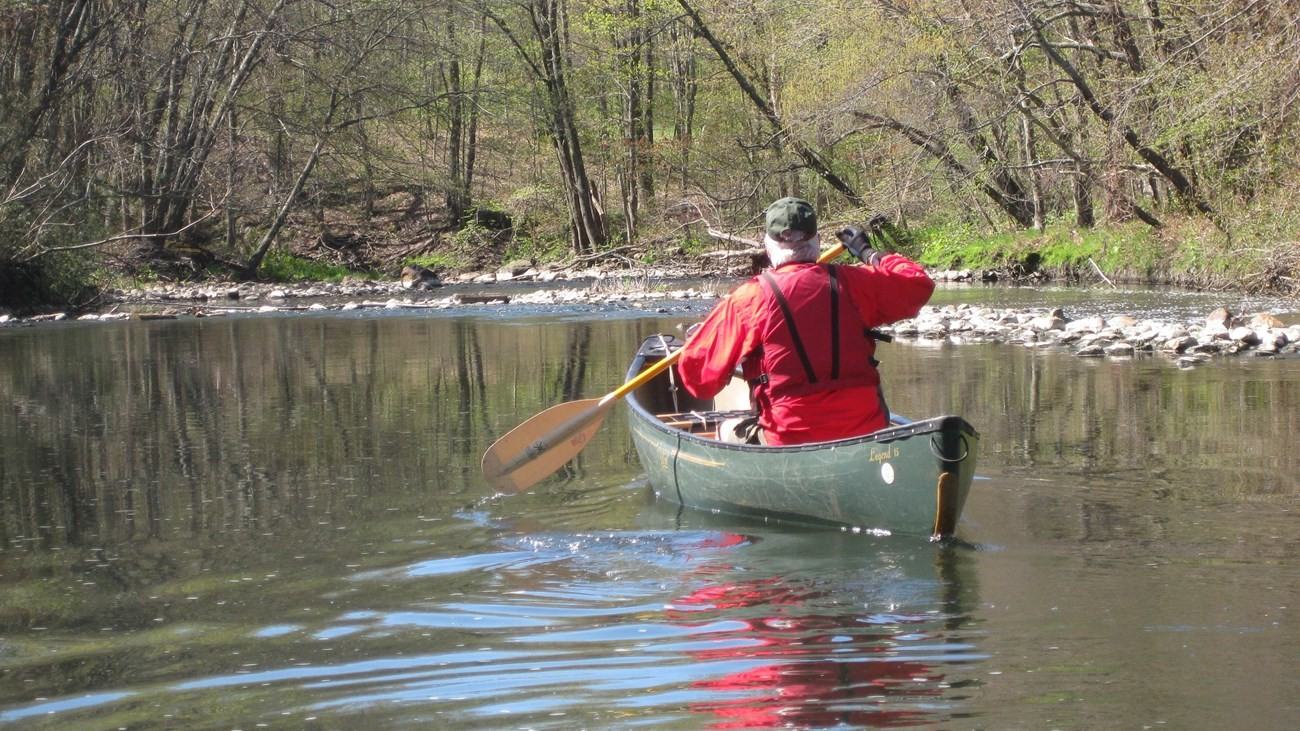
The Blackstone River offers a paddle through the industrial history of Massachusetts and Rhode Island, where heritage buildings, state-park launches and historic dams make route planning essential.
A river that tells an industrial story from the water
The Blackstone River flows through Massachusetts and Rhode Island, linking old mill towns, wooded stretches and modern communities. Today a canoe or kayak offers a view of that landscape from the route once used to power much of its industry. The National Park Service describes the river and associated canals as a rewarding way to experience the Blackstone River Valley National Historical Park and the region's industrial heritage.
Visitors should not imagine an uninterrupted forty-six-mile float. The waterway descends steadily from the Worcester area toward Rhode Island, and a sequence of dams interrupts the route. Some sections include easier calm water, while others demand careful attention to current and access. Choosing a suitable reach for a few hours is a more realistic introduction than attempting a long end-to-end journey without detailed local knowledge.
The river and its canal offer contrasting experiences
The Blackstone's main stem travels roughly forty-six miles through historic villages, forests, farms and developed land. Its average drop is close to ten feet per mile, a gradient that explains why mills were built along its banks. Waterwheels and later industrial systems exploited the fall in elevation, leaving a concentration of dams, mill buildings, bridges and canal structures that paddlers can still encounter.
The canal traces a different history of moving goods and people during the industrial age. On some outings a calm canal reach can be more approachable than the river's current, while other stretches are unsuitable or lack access. The National Park Service directs paddlers to individual access guidance rather than presenting the entire canal as one navigable route. Looking at the two waterways together shows how transport and water power shaped neighbouring communities.
Dams and portages define route planning
The National Park Service records eighteen remaining dams along the Blackstone and warns that they make portaging necessary on a number of stretches. A portage requires moving a canoe or kayak around an obstruction on land, which can be awkward where banks are steep or access is restricted. The river's industrial structures are historically important but should never be treated as safe places to paddle through.
An enjoyable trip therefore begins with a map that identifies the exact launch, takeout and any intervening barriers. Conditions upstream and downstream of a dam can differ sharply, and approaching one without a planned exit is a poor decision. Paddlers should ask local outfitters or the heritage corridor organisation for current route information. A manageable stretch with a confirmed public landing is preferable to a longer journey that relies on uncertain access.
Blackstone River State Park offers a useful starting point
Blackstone River State Park near Lincoln, Rhode Island, offers a practical way to combine time afloat with a visit on land. The National Park Service recommends the area around the Kelly House Museum and Blackstone River Bikeway for exploring the valley's history. The state park has boat launches, fishing areas and places to walk alongside the water, making it possible to plan a day around more than the paddle itself.
The state park and the federal historical park have different responsibilities and rules. In particular, the National Park Service has not designated launches on land it directly administers within the national historical park. Visitors should choose an established, authorised launch rather than assume any bank inside a park boundary is available. Confirming the access operator, parking rules and water conditions before arrival avoids confusion.
Read the industrial landscape from a canoe
At Old Slater Mill in Pawtucket, the valley's industrial history becomes especially clear. Water power supported early textile production, and mill villages developed as industrial employment expanded. The Blackstone River's sustained descent made it an unusually useful source of energy. On a paddling trip, the dams and surviving buildings are a reminder that this waterway once performed a working role that shaped the wider region.
Some of the most interesting historical locations are better visited on foot after leaving the boat at a proper access point. The park recommends the Old Slater Mill visitor facilities and related heritage sites for learning how cotton spinning and industrial communities developed. A mixed itinerary can therefore include water, a museum and short walking sections. The purpose is to understand the landscape, not to try to reach every mill directly from the river.
Ecological recovery is part of the modern story
The river's industrial success carried an environmental cost. Historical mill operations introduced pollutants, including heavy metals associated with textile processes, while rubbish accumulated in and near the water. The National Park Service notes that the Blackstone became one of the most polluted rivers in the United States by the 1960s. Local conservation efforts helped reverse some of that damage, turning the river into a focus for renewed public recreation.
Fish, turtles, beavers, river otters and birds now occupy parts of the recovering waterway, although that does not mean every section is free from contamination. Paddlers should observe wildlife without disturbing it and follow local water-quality advice. A canoe allows an especially quiet approach to riverbank habitats when the route is suitable. The recovery story is an important part of understanding why the Blackstone is valued today.
A few hours is a sensible first visit
The National Park Service presents paddling the Blackstone as an activity that can take roughly one to four hours, depending on the chosen location and conditions. Spring through autumn are the usual visiting seasons. That makes a half-day journey attractive for paddlers who also want to see a historic village or walk part of the towpath. The precise duration still depends on current, weather and where the group can safely finish.
Everyone should have a suitable personal flotation device and be physically prepared to handle the boat and access points. A short section is not automatically without obstacles: a strong current, fallen branches or an unfamiliar landing can quickly change the outing. Checking the forecast and obtaining current route information are sensible steps, as is carrying water and keeping a return plan with someone ashore.
Enjoy the valley without confusing its boundaries
Blackstone River Valley National Historical Park preserves important pieces of a wider industrial landscape, but the river and state-managed recreation areas extend beyond its directly administered properties. Visitors should use recognised launches and respect both local waterway rules and access restrictions. The National Park Service directs paddlers to the broader National Heritage Corridor for further route details and advice on places to get afloat.
For a rewarding visit, choose a defined water section, confirm the portage situation and leave room to explore a nearby historical site. The Blackstone combines working-waterway history with woodland and urban scenery in a way few paddle destinations can match. Moving quietly through an appropriate reach offers a different perspective on a valley shaped by rivers, industry and generations of people who worked beside the water.