
The Black Canyon National Water Trail below Hoover Dam offers a memorable Colorado River kayak journey, with specialised access and cold-water precautions.
A canyon journey below a famous dam
Black Canyon on the Colorado River offers a striking small-boat experience close to Hoover Dam, where high canyon walls rise above narrow stretches of water. The route forms part of the Black Canyon National Water Trail within Lake Mead National Recreation Area. A kayak or canoe gives visitors a close view of the rock formations and quiet side canyons that is very different from the perspective offered by a road or a viewing platform.
The setting invites slow travel, but the waterway is not simply a sheltered lake. River releases, current, boat traffic and cold temperatures influence the conditions. The National Park Service advises paddlers to assess their abilities and equipment before departure, and a guided excursion can be a suitable starting point for someone with limited river experience.
Willow Beach as a practical starting point
Willow Beach on Lake Mohave sits within the Black Canyon water trail and is recognised by the Park Service as an important paddling access point. Operators offer rentals and guided trips around the area, giving visitors options that range from modest excursions to longer routes. A short trip from an established launch can reveal the canyon's character without requiring an ambitious paddle upriver.
There is still a need to consider the return journey. Paddling against a current or a headwind can be substantially harder than travelling with it, and the crew should choose a turning point that leaves plenty of energy and daylight. The sensible plan is one based on real conditions and local advice rather than a map distance that looks manageable from home.
Special access to the Hoover Dam launch
Launching immediately below Hoover Dam is subject to unusual arrangements because of the dam's security zone. The National Park Service explains that only a limited number of permitted outfitters can provide access, typically involving transport through the controlled area. Travellers with their own kayak may be able to arrange approved livery service, while others can choose an organised trip with equipment included.
A booking with an authorised outfitter is essential for this type of launch. Visitors should not assume they can carry a kayak down from a public road or arrive unannounced at the dam with a roof rack. Operators can explain the relevant identification, timing and safety requirements, and the itinerary should allow for any changes imposed by security or river conditions.
Cold water can surprise summer visitors
The Colorado River below Hoover Dam remains cold even when desert air temperatures become very hot. The NPS describes water temperatures around the low fifties Fahrenheit, roughly ten degrees Celsius, on parts of this route. That difference can create serious risks if a paddler falls into the river while wearing clothing selected only for warm weather.
A suitable personal flotation device is required, and the Park Service sets particular life-jacket requirements for the river section between the dam and River Mile 43. Clothing and rescue arrangements should match the immersion risk. A guided group should understand what equipment is provided and what individual preparation is expected before leaving the launch.
Motorboats and paddlers share narrow water
Black Canyon can become busy where the waterway narrows and different types of craft travel through the same corridor. A kayak's low profile makes it important to remain visible and choose a course that does not interfere with larger or faster vessels. Experienced paddlers also need to consider how wakes rebound from canyon walls and disturb the water unexpectedly.
Courtesy between operators is essential. Motorboat skippers should moderate speed and wash when approaching small craft, while kayakers should avoid obstructing channels or stopping in places where other vessels have limited room to turn. A quiet day depends as much on considerate behaviour as on the natural beauty of the canyon.
The lake's rules still apply to a paddlecraft
The NPS makes clear that a kayak, canoe or paddleboard is a vessel and subject to relevant boating requirements. Launching is permitted in many locations where boats may operate, but certain designated swimming beaches are excluded. Visitors should review the current rules for the exact starting point and not assume that hand-powered propulsion allows unrestricted access.
Life jackets, navigation awareness and appropriate safety equipment remain necessary. Paddlers should also check whether a selected route crosses a management zone with temporary restrictions on motorised traffic or different operating arrangements on particular days. A qualified local guide can explain which parts of the water trail best suit the group's expectations.
Choosing a trip rather than chasing a landmark
Some visitors are attracted by named caves, hot springs or viewpoints featured in travel photography, but the most famous spot is not always appropriate on a given day. A modest route with time to pause can provide a richer experience than repeatedly extending the journey to reach another waypoint. The shape of the canyon and the changing light are rewards in themselves.
A group should carry enough drinking water, sun protection and appropriate clothing for the forecast. Extra time is needed for launch procedures and any transport supplied by an outfitter. It is also important to protect sensitive habitats and follow the operator's guidance about where landing or entering the water is allowed.
An authentic view from the Colorado River
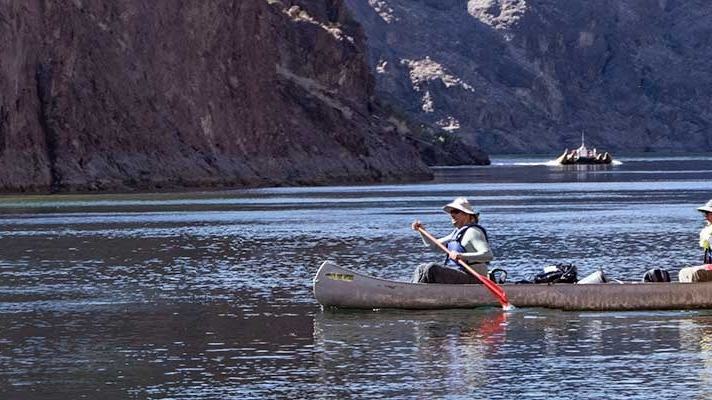
The official National Park Service photograph shows people paddling in the Black Canyon setting beneath tall rock walls. It is an image of the actual type of outing described, not a composite promotion or unrelated kayak. The scene also demonstrates that even an ordinary canoe can feel remarkably small against this landscape.
For a visitor planning a Black Canyon journey, the park's current kayaking information and approved local operators provide the appropriate next steps. The goal should be a safe, unhurried encounter with the canyon, undertaken with suitable equipment and respect for the cold river. When those conditions are met, travelling by paddle offers a memorable way to discover the landscape below Hoover Dam.