
A small-boat travel guide to the Colorado River’s Black Canyon beneath Hoover Dam, covering its thirty-mile trail, authorised launch points and desert conditions.
Below Hoover Dam, the Colorado River enters a canyon landscape of dark rock, coves, hot springs and extraordinary desert scenery. The Black Canyon National Water Trail, designated in 2014, provides a boating destination that appeals to travellers who want something different from a conventional lake holiday. Managed within Lake Mead National Recreation Area, the water trail extends for approximately thirty miles and offers opportunities for guided rafting, kayaking and other suitable boats. Yet this is not an invitation for beginners to launch anywhere they please. The National Park Service explains that access from Hoover Dam is controlled, that different sections demand careful planning and that wind and seasonal weather can be serious hazards. The reward for responsible preparation is the chance to see a dramatic stretch of the American Southwest from the water itself.
A designated national water trail in the desert
The National Park Service states that Black Canyon was designated a National Water Trail by the Secretary of the Interior in 2014, becoming the Southwest's first trail of this kind and the first described as passing through a desert. The official route is approximately thirty miles long, although visitors may choose shorter outings or guided experiences appropriate to their abilities. The canyon is framed by geological formations and includes places associated with the construction of Hoover Dam. This mixture of nature and industrial history helps distinguish the trip from a purely scenic river journey. The designation should not be read as a guarantee that every mile is easy or accessible. It identifies a recognised corridor whose current conditions and operating rules still need attention.
The view from a small craft
In a kayak, high canyon walls can make the water feel enclosed even where the channel is broad. The absence of a large engine can give the traveller time to notice rock colours, shadow patterns and changes in the canyon's shape. The Park Service describes beaches, caves, coves, hot springs and wilderness along the route, with desert bighorn sheep sometimes seen on the cliffs. Wildlife observations should be made from a respectful distance, and paddlers should avoid approaching animals or entering restricted areas simply to obtain a photograph. Some natural features may be difficult or unsafe to reach in particular conditions. Their presence in the official guide is a reason to research the trip, not a promise that every visitor can explore all of them safely.
Three important access locations
The official NPS information identifies major access points at Hoover Dam, Willow Beach and Eldorado Canyon. Each has a distinct role in planning a trip. Hoover Dam is at river mile 64 and has controlled access through authorised vendors. Willow Beach, near river mile 52.5, is described as the most popular place for launching and retrieving personal paddlecraft and motorised boats. Eldorado Canyon, around river mile 39, marks the downstream end of the trail, with access at Nelson's Landing and no visitor services at that location. These details are not interchangeable. A party must choose access points that suit its trip, arrange any necessary transport and check the latest rules, particularly where a remote take-out offers limited facilities.
Starting below Hoover Dam
Launching from Hoover Dam is a special arrangement, not a public ramp at which anyone can arrive unannounced. The NPS says access to the dam's security zone is provided through a limited number of authorised vendors, and visitors are escorted on a narrated bus journey to the launch. Outfitters may offer raft trips or kayak adventures that begin near the dam. Anyone interested in that experience must book with an approved provider and follow its procedures. A scenic photograph of paddlers near the dam should not be interpreted as evidence that private launch access is available without arrangement. The need for controlled access is a practical part of the journey and should be considered when comparing options.
Willow Beach as the flexible alternative
Willow Beach provides a more conventional point for travellers who want to launch or retrieve a small craft. The Park Service identifies it as the main access location for personal paddlecraft and a place served by kayak and canoe rental operators. Such services can make the trip accessible to visitors who do not own equipment, but actual availability, booking requirements and route limits must be checked. The river is not a sheltered swimming pool, and a rental does not remove the need for paddling skill. Wind, boat traffic and the distance back to the launch all affect the day. A responsible visitor should tell the provider what experience they have and choose a trip that matches it rather than the most dramatic photograph in an advertisement.
Eldorado Canyon and the limits of services
At the downstream end, the NPS lists access at Nelson's Landing near Eldorado Canyon. It specifically notes that visitor services are absent there, making it a location for which independent planning is essential. Anyone considering a trip that finishes at such a place needs to arrange transport, supplies and a contingency plan in advance. It is easy to focus on the romantic idea of finishing a canyon journey in the desert. The reality is that moving a boat, equipment and people after a long day may be difficult without suitable organisation. A guided outfitter may handle those details, but the arrangements should be confirmed and not presumed. The absence of amenities is part of the location's character, not a problem to discover at the finish.
Permits, passes and vessel requirements
The park explains that visitors need an appropriate vehicle entrance pass and a vessel pass to launch on the Black Canyon water trail. It also advises boaters to meet the applicable state registration and equipment requirements. Nevada and Arizona have overlapping interests in the wider Lake Mead and Lake Mohave area, so operators should check which laws apply to their boat and planned route. The NPS specifically discusses aquatic invasive species requirements, including Nevada decals and an Arizona-registration exception. Those rules can change, and a visitor should verify them through current official guidance before travelling. A travel feature cannot serve as a legal clearance certificate. The goal is to identify the kinds of checks required, not replace the agencies responsible for them.
Kayaks and motorboats share the water
Although the route is attractive for paddling, it is not reserved exclusively for kayakers. The official guide refers to paddlers and motorboat users, and small-craft crews must remain aware of other traffic. A kayak is relatively low in the water and may be difficult for a fast-moving vessel to spot. Keeping a lookout, selecting a sensible path and wearing suitable buoyancy equipment remain important. Motorboat operators have corresponding responsibilities concerning wake, speed and safe separation. The NPS lists several federal and state vessel-safety requirements that may apply depending on the craft. Even a short kayak journey should involve appropriate signalling and a clear understanding of how to avoid conflict with other vessels.
Weather can be demanding in any season
The park says the Black Canyon can be visited year-round, but conditions vary. Summer heat can make exposure a serious concern, and the monsoon season can bring sudden rain and flash flooding. Cooler months may offer more comfortable temperatures while strong winds make paddling difficult. The availability of a route throughout the year is therefore not an assurance that it is safe on every day. Visitors should review weather forecasts, park alerts and any current restrictions before departure. A narrow canyon landscape can complicate decisions when conditions change, and a party may have limited alternatives for leaving the water. Planning should include conservative turnaround points and an understanding of the limitations of the chosen craft.
The lure and limits of hot springs
The official NPS route description lists hot springs among the canyon's natural features. That may sound appealing during a river holiday, particularly when the air is cooler. However, the presence of a spring on a map does not establish that it is open for bathing, safe to approach or suitable for all visitors. Water temperatures, access restrictions and environmental protections require current local information. A paddler should avoid entering unknown pools or leaving a safe route simply because a promotional description mentions hot water. A guided trip may include officially permitted stops where conditions allow, but travellers need to confirm those details in advance. The landscape is worth visiting without treating each natural feature as a guaranteed attraction.
Wildlife among the cliffs
Desert bighorn sheep are among the animals the NPS says may sometimes be seen on cliffs along Black Canyon. Such sightings depend on season, weather and chance, and should never be guaranteed. Watching wildlife from the river can be memorable because the animals inhabit a landscape that initially appears austere. Yet a low, quiet boat can still disturb animals if driven or paddled too close. Keep adequate distance and do not deliberately block an animal's movement. Visitors should also avoid leaving food or litter at beaches and rest areas. A healthy recreation area depends on people recognising that wildlife and habitat matter independently of whether they produce a memorable photograph for an individual visitor.
Historic engineering seen from the river
Hoover Dam is one of the defining pieces of infrastructure in the region, and the NPS notes that historic structures associated with its construction can be viewed along the canyon. From the water, the engineering story takes on a different scale. It is possible to appreciate both the physical setting and the human work that altered it. The practical meaning for paddlers is that this is a managed river corridor with security arrangements and restrictions, not a remote wilderness without human influence. Any historical structure should be observed from authorised areas, with no assumption that landing or entering a structure is permitted. The juxtaposition of engineered water management and dramatic canyon scenery is central to the destination's appeal.
Photography from a moving kayak
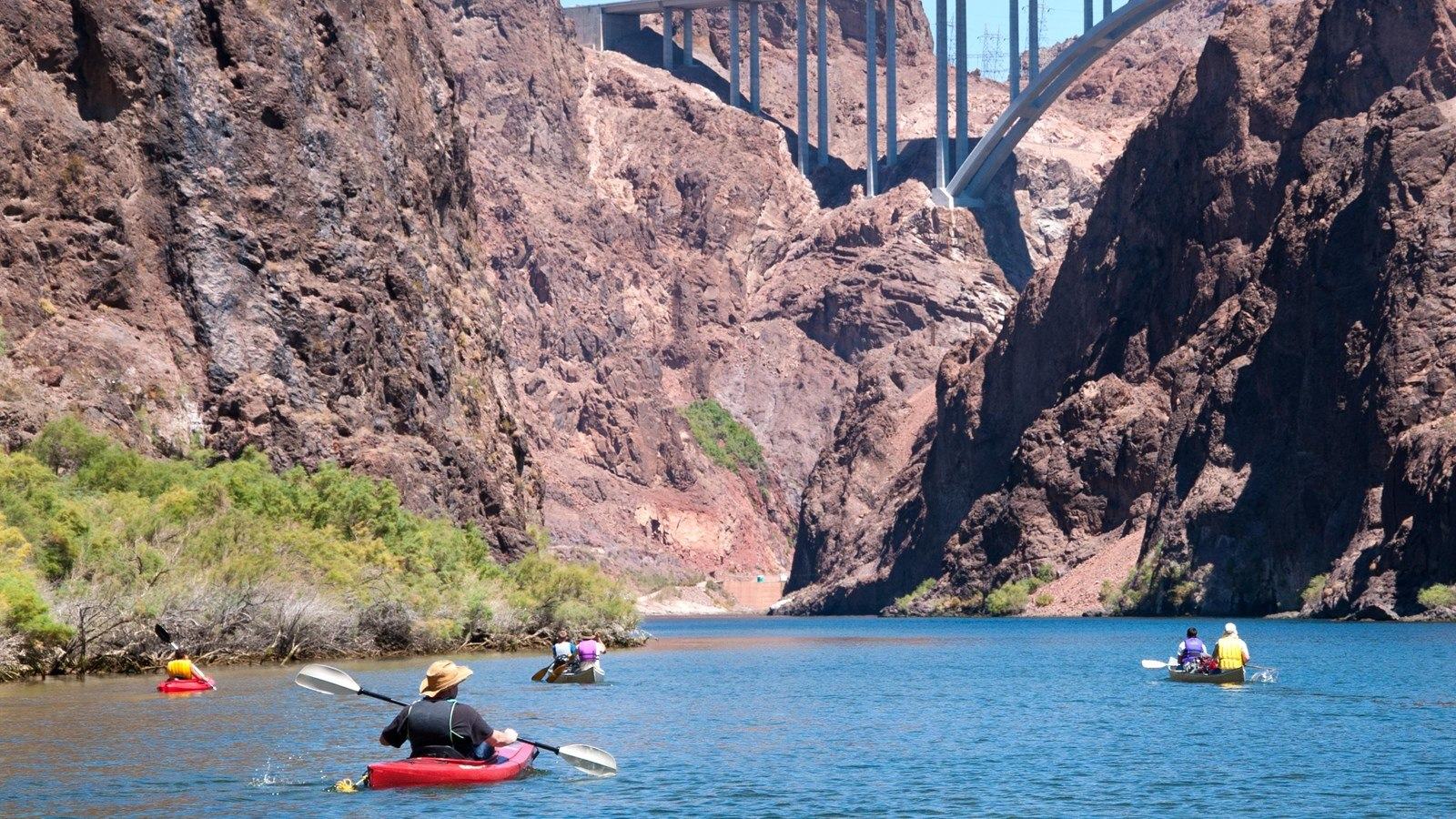
The contrast between dark cliffs and bright water can make Black Canyon rewarding for photography. Safe image-making, however, should come after maintaining control of the boat and watching for other craft. Secure cameras against water and avoid leaning dangerously or trying to stand in an unstable vessel for a better viewpoint. A guided excursion may provide opportunities to stop safely, but those pauses depend on the route and conditions. The lead photograph used here comes from the National Park Service's official Black Canyon water-trail guide and depicts real paddlers travelling through the canyon. It is documentary evidence of the landscape, not a claim that the current weather or navigational conditions match the moment when the image was taken.
Choosing the right kind of experience
The canyon can be explored through several types of authorised activity, including guided raft trips, kayak rentals and suitable private boating arrangements. Beginners may find a professionally organised trip preferable to attempting a long route with complicated transport. More experienced paddlers may consider a different itinerary, but they still need to comply with access rules and current conditions. A family member who does not want to paddle may enjoy the landscape from an appropriate guided raft excursion rather than feeling obliged to use the same craft as everyone else. The best holiday matches the people involved rather than trying to reproduce a demanding adventure for which they are not prepared.
The source and the trip it describes
The Park Service's official Black Canyon National Water Trail page provides the verified basis for this feature: designation in 2014, an approximately thirty-mile route, access at Hoover Dam, Willow Beach and Eldorado Canyon, and the major safety and permit considerations. Those details should be checked against current notices and vendor information when planning an actual outing. The lead photograph is a genuine NPS image credited to A. Cattoir and published alongside the route description. This article does not guarantee a tour, launch permit, wildlife sighting or particular water condition. It describes a destination with extraordinary scenic possibilities and clear operational responsibilities.
Why the canyon suits thoughtful small-boat travel
Black Canyon can give a small-boat holiday a sense of scale far beyond the dimensions of the kayak or canoe. The cliffs, desert light and river history are compelling, while the need to plan permits, transport and safe routes ensures that the experience cannot be approached casually. A successful trip may be a short guided paddle or a longer expedition suited to an experienced group. Both can offer a view of the Colorado River that differs from a roadside lookout. The essential principle is to choose a properly authorised journey and take conditions seriously. Done that way, the Black Canyon water trail provides a distinctive encounter with the American Southwest from the water.
Sources and photograph attribution
Official destination and boating guidance: National Park Service — Lake Mead National Recreation Area. Current access, rules, weather and reservations must be checked independently before travel.
Photo: National Park Service / A. Cattoir, authentic kayakers in Black Canyon on the Colorado River. Source: https://www.nps.gov/thingstodo/black-canyon-national-water-trail.htm. Original rights remain with the credited creator or as specified by the source and licence.