
The 2026 Good Design-recognised BioShelter research initiative brings species-specific habitat geometry and robotic fabrication to Sydney's hardened harbour edges.
When a seawall becomes a habitat
Sydney Harbour's hardened edges are a reminder that waterfront construction can displace the intricate rock pools and crevices on which marine organisms depend. A flat retaining wall may perform its engineering task yet provide far fewer niches than a natural shoreline. The BioShelter research project asks whether a city can keep the infrastructure it needs while giving native marine life more opportunities to settle and shelter.
Developed through research teams at the University of New South Wales, BioShelter received recognition in the 2026 Australian Good Design Awards. Its purpose is not to place a generic decoration underwater. Instead, it combines field knowledge of local species, computational geometry and robotic fabrication to produce habitat structures suited to a particular site.
Designed from ecological evidence
The research begins with the species and habitat-forming organisms found along natural rocky shores. Their needs inform the geometry, including ledges, recesses and varied surfaces that may offer different microhabitats. It is a more targeted approach than assuming every stretch of artificial waterfront requires an identical concrete panel.
The project team translates these inputs into digital models that marine biologists can review before fabrication. This collaboration is significant because an intricate shape is not automatically ecologically useful. Design needs to be tested against biological priorities as well as structural requirements, installation access and the forces operating at a busy urban waterfront.
From digital model to physical tile
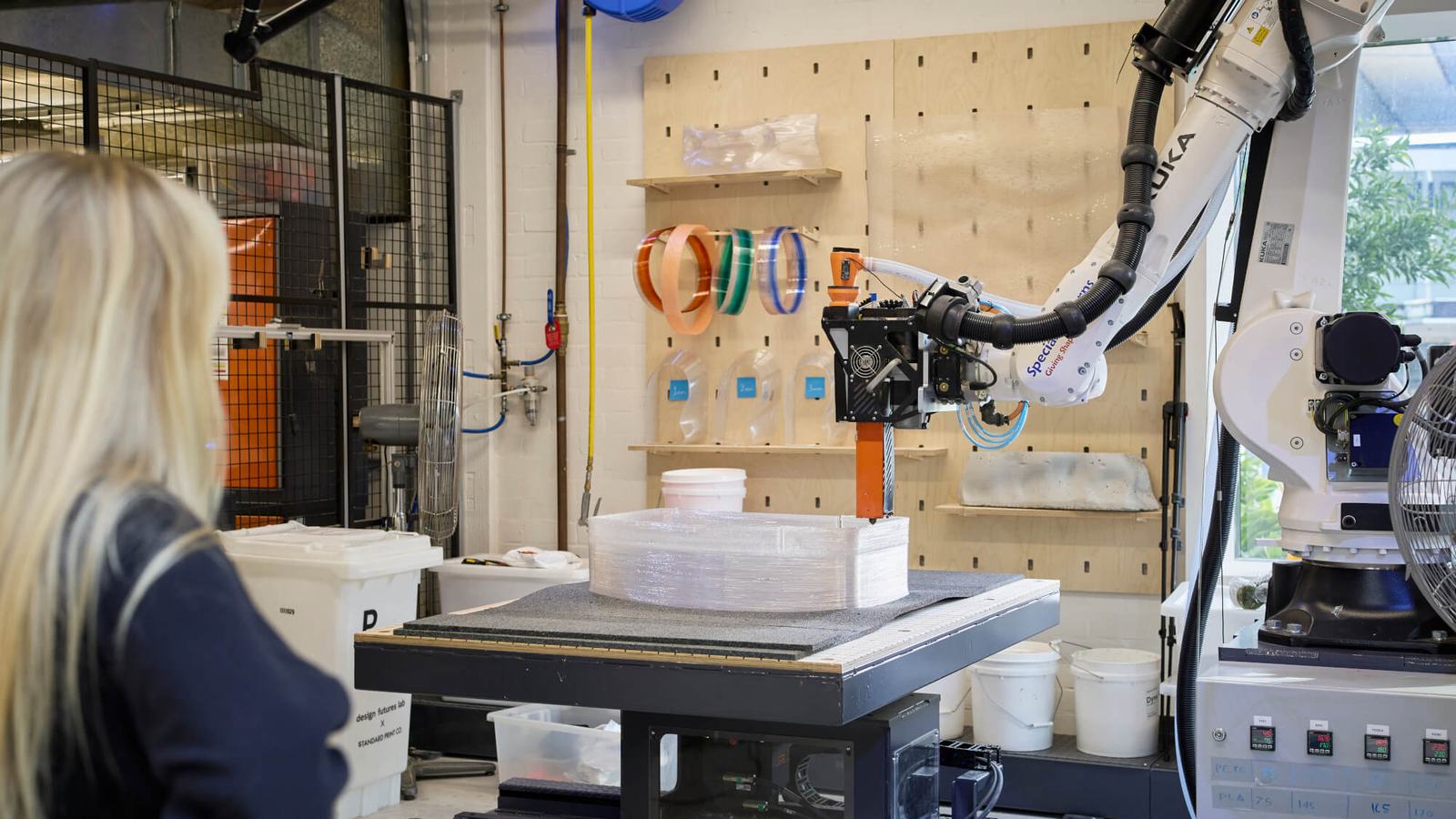
A custom computational workflow produces both a proposed surface and information needed for robotic manufacturing. The researchers use three-dimensional printing to produce complex components, exploring sustainable material choices and the practical constraints of production time and cost. The software can also divide an elaborate overall geometry into smaller, more manageable tiles.
That modularity addresses a problem familiar to any waterfront contractor. A beautiful large prototype may be impossible to carry, position or replace in a real harbour. By considering maximum dimensions and handling weights during design, the project creates a bridge between a laboratory idea and an intervention that could plausibly be installed along working shorelines.
A research lineage rather than an overnight invention
The BioShelter programme has developed over several iterations. Earlier work from 2016 and 2017 interpreted data describing Sydney's natural rocky shoreline, while a later phase tested an artificial marine habitat beneath the Anzac Bridge at Pyrmont. The current award-recognised iteration was developed for the new Sydney Fish Market waterfront and placed particular emphasis on robotic fabrication.
These milestones matter because they show a progression of questions being tackled, rather than a single product launching directly from the drawing board. The third iteration has been used to verify aspects of the design-to-fabrication method at the Fish Market. Research toward commercial-scale manufacture continues; readers should not assume the tiles are available as an off-the-shelf worldwide harbour retrofit.
More than a place for barnacles
Much discussion of nature-friendly seawalls centres on species that cling to exposed surfaces. BioShelter's ambition is broader, considering relief and hiding places potentially relevant to fish as well as organisms that form or inhabit rocky-shore communities. Complexity is valuable only insofar as it serves the target habitat, and this is where the locally tailored design method is particularly interesting.
A project installed in one harbour cannot be transplanted unchanged to another. Tidal range, salinity, water movement, local ecology and physical access differ considerably. The significance of the digital approach is that it can accommodate those inputs, rather than treating one visually successful tile as a universal blueprint.
Implications for marina development
Modern marinas and leisure waterfronts balance access, berthing capacity, flood resilience and development economics. Their concrete walls, jetties and revetments can have lasting ecological effects. If habitat-led geometry proves durable and practical over time, future refurbishments could consider biodiversity enhancement as part of their marine works rather than as a separate ornamental project.
That possibility is especially relevant where leisure boating meets urban regeneration. Visitors see the promenade and moorings above water, but the shore's submerged surfaces form another built environment. Good environmental design asks how both can function together, while acknowledging that construction effects, maintenance and long-term ecological outcomes still require formal assessment.
What scientific verification must establish
More varied surfaces are an encouraging starting point, but environmental benefit should ultimately be established by monitored biological outcomes. Researchers and infrastructure owners need to ask which species actually colonise the installation, how communities evolve seasonally, whether invasive organisms gain a foothold and how panels withstand fouling, impacts or repair work.
Those questions are not criticisms of the BioShelter design; they are the normal work of turning promising research into responsible infrastructure. The award judges have recognised an approach to design, while lasting habitat restoration depends on evidence gathered in the water over years. The difference between the two claims is important for clear reporting.
A new role for the harbour edge
BioShelter highlights a shift in how marine structures are imagined. The waterfront need not be reduced to a boundary between the city and the sea. It can potentially perform structural, operational and ecological duties simultaneously when the relevant disciplines work together early enough.
For boat owners, harbour visitors and marina developers, the immediate story is a 2026-recognised Australian design experiment with a practical focus on Sydney Fish Market. The larger story is about raising expectations of the places where recreation and coastal infrastructure meet. Cleaner water and richer habitats are not outcomes any single tile can promise, but they are ambitions worth engineering for.