
Bighorn Canyon National Recreation Area offers paddling beneath steep canyon walls, with practical launches, guided options and changing water levels to consider.
A river landscape transformed into a lake
Bighorn Canyon National Recreation Area spans parts of Wyoming and Montana, where Bighorn Lake runs beneath dramatic rock walls and through broad stretches of open water. A kayak can provide an unusually close perspective on the canyon's geology, travelling at a pace that lets paddlers observe colour and texture in the cliffs. The National Park Service recognises both motorised boating and paddlecraft as important ways of enjoying this landscape.
The scale of the surroundings deserves respect. A calm-looking corridor between cliffs may still carry wind and boat wakes, while the shoreline does not always provide an easy place to land. A group should choose a route that leaves enough time and energy to return rather than relying on the shelter suggested by a photograph of smooth water.
Starting near Barry's Landing
Barry's Landing is one of the access points in the southern district, which is reached from the Lovell, Wyoming area. The National Park Service identifies it alongside Horseshoe Bend and Kane as a way to reach different portions of Bighorn Lake. The southern facilities allow visitors to consider routes based on access and the prevailing conditions.
Kayakers need to check the usable boat-ramp and shoreline conditions before arriving. Lake levels fluctuate, and low water may change how easy it is to reach the launch or find a permitted landing. A vehicle parked at the wrong point can create a long carrying task before the trip even begins.
Ranger-led outings introduce the canyon
The Park Service has offered free guided kayaking excursions in both the Wyoming and Montana districts at selected times. Such outings can provide valuable local understanding of the canyon and the practical arrangements needed to paddle safely. Availability is seasonal and should be confirmed with the relevant visitor centre rather than assumed from a previous year's programme.
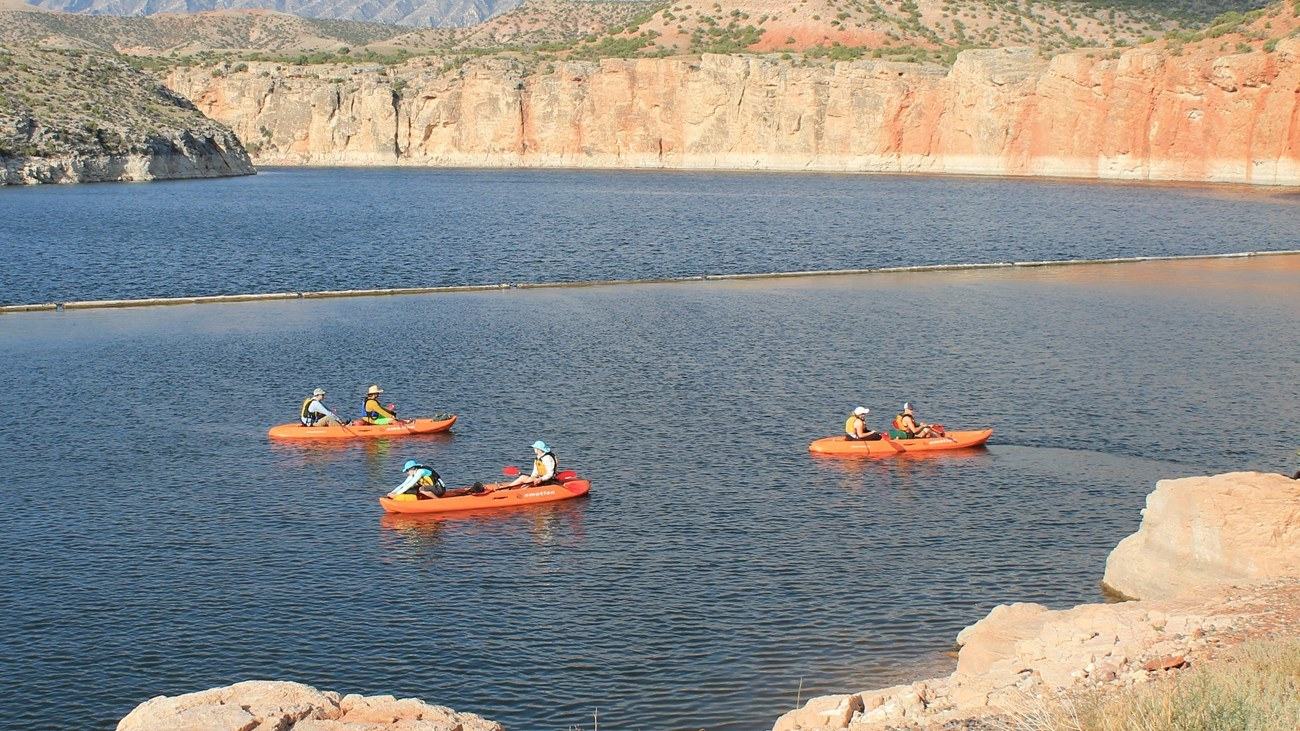
The official image accompanying this article shows several orange kayaks leaving Barry's Landing on a ranger-led trip. It is a photograph of actual paddlers on Bighorn Lake, which makes it an accurate introduction to the experience. A structured tour can also help visitors decide whether they have the skills and interest for a longer independent journey.
Choosing between two park districts
Bighorn Canyon has a northern district around Fort Smith, Montana, and a southern district around Lovell, Wyoming. The two areas have separate road approaches that are several hours apart, so visitors should establish which one they intend to explore before booking accommodation or arranging a rental. The northern district includes access at Ok-A-Beh.
The existence of boat ramps in both districts does not make a full-lake paddle a realistic casual outing. The distance, exposure and changing conditions can require extensive planning. A short trip from an accessible southern or northern launch is more suitable for someone who wants a scenic introduction rather than an expedition.
Protecting the water from invasive species
Boats brought into Wyoming require compliance with the state's aquatic invasive species requirements, and the NPS highlights inspection and decal arrangements. These rules may apply to kayaks as well as motorised craft, with specific state provisions worth checking before departure. A paddler moving between lakes should clean, drain and dry equipment to reduce the possibility of transporting unwanted organisms.
The process is not limited to removing obvious weeds. Water can remain inside footwells, hatches or a trailer used for transport, and wet clothing or gear may also need attention. Owners should build enough time into travel plans for any inspection or decontamination required by the relevant state.
Water levels and the hazards of a canyon
The Park Service publishes minimum operating levels for different launches and notes that the lake's elevation can change substantially. At lower water levels, rocks and driftwood that were previously submerged may create unexpected obstacles. A paddler should consult current lake data and treat recently exposed shorelines as unfamiliar terrain.
Bighorn's steep canyon walls present an additional consideration: there may be places where leaving the water is difficult or impossible. A damaged kayak or sudden weather change could leave the crew far from a safe take-out. The NPS advises boaters stranded in the canyon not to attempt to climb the cliffs but to stay with their craft while seeking help.
Fishing, boating and shared courtesy
Bighorn Lake also attracts fishing boats, family motorboats and organised tours. Different craft travel at different speeds and may have very different stopping distances. Motorboat operators should avoid creating unnecessary wake near paddlers, while kayak crews should remain visible, travel predictably and avoid obstructing narrow areas.
Courtesy extends to the shoreline and to other visitors looking for a quiet experience. Noise can carry surprisingly far between cliffs, particularly in the early morning. A respectful approach makes the canyon more enjoyable for anglers, paddlers and passengers alike.
A measured journey beneath the cliffs
The spectacle of Bighorn Canyon does not require a long itinerary. A carefully chosen paddle from an authorised launch can reveal changing rock colours, reflections and stretches of shoreline that are almost impossible to appreciate at road speed. Appropriate flotation equipment, suitable clothing and a plan left ashore should accompany the trip.
Visitors should check the current boating guidance, launch levels and tour information through the National Park Service. The essential pleasure is being surrounded by the canyon on a craft small enough to make every detail feel close. A successful outing is defined by the quality of that experience and a safe return rather than by the number of miles covered.