
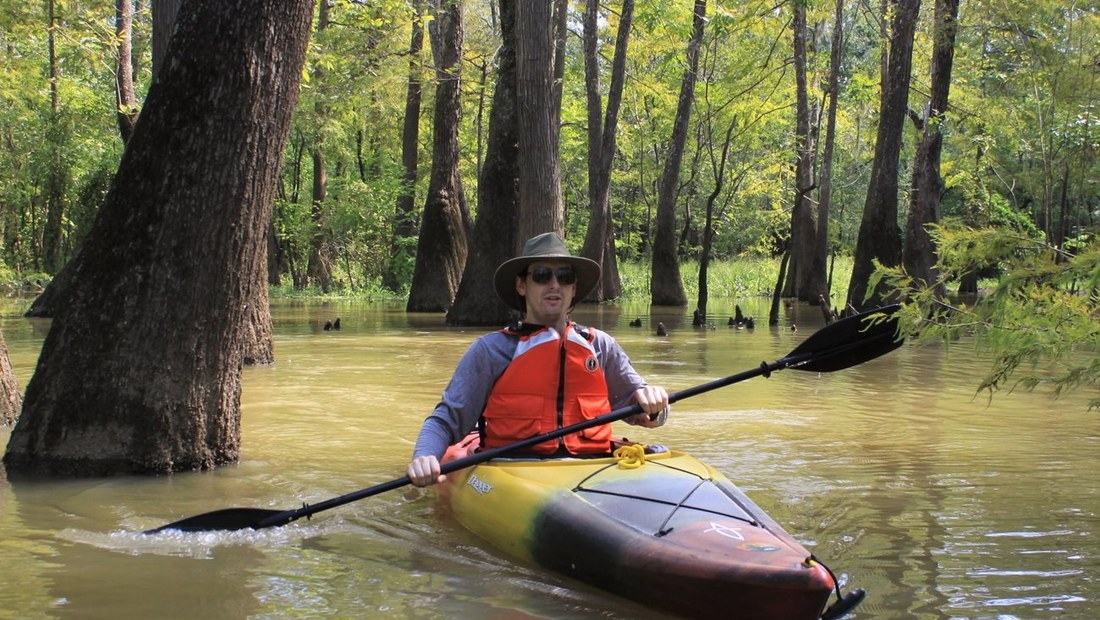
Big Thicket National Preserve offers paddling along creeks, rivers and bayous, with designated water trails and free ranger-led activities during the year.
A different form of Texas wilderness
Big Thicket National Preserve in southeast Texas brings together forest, wetland and a network of creeks, bayous and rivers that invite exploration by canoe or kayak. The National Park Service describes numerous access points and several route possibilities for paddlers with different levels of experience. The appeal lies in a quieter landscape where the presence of trees, reflections and wildlife creates a very different sense of place from an exposed lake.
The preserve is not one simple paddling circuit. Each waterway has its own current, access arrangements and local conditions, and a trip may require transport between a launch and the take-out. Visitors can make the most of the setting by choosing a short route that suits their skills rather than trying to cover every named creek in a single day.
Three official Texas Paddling Trails
The National Park Service identifies three official Texas Paddling Trails within the wider Big Thicket area. These offer more clearly defined routes than an improvised journey into an unfamiliar bayou. A designated water trail can help with route selection and expectations, but it does not mean that the river is maintained in the same way as a road or that the conditions will be easy throughout the season.
People planning a first outing should check the exact launch locations, distance, take-out points and the current status of each route. A water trail may change significantly after flooding, when tree branches or debris become lodged across the channel. Local advice can help a paddler decide which section is most suitable for a half-day introduction.
A chance to paddle with park staff
Big Thicket also offers free ranger-led paddling activities at certain times. These can provide an introduction to the landscape and help visitors understand the plants and waterways they are passing. The preserve supplies canoes for its own ranger-led trips, but does not operate a general rental service for people who simply want to take a boat away independently.
Independent visitors may obtain rental equipment through nearby state parks or local commercial outfitters, subject to their rules. The NPS notes that equipment hired from a state park may not be transported to another location. Confirming those details before arrival prevents a visitor from planning a launch that their rental agreement does not permit.
Water levels alter every journey
The agency warns that high water may produce faster currents and submerged obstructions, while low water can expose shallow passages and fallen limbs. Both conditions may complicate a journey, even for someone comfortable on a calmer lake. A canoe that moves easily in adequate depth may become difficult to manage when loaded and repeatedly caught on obstacles.
Weather forecasts should be considered together with the latest local water-level information. A thunderstorm upstream can change the situation on a creek without creating obvious heavy rain at the launch. The safest response to unsuitable conditions may be to visit a boardwalk or explore a trail on land rather than insist on paddling.
Clothing and the local environment
Southeast Texas can be hot and humid, making hydration and sensible sun protection important even beneath a canopy of trees. The National Park Service advises visitors to know the signs of heat exhaustion and hypothermia because temperature and immersion conditions differ. Carrying adequate drinking water is essential; river or creek water should not be consumed untreated.
The group should also pack clothing that can tolerate getting wet, footwear appropriate to muddy launches and suitable protection from insects where necessary. Loose equipment needs to be secured so that it cannot escape if the canoe strikes an obstruction. A modest, well-organised set of supplies often proves more useful than carrying numerous comforts that make the boat difficult to manoeuvre.
Float plans and personal flotation
The preserve recommends wearing a life jacket regardless of the paddler's swimming ability or the apparent depth. A shallow channel may still contain strong current, hidden holes and obstacles that complicate escape. A correctly sized personal flotation device is basic equipment, while an appropriate map and means of communication add further resilience.
Visitors are also advised to leave a float plan with a trusted person, identifying the planned launch, take-out and estimated return. That information may be especially important when a route crosses a wooded area with limited communication coverage. A map should be carried on the boat instead of relying solely on an online route viewed before departure.
Permitted sandbar camping
For those considering an overnight adventure, backcountry camping is allowed year-round on specified sandbars along Village Creek and the Neches River, with a free permit available from the visitor centre. Such a trip can provide a deeper encounter with the preserve, but introduces more responsibilities than an ordinary day paddle. Camping rules, water levels and safe landing areas must all be considered.
The NPS cautions that some areas beyond the Neches River sandbars may be affected by hunting activities during the October-to-February season. Campers should review the latest park advice and avoid creating a route based only on a desirable photograph. Understanding the actual location and access conditions is central to a responsible stay.
An understated small-boat experience
The official park imagery shows kayakers among the green waterways of the preserve, accurately reflecting its quieter appeal. The reward is often found in details—the movement of water through trees, birds calling above the bank and the changing pattern of light. A small craft makes it possible to experience these environments slowly rather than simply observing them from a road.
Big Thicket is therefore an excellent example of a destination where careful preparation increases enjoyment. Visitors should consult the latest National Park Service paddling page, verify any organised ranger session and confirm the permitted route. With a suitable boat and realistic plan, the waterways can offer an absorbing day that feels very different from conventional motorboating.