
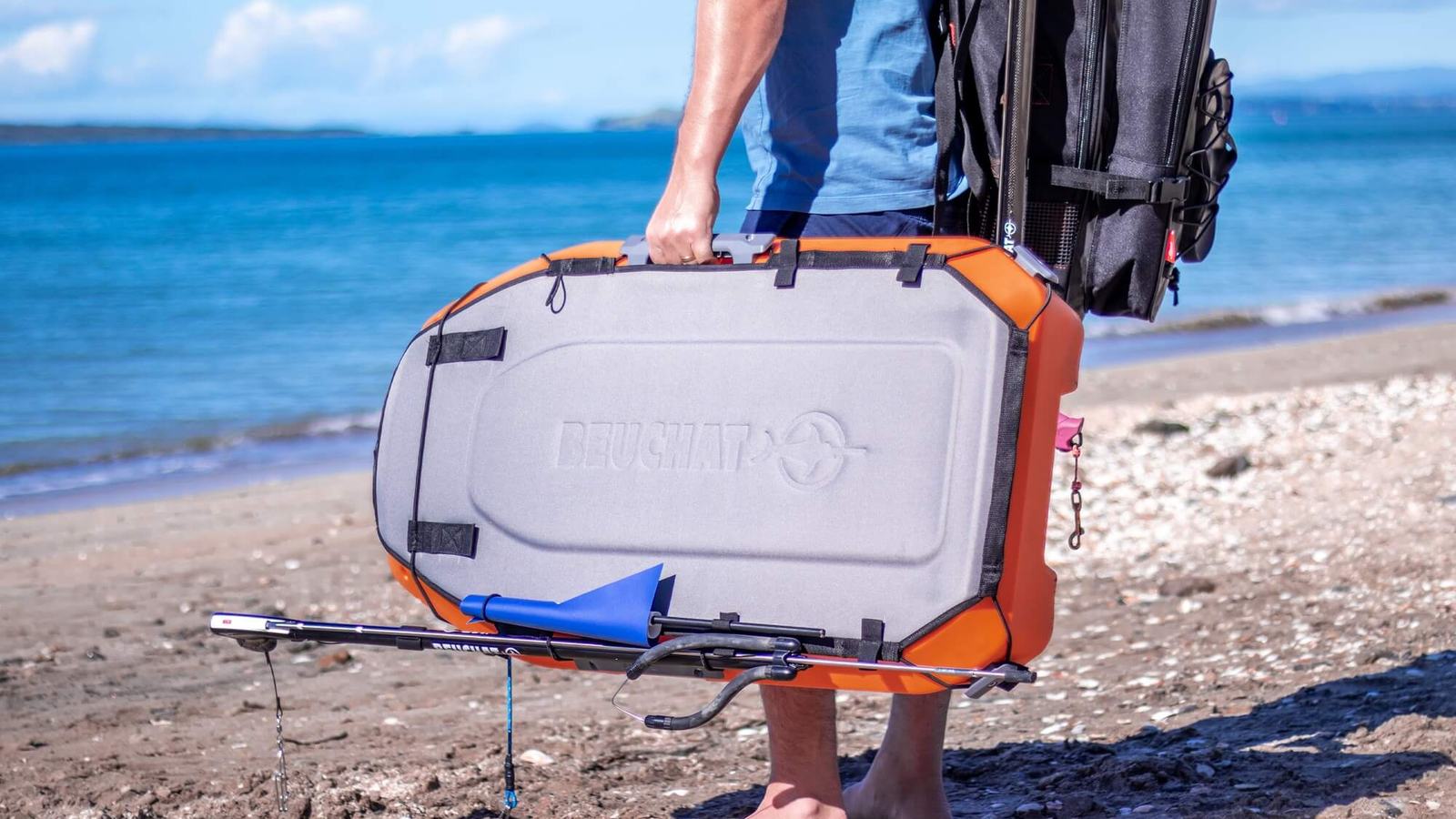
The Beuchat Personal Dive Tender, a 2026 Australian Good Design entry, combines an insulated cover, rigid hull, 32-litre storage and one-handed access for recreational spearfishing.
A specialist accessory designed around real dives
A floating container may look like a simple piece of spearfishing equipment, but a diver using it offshore needs much more than somewhere to put a catch. The Beuchat Personal Dive Tender, or PDT, addresses that everyday problem with a rigid, low-profile hull, a fitted insulating cover and storage intended to be managed while the user is in the water.
The New Zealand-designed product appeared among the 2026 Australian Good Design Award entries in the Product, Sport and Lifestyle category. Designed by Blender and Pacific Blue Sports for Pacific Blue Sports, the tender is intended for recreational spearfishing in Australasian conditions rather than as a small boat or a replacement for established diving safety arrangements.
Why the old plastic-tub approach needed rethinking
The design team describes common float tubs as functional but awkward. Loose fabric covers can let water in, offer limited insulation and become difficult to control if the float turns over. The user may be carrying a speargun, holding a line or managing a fish at precisely the moment that the storage compartment needs attention.
Beuchat's solution starts with a rotationally moulded high-density polyethylene hull. The material is selected for impact resistance, UV stability and the knocks associated with rocks, launch sites and repeated handling. Rather than aiming for a deep, bulky shape, the design focuses on low towing drag and manageable behaviour in wind and small waves.
Keeping a catch enclosed
The PDT uses a heat-pressed EVA foam cover with a ballistic-nylon underside to provide an insulated enclosure. According to the award submission, the covered compartment helps keep a caught fish, blood and associated waste inside the tender rather than exposed directly to the surrounding water. This is a practical hygiene and catch-management consideration, not a guarantee about the behaviour of marine wildlife.
The award description also highlights a cover fastening system that can be opened and closed with one hand. That detail matters because a user may need to maintain control of other equipment. It is worth trying the fastening arrangement with the correct gloves before purchase, as a mechanism that looks easy on dry land may feel different in chop or with cold hands.
Storage arranged for the job
Inside, the manufacturer describes around 32 litres of storage and low-profile ribs for basic separation. A smaller sealed locker at the bow has a dual-tab opening mechanism, intended to keep valuables and smaller essentials away from the main catch area. The designer says the arrangement aims to reduce accidental opening while remaining practical for the user.
Integrated handles and cleats provide places for carrying and managing lines, while external attachment points accommodate accessories such as flags and lights. The fastening hardware includes marine-grade 316 stainless steel. Owners should still rinse the equipment and inspect attachments routinely because salt, sand and repeated impacts can undermine even corrosion-resistant fittings over time.
Making equipment visible and manageable
A float's visibility and attachment arrangement matter as much as the space within it. Appropriate dive flags, separation from vessel traffic and compliance with local rules remain essential, irrespective of the shape of the accessory. A buyer should verify that their intended flag and any lighting fit the actual attachment points and remain clearly visible from nearby boats.
The PDT should not be treated as a lifejacket, a rescue craft or an invitation to exceed personal diving limits. Freediving and spearfishing require suitable training, buddy procedures and a careful assessment of weather, currents and surface traffic. The manufacturer-specific equipment instructions and the regulations at the intended dive location take priority over any general product description.
Why small-boat owners may be interested
Many recreational divers reach their grounds aboard a compact open boat, RIB or centre-console craft. On vessels of that scale, every item has to be carried, secured and stowed without obstructing movement around the cockpit. The award entry specifically addresses the tender's space-efficient proportions and handling, making it relevant to boat owners who routinely combine a fishing trip with a dive.
Before buying, measure the area where the float will travel and decide how it will be restrained in transit. Consider drainage, sharp equipment, access to the boarding ladder and whether a loaded tender can be recovered safely. A high-quality hull solves little if it slides around the deck or blocks an emergency route.
What the 2026 design recognition establishes
The Australian Good Design project describes a lengthy development process for the semi-rigid insulated cover, including research into suitable materials and manufacturing methods. The team also refined the single-handed fastening system in response to user requirements. Input from experienced spearfishers informed the product, according to the submitted account.
An award entry explains the intentions and design work behind a product; it should not be mistaken for independent testing of every safety or durability claim. Prospective owners can use the details as questions to ask a dealer, including cover replacement, dry-locker maintenance, repairability, flag compatibility and the practical method for towing in their usual conditions.
A more considered approach to diving accessories
The Beuchat PDT illustrates how a modest-seeming water-sports accessory can benefit from the same joined-up thinking used on larger marine equipment. Hull shape, insulation, line management, hardware and the way a person opens a compartment all affect whether the item earns its place aboard a small boat.
For a trained diver whose sessions involve collecting and transporting a catch, the design may offer a more organised option than a makeshift tub. For beginners, sound instruction and careful preparation remain more important than buying a premium float. The official 2026 design-award project explains the construction and intended use, while authorised dealers can confirm current availability and approved accessories.