
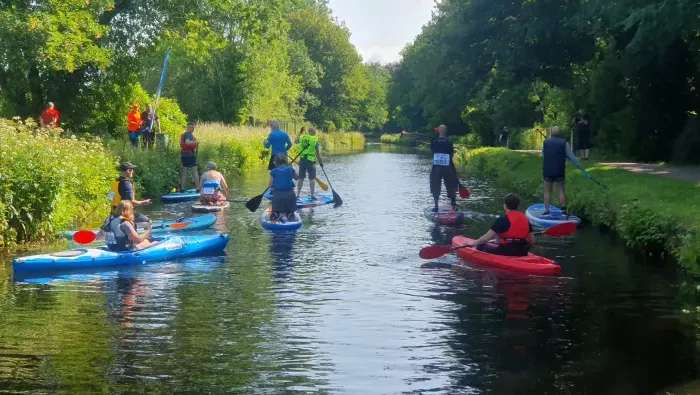
AquaPaddle has expanded its free timed 5km social paddles to 73 UK locations, creating a regular community format for SUPs, kayaks and canoes.
AquaPaddle’s free 5km social-paddling network has expanded to 73 UK locations, with 625 completed events and 7,791 recorded finishes according to statistics shown on the organisation’s website on 23 September 2026. The network had recorded 3,090 unique finishers, supported by 691 volunteers and 66 crews.
The concept is intentionally simple: paddlers register once, turn up to a local event and complete a timed 5km course on a SUP, kayak, canoe or another suitable paddle craft. AquaPaddle describes the format as a social challenge rather than a race, making participation and regularity more important than finishing position.
A repeatable format helps people keep paddling
Many watersports initiatives focus on getting someone onto the water for the first time, but retaining participation can be harder. A regular local event gives paddlers a reason to return, meet the same community and gradually build confidence without needing to enter formal competition.
The recorded time still gives people a personal benchmark if they want one. That combination can appeal to both relaxed recreational paddlers and people who enjoy tracking improvement but do not want the pressure or equipment demands of racing.
SUPs, kayaks and canoes share the same course
AquaPaddle’s mixed-craft approach avoids dividing participants into separate communities before they arrive. Someone on an inflatable SUP can take part alongside sea kayaks, recreational kayaks and canoes, provided the craft and paddler are suitable for the local conditions.
That is particularly relevant to LBG because small-craft users often move between categories over time. A person may begin on a board, later buy a kayak or paddle with family in a canoe, while still wanting the same social reason to get out regularly.
BlueSpace adds a wellbeing dimension
The organisation also runs BlueSpace sessions intended to support people who may benefit from time on the water for mental or physical health reasons. Delivery partners from the paddling community provide those sessions locally, extending the project beyond the timed 5km events.
The growth figures suggest that a low-cost, repeatable and social format can turn paddling into a routine rather than an occasional summer activity. For LBG Lifestyle, that makes AquaPaddle a useful example of how community infrastructure can be just as important as the craft itself in keeping people on the water.
Source
AquaPaddle