
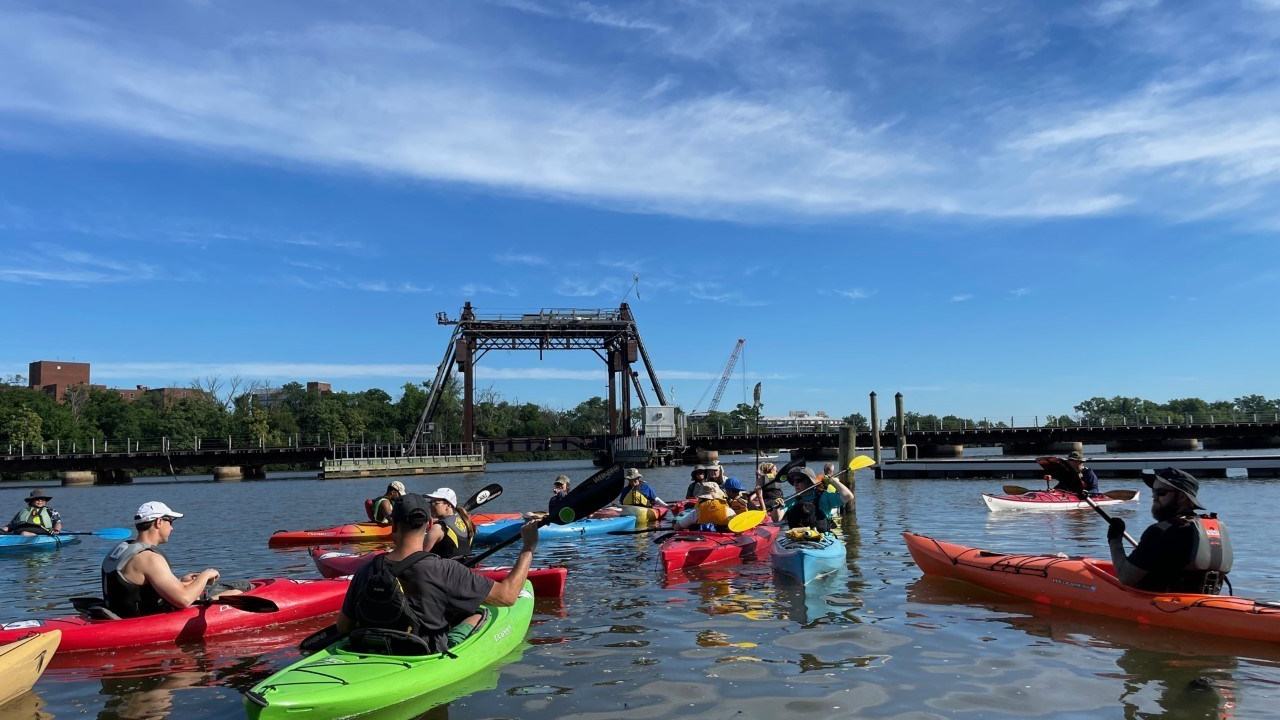
Anacostia Park provides a public route onto Washington's tidal river. It makes an unusually varied city paddle, provided the launch, tide and return journey are planned.
A river journey through a capital city
The Anacostia River offers a different perspective on Washington, DC, one in which bridges, gardens, parkland and working waterfronts replace the usual sequence of monuments and streets. For paddlers, the experience combines moments of relative calm with unmistakable urban scenery. Its accessibility should not lead anyone to overlook the fact that this is a tidal waterway with the usual obligations of navigation.
Anacostia Park has its own public boat ramp, and the National Park Service welcomes boating, sailing, rowing, kayaking and paddleboarding. The ramp is at the north end of Anacostia Drive SE, with parking for vehicles and trailers nearby. The park says use of the ramp and its parking is free, although that is separate from any equipment hire or outside commercial tour.
Decide whether to bring or hire a boat
The park does not offer its own boat rentals, so paddlers arriving without equipment need to plan differently. The National Park Service points to Bladensburg Waterfront Park across the District line in Maryland for seasonal kayak, canoe and rowboat hire, generally from April through October. It also notes guided outings through local organisations, but their dates and availability should always be confirmed directly.
People bringing their own small craft can use the Anacostia Park ramp while observing any current access guidance. It helps to decide in advance where to load equipment, how long the return paddle will take and whether the chosen boat is appropriate for the route. A free launch does not mean there will be rescue services or shore-side supervision along the journey.
The tide changes the experience
The Anacostia is a freshwater tidal river, a combination that sometimes surprises visitors expecting an ordinary inland stream. The park describes a rise and fall of roughly three feet twice each day. That movement affects shallow areas and creek entrances, so a pleasant landing or side channel at one point in a trip may look very different several hours later.
Consult local tide predictions and do not plan to cross marginal mudflats merely because a thin layer of water is present at launch. Wind can make progress harder on the way home, while evening light arrives earlier than a leisurely waterfront itinerary may suggest. A conservative turning point is especially sensible for an unfamiliar group or family outing.
Choose the urban and natural highlights
The National Park Service's map identifies places linked by the larger river landscape, including Kenilworth Aquatic Gardens, the National Arboretum, the Navy Yard and the waterfront around Nationals Park. These are not all immediate kayak landings, and several require a separate shore visit. Treat the map as a menu of interests rather than a promise that every destination is accessible directly from a boat.
An enjoyable route might emphasise tree-lined banks and wildlife observation, while another could focus on the changing cityscape near bridges and developed waterfronts. Looking for birds, noticing the bank vegetation and pausing in an appropriate location can give the outing a slower rhythm. Avoid disturbing wildlife or assuming that informal access through a private or sensitive shoreline is permitted.
Stay visible, equipped and informed
The park advises wearing a life jacket, carrying extra drinking water and food, and keeping a phone in a waterproof bag. It also recommends leaving a route plan with someone ashore. Those are straightforward measures that become more important when paddlers are separated by a bend or when conditions change under a bridge.
Boaters must follow District of Columbia harbour and boating safety rules as well as the appropriate park guidance. Check the forecast and consider how wind, tide and any traffic could alter the return trip. A paddler with limited experience may gain much more from a guided excursion than from attempting a long independent route through unfamiliar waters.
Let Washington’s waterfront unfold slowly
One of the pleasures of paddling a city river is discovering that familiar places look different from water level. Distant buildings may frame a scene, but the smaller details of a reed bed or a heron on the bank can hold attention for longer. The Anacostia's mix of scenery makes that contrast more interesting than simply chasing a famous skyline.
Plan the outing around conditions and the time available, with an easy return to the chosen ramp or authorised take-out. There is no need to reach every mapped point in one day. The best small-boat itinerary gives sufficient space for unexpected observations without putting the final landing at the mercy of the tide.
An afternoon here can be an introduction to the river rather than a test of endurance. Keeping the trip short enough to finish comfortably will often leave more time for exploring neighbouring green spaces and learning how the city's waterfront is being cared for.
Current access details, conditions and regulations should be checked with National Park Service — Anacostia Park boating before a visit. The photograph is credited to National Park Service photograph, kayakers at the Anacostia boat ramp.