
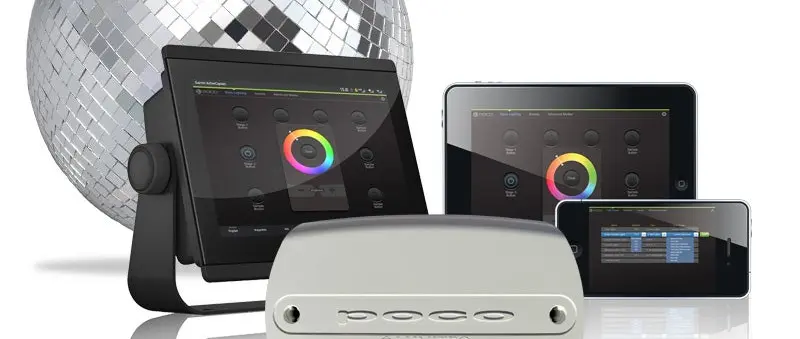
Lumitec has introduced a Channel Expander feature for its Poco Digital Lighting Control platform, aimed at boats with larger or more complex lighting layouts. The update allows multiple Poco modules to communicate across an NMEA 2000-based network rather than treating each controller as an isolated unit.
The change increases the number of lighting channels that can be managed within one system and gives installers more flexibility in dividing a boat into separate lighting zones. It is particularly relevant to boats that combine interior, courtesy, deck and underwater lighting.
Poco modules can be networked together
Poco 4 is a four-channel controller rated at up to 10 amps per channel and already supports NMEA 2000 integration. The Channel Expander feature builds on that architecture by allowing additional modules to contribute more controllable outputs.
That approach can reduce the need to force multiple lighting groups onto the same physical channel. It also gives builders and retrofit installers more room to expand a system as the number of lights and zones increases.
Control remains available from MFDs and mobile devices
Lumitec’s Poco platform can be controlled from compatible multifunction displays or the company’s mobile app. With PLI-enabled Lumitec lights, users can adjust colour, brightness and programmed scenes from the same interface.
The system can also work with selected third-party lighting through Pico expansion modules. Compatibility still needs to be checked carefully because not every light or multifunction display supports the same level of control.
Networked lighting moves further down the boat-size range
Digital lighting control was once concentrated on larger yachts with extensive automation systems, but compact controllers have made it practical on smaller production boats. The new expansion feature pushes that trend further by making larger multi-zone systems possible without changing the basic control concept.
For LBG owners, the benefit is mainly flexibility rather than novelty. A well-designed network can simplify switching and scene control, but it should still be planned around proper circuit protection, cable sizing and service access.